TLDR: Stop scrubbing! Most DIY bleach "fixes" like markers or coffee actually make things worse and will definitely lose you your security deposit. The secret to saving your money (and your carpet) is professional colour restoration that neutralises the bleach and re-adds the lost pigment. Read on to avoid the 7 most expensive mistakes tenants make.
We’ve all been there. You’re doing a deep clean, a bit of bleach splashes, and suddenly your beautiful grey carpet has a bright white eye staring back at you. Cue the internal screaming.
If you’re a tenant, your first thought is probably your security deposit. Your second thought is usually a frantic Google search that leads you to some "brilliant" Reddit hack involving a Sharpie or a cup of Nescafe.
Before you reach for the stationery cupboard or the kettle, stop. At BD365 Carpet Colour Solutions, we’ve seen it all. We spend our days fixing the "fixes." If you want that deposit back, you need to avoid these seven common mistakes that turn a tiny spot into a total carpet replacement bill.
1. Treating it like a "Stain"
This is the big one. A bleach spot is not a stain.
A stain is something added to the fibre (like red wine or mud). A bleach spot is something taken away. The bleach has literally stripped the colour molecules out of the carpet.
The Mistake: You grab a cloth and start scrubbing like your life depends on it.
The Result: You aren't "cleaning" anything; you’re just fraying the carpet fibres and spreading the active bleach to the surrounding area. You end up with a fuzzy, distorted patch that’s twice as big as the original spot.
2. The "Sharpie & Espresso" Hack
Reddit loves telling people to "just colour it in" with a permanent marker or dab it with coffee. Please, for the love of your deposit, don’t do this.

The Mistake: Using non-carpet-safe dyes to hide the spot.
The Result: Markers and coffee aren't "colourfast." They look muddy, they don't match the tone, and they will likely rub off on your socks or the landlord’s professional cleaner’s equipment. Nothing says "I'm trying to hide damage" like a purple-ish smudge where a white spot used to be.
3. Forgetting to Neutralise the Bleach
Did you know bleach can stay "active" in your carpet for a long time?
The Mistake: Even if you find a decent DIY dye, if you haven't neutralised the bleach first, the chemical will just eat the new colour you’ve put down.
The Result: The spot returns, often looking weirder and more blotchy than before. At BD365, we always use professional-grade neutralisers to stop the chemical reaction in its tracks before we even think about adding colour.
4. The "Frankenstein" DIY Patch
You think, "I'll just cut a bit of carpet from the back of the wardrobe and glue it in!" It sounds simple, right? It isn't.
The Mistake: Attempting a DIY patch without the right tools or knowledge of "pile direction."
The Result: You end up with a visible seam, glue-damaged fibres, and a patch that stands out like a sore thumb because the "donor" carpet hasn't been walked on as much as the main room. Landlords hate this. It looks like a botched repair, and they’ll likely charge you for a full room replacement.

5. Playing Chemist with More Chemicals
Desperation leads to strange choices. Some people try to use hydrogen peroxide or even more bleach to "blend" the edges of the spot.
The Mistake: Adding more oxidising agents to the area.
The Result: You create a massive, pale halo around the original spot. You’ve now gone from a 2cm problem to a 20cm problem. Congratulations, you’ve just bought your landlord a new carpet.
6. Shaving the Carpet
Yes, people actually try this. They think if they shave off the top layer of bleached fibres, the "real" colour will be underneath.
The Mistake: Using a razor or scissors to "trim" the bleached area.
The Result: Most carpets are "solution-dyed," meaning the colour is lost all the way down the fibre. Shaving it just leaves you with a bald, low spot in the middle of your floor. It’s impossible to hide and screams "damage."
7. The "Silence is Golden" Strategy
You decide to hide the spot under a rug or a sofa and hope the landlord doesn't notice during the move-out inspection.
The Mistake: Hoping for the best instead of being proactive.
The Result: Landlords always check under rugs. If they find a hidden "fix" or an obvious bleach spot, they won't be in a mood to negotiate. They will get a quote for a full replacement and take it out of your deposit.
The Pro Solution: Restore, Don't Replace
The good news? You don't have to lose your deposit, and you don't have to buy a whole new carpet.
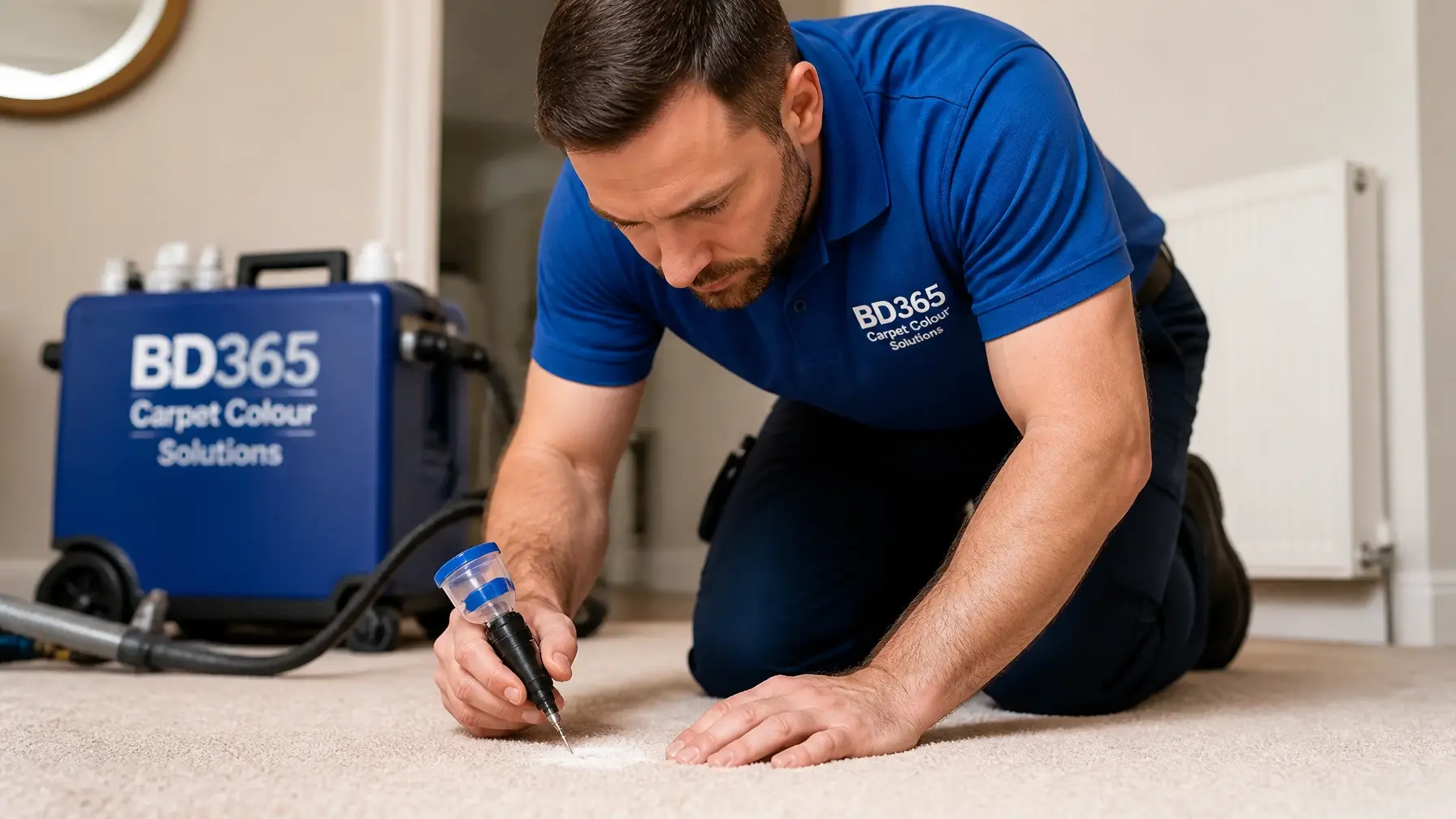
Professional carpet dyeing and bleach spot repair is a fraction of the cost of replacement. At BD365, we use specialised dyes and advanced colour-matching technology to replace the exact pigments the bleach took away.
Whether it's a tiny splash or a larger spill, we can usually make it disappear entirely. It's eco-friendly, fast, and: most importantly: landlord-proof.

Why Choose BD365 for Your Bleach Spots?
- Expert Colour Matching: We don't just "colour it in." We rebuild the colour of your carpet fibre by fibre.
- Neutralisation: We make sure the bleach is dead before we start, ensuring a permanent fix.
- Eco-Friendly: Our dyes are safe for pets and kids (and your conscience).
- Cost-Effective: A repair is significantly cheaper than losing your entire security deposit or paying for a new carpet.
Got a bleach spot panic? Don't reach for the markers. Give us a shout at BD365 Carpet Colour Solutions and let’s save that deposit together!