TLDR: Bleach spots on patterned carpets aren't a death sentence. While DIY fixes like markers usually end in a muddy mess, professional carpet dyeing can restore complex patterns seamlessly. At BD365, we specialise in colour restoration that saves you thousands in replacement costs while being eco-friendly and safe for your family. Don’t bin it, restore it!
The "Oops" Moment: When Bleach Meets Pattern
We’ve all been there. You’re doing a bit of deep cleaning, perhaps tackling a stubborn stain, and suddenly, drip. A splash of bleach lands right in the middle of your gorgeous, patterned Axminster or that high-end geometric rug in the hallway.
Your heart sinks. Why? Because patterned carpets are notoriously expensive, and common wisdom says once the colour is gone, the carpet is toast. You start Googling "how to hide carpet stains" or, worse, "new carpet prices," and suddenly your weekend is ruined.
But here’s the thing: bleach isn't actually a "stain." It's the absence of colour. It has literally stripped the pigment out of the fibres. On a solid-coloured carpet, it's a headache. On a patterned carpet? It’s a full-blown jigsaw puzzle of missing pieces.
Before you start dragging the furniture around to hide the evidence, let’s talk about why you don’t need a skip, you just need a bit of science and some expert colour matching.
Why Patterned Carpets are the "Final Boss" of Bleach Spots
If you’ve ever tried to fix a bleach spot on a plain beige carpet, you might have gotten away with a bit of "good enough." But patterned carpets are a different beast entirely.
- Multiple Pigments: A single square inch of patterned carpet might contain four or five different dye colours. To fix a spot, you can't just slap on some "brown" dye. You have to meticulously restore each individual colour to match the surrounding pattern.
- Fibre Complexity: Whether it’s wool, nylon, or a blend, different fibres react to bleach differently. Bleach spots on wool carpets are particularly delicate because the bleach can actually degrade the protein structure of the wool itself.
- The "White Hole" Effect: On a pattern, a bleach spot isn't just a mark; it’s a break in the visual flow. Your eyes are designed to follow patterns, so any disruption, even a small one, sticks out like a sore thumb. This is often why your carpet looks white after using bleach cleaner; the cleaner has "cleaned" the colour right out of the room.
The DIY Trap: Why Sharpies and Crayons Usually Fail
If you spend five minutes on Reddit, you’ll find plenty of "life hacks" for carpet bleach spots. People suggest everything from permanent markers to kid’s crayons and even hair dye.
While we love a bit of DIY spirit, these "fixes" are often the reason we get called in for a rescue mission later. Here’s why:
- The Muddy Mess: Markers aren't designed for carpet fibres. They sit on top of the pile and often turn a weird, metallic purple or green over time. When you try to layer them to match a pattern, you usually end up with a dark, muddy blob that’s more noticeable than the original white spot.
- The Transfer Problem: Imagine fixing a spot with a Sharpie, only for your toddler or the family dog to walk over it and track "permanent" black ink across your sofa.
- It’s Not Permanent: Most DIY dyes aren't pH-stable or light-fast. They’ll fade, wash out during your next professional clean, or shift colours in the sun.
At BD365, we’ve seen it all. We’ve even answered the age-old question: Can you use hair dye to fix a bleach spot? (Spoiler: Please don’t).

The BD365 Way: How We Restore the "Impossible"
So, how do we actually fix a bleach spot on a patterned carpet without replacing the whole thing? It’s a mix of art, chemistry, and a very steady hand.
Step 1: Neutralise the Enemy
Before we can add colour back, we have to make sure the bleach is actually gone. Bleach can stay active in carpet fibres for a long time. If we add dye without neutralising it first, the bleach will just "eat" the new dye. We use professional-grade neutralisers to stop the chemical reaction in its tracks.
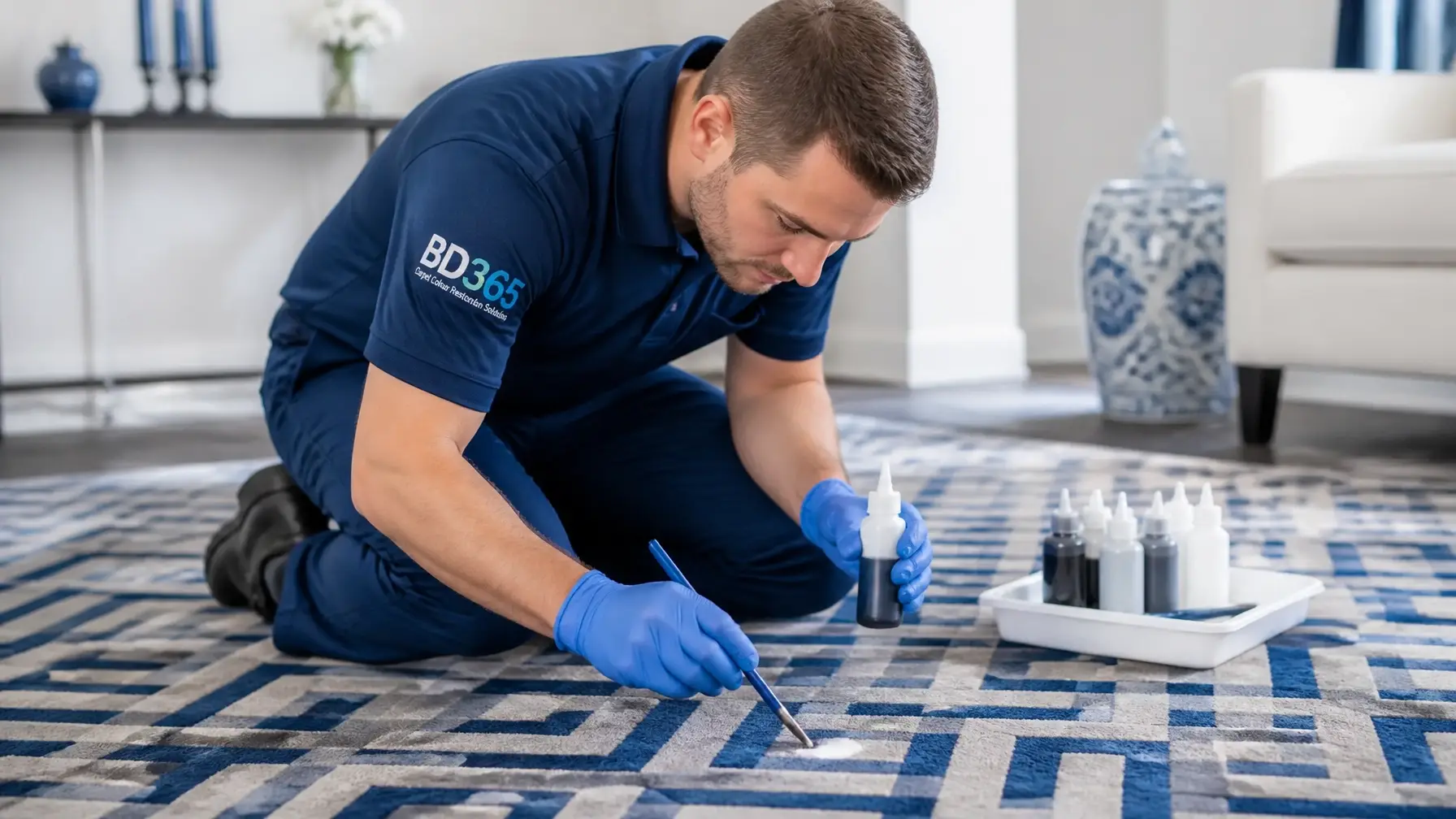
Step 2: Colour Theory & Custom Mixing
We don't use "off-the-shelf" colours. Our technicians are trained in advanced colour theory. We look at the "missing" primary colours (red, yellow, and blue) and calculate exactly what needs to be added back to recreate the original shade. For a patterned carpet, this means mixing several different batches of dye to match every single hue in the design.
Step 3: Precision Application
This is where the magic happens. Using precision tools, we "re-paint" the pattern tuft by tuft. We blend the new dye into the existing fibres so that the transition is seamless. When we’re finished, you won’t just "not see the spot": you won’t even be able to find where it was.
Sustainability: Save Your Carpet, Save the Planet
One of the biggest reasons our clients choose BD365 is our commitment to sustainability. Replacing a carpet isn't just expensive; it’s environmentally taxing.
Think about the process: the old carpet goes to a landfill (where it can take hundreds of years to decompose), and a new one has to be manufactured, shipped, and installed. By choosing carpet restoration, you are significantly reducing your carbon footprint.
We live by the mantra: Restore where possible. Replace only when necessary.
Plus, our dyes are eco-friendly, non-toxic, and completely safe for your two-legged and four-legged family members. You don't have to worry about harsh chemicals lingering in your home after we’ve finished our work.

Is it Cost-Effective?
Let’s talk brass tacks. A high-quality patterned carpet can cost upwards of £50 to £100 per square metre (or much more for designer rugs). When you factor in the cost of professional fitters and moving all your furniture, a replacement can easily run into the thousands.
How much does it cost to fix a bleach spot? Usually, it’s a fraction of the cost of a replacement. You’re paying for a specialist’s time and expertise, but you’re saving the massive overhead of a brand-new floor. It’s a win-win for your wallet and your home.
When Should You Call the Pros?
If your bleach spot is:
- In a highly visible area (like the middle of the lounge).
- On a patterned or multi-toned carpet.
- Larger than a 2-pence piece.
- On a luxury fibre like wool or silk.
…then it’s time to call in the experts. Don't risk making it worse with "hacks" that leave you with a permanent mess. We’ve even written about creative ways to hide bleach spots and why, frankly, you shouldn't have to hide them at all.
Ready to Give Your Carpet a Second Chance?
At BD365 Carpet Colour Solutions, we’re passionate about bringing life back to tired or damaged floors. Whether it’s a bleach spill, sun fading, or you just fancy a completely new colour, we’re here to help.
Don’t let a small cleaning mishap turn into a major renovation project. Our team operates across the UK, bringing professional, witty, and (most importantly) effective restoration services right to your door.

Contact us today for a quote and let’s get that pattern looking perfect again!