TL;DR: If pale stripes appeared after bleach or a bleach-based product went into a carpet cleaner’s tank, the marks may be dye loss, not water marks or residue. Stop using the machine on the area and don’t try to clean the colour back in. BD365 specialises in bleach spot repair, carpet dyeing and carpet colour restoration. We assess carpets nationwide across the UK and can advise whether restoration is suitable before you consider replacement.
You hired a carpet cleaner, filled the tank and set off down the hallway. Maybe there was a stubborn stain. Maybe the room smelled less than fresh. Maybe “a proper deep clean” sounded like a good idea.
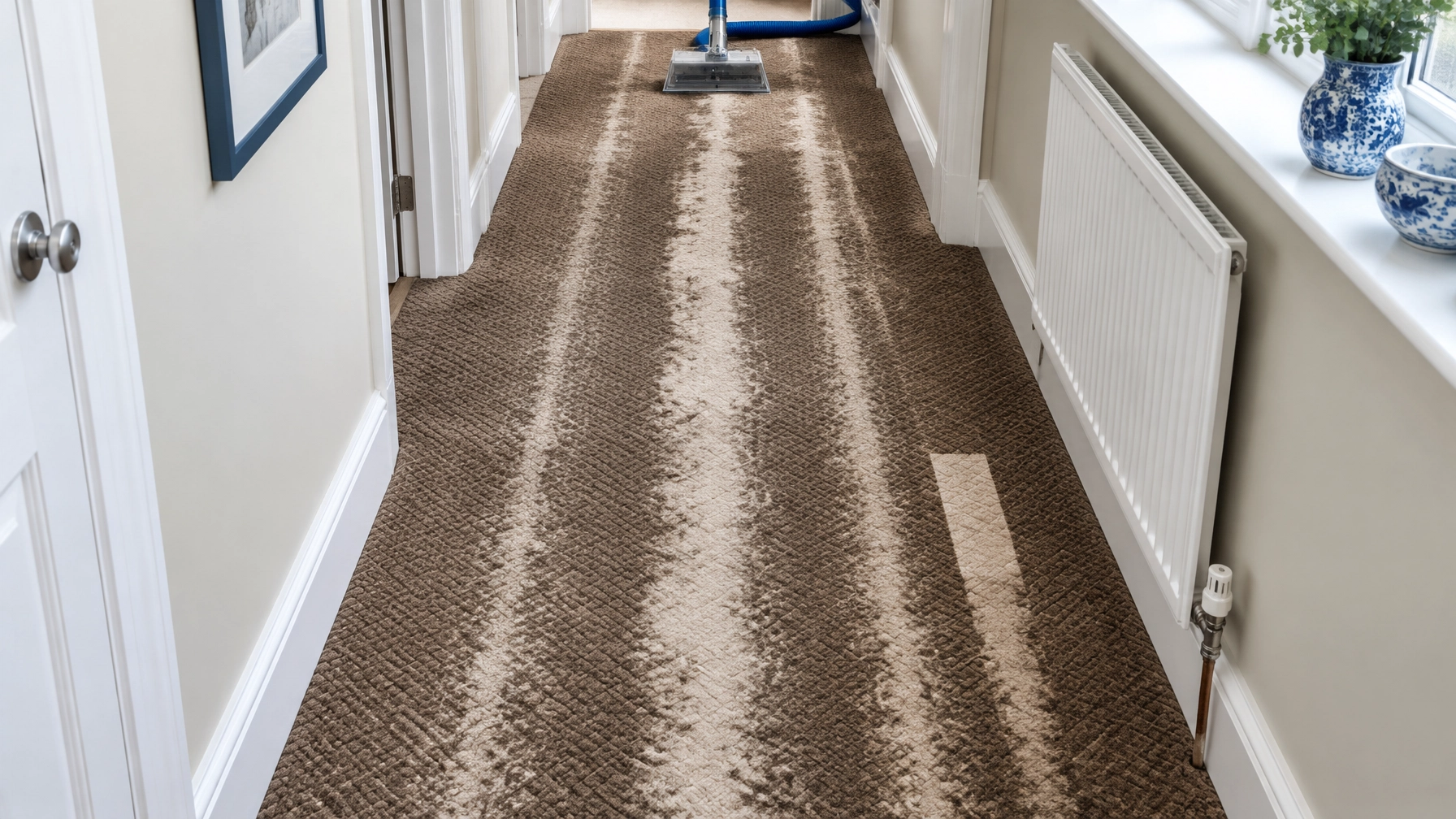
Then, a day or two later, pale bands appeared along the machine’s route. Not dirt. Not quite a watermark. The hallway now looks like it has been cleaned in stripes.
If bleach or a bleach-based product went into the tank, or was sprayed on the carpet first, those stripes may be a chemical colour change. And sadly, this is one cleaning job where another go with the machine is unlikely to help.
Why does bleach leave stripes in a carpet?
Household bleach commonly contains sodium hypochlorite. It can oxidise and destroy the dye molecules that give carpet fibres their colour. That means the pale patch is often not a stain sitting on top of the carpet. Some of the original colour is gone.
The University of Nebraska–Lincoln Extension’s guide to chemical spots and discolouration explains how household chemicals can cause lasting changes to furnishings. Cleanfax’s guide to bleach discolouration also distinguishes colour loss from ordinary soiling: cleaning cannot remove colour that is no longer there.
Nylon and wool carpets can both suffer permanent colour loss. Wool needs particular care, as bleach can also damage the fibre itself and may cause yellowing.
The pattern can offer a clue. An extraction cleaner lays solution down in passes. If bleach is involved, overlapping passes may leave uneven bands: more affected where solution was applied for longer, with softer or sharper edges elsewhere. A mark may seem to “appear” after the clean because colour loss can become more obvious as the carpet dries fully.

“It looks better when wet. Does that mean it’s just a water mark?”
Not necessarily. Re-wetting can temporarily change how the carpet reflects light, making pale areas look less obvious. Once dry, the contrast may return. That brief improvement does not prove the colour is intact.
A carpet machine is designed to clean with approved solutions, not to restore dye. Rug Doctor’s TruDeep user guide explicitly says not to use bleach or non-approved products. It warns that inappropriate products can damage the carpet or machine, and that other cleaning solutions may affect the machine and carpet warranties. Clorox’s carpet-cleaner guidance also flags carpet and machine compatibility concerns. Always follow the instructions for your particular machine and carpet.

What to do now, and what not to try
If the carpet is still wet, keep the response simple:
- Stop using the machine on that area.
- Blot any wet solution with a plain white towel.
- Keep people and pets off the area while it dries.
- Photograph it in daylight from a couple of angles, including a straight-down view that shows the stripe pattern.
- Write down exactly what went into the tank and whether anything was sprayed on the carpet first.
- Get the carpet assessed before attempting anything else.
Please don’t try to “re-clean it out”. Don’t use vinegar or bicarbonate. Don’t add more product, and don’t test a dye or marker pen on the carpet. The aim is to avoid adding another variable to a problem that may already involve colour loss.
For more on the difference between colour loss and a normal mark, see our guide to bleach spots versus ordinary stains. You can also read why a carpet may turn white after bleach cleaner.
Hotels: striped corridors can mean more than a cleaning complaint
For hotels, one tank mistake can affect a corridor, guest room or other visible area, and create a headache for housekeeping and management. If rooms need to be taken out of service while flooring is assessed or replaced, the costs may include lost availability as well as the carpet itself.
That’s why hotel carpet repair and hotel carpet restoration are worth considering before assuming a whole area needs replacing. BD365 assesses commercial carpets and can advise whether colour restoration is a realistic option. The result depends on the fibre, the carpet’s condition and how widely the chemical has affected it. We’ll be honest if restoration is unlikely to work.
Landlords and letting agents: document first, then assess
If this happens during an end-of-tenancy clean, the pale stripes may raise questions about responsibility, repair costs and a deposit. Clear photographs and a record of the product used can help everyone understand what happened. An independent carpet assessment may also clarify whether the damage is suitable for repair.
Our carpet restoration for landlords service gives agents and property managers another option to explore before replacing an otherwise usable carpet. For more on the factors that affect price, see how much it costs to fix a bleach spot.
Can the colour be restored?
Cleaning cannot put missing dye back. Professional colour restoration is different: a specialist assesses the carpet, deals with any residual bleach where appropriate, and matches and reapplies colour to the affected area.
BD365 specialises in bleach spot repair, professional carpet dyeing and broader carpet colour restoration. Our team has specialist colour training, and our work is trusted by Dr Beckmann’s. We use eco-friendly dyeing techniques designed to be safe for children and pets, with fast turnaround times where the job and carpet allow.

The important caveat: not every carpet can be dyed. Some solution-dyed polypropylene carpets and some stain-protected nylons may resist dye. Fibre, colour, condition and the extent of the damage all matter. Sometimes replacement really is the sensible answer, and we’ll say so.
Where restoration is suitable, it can be a cost-effective, eco-friendly alternative to removing a carpet that still has plenty of life left. Carpet recolouring can give an otherwise serviceable floor a second chance, helping keep it out of landfill and avoiding the cost and disruption of replacement. (You may also see it spelled “carpet recoloring” online.)
A note for professional cleaners
Bleach should never be treated as a general-purpose carpet-machine solution. Use only products approved for the machine and suitable for the carpet. If a client has already used bleach, explain that the pale marks may be colour loss rather than residue. Record what was used, photograph the area and recommend a professional assessment, without promising that a re-clean will reverse the damage.
If you’re wondering whether you can fix bleach spots on carpet without replacing it, send us a few clear photos first. BD365 provides carpet restoration services nationwide across the UK, for homes, rental properties and commercial spaces.
Call 0800 1931 365, WhatsApp 07561 700670, or email info@bd365.co.uk. We’ll take an honest look and let you know whether restoration may be suitable.