The short version
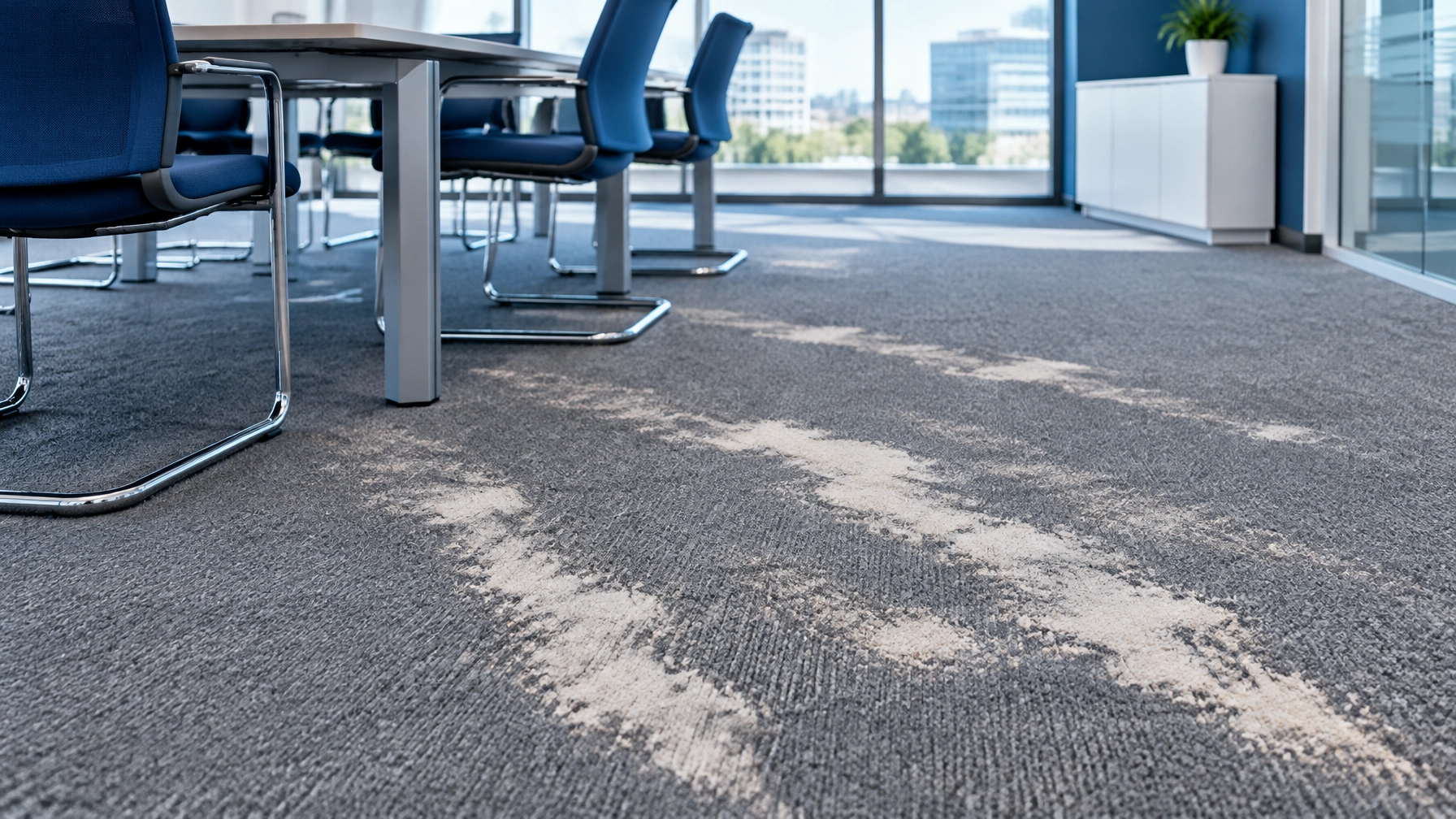
In this fictionalised office scenario, a Friday coffee clean-up turns into a Monday-morning carpet shock: pale streaks appear where a stronger product has affected the grey carpet’s colour. A brown coffee mark may be residue that cleaning can remove. A pale mark may be dye loss, which scrubbing cannot fix.
BD365 specialises in professional carpet restoration, carpet dyeing and bleach spot repair. Where a carpet is suitable, restoration can often improve its appearance without the disruption and waste of replacement. We provide nationwide UK coverage and also work across Europe.
This is a fictionalised scenario created for illustration. It is not a report of a real BD365 customer incident.
Monday Morning, Meeting Room: The Carpet Has Changed
Imagine arriving at the office before your first client meeting. The meeting room looks ready: chairs are in place, the table is clear, the coffee cups from Friday are gone.
Then you see the floor.
Pale lines run across the grey carpet near the chairs and along the route people walk most often. They look almost like dried spill marks, except they are lighter than the surrounding carpet. The office cleaner had treated the coffee spills on Friday with something stronger. The air conditioning ran over the weekend. By Monday, the carpet had dried and the marks stood out.
The damage is fictional, but the worry is familiar: What will clients notice when they walk in?
First impressions happen quickly. In a client-facing meeting room, a visible patchwork on the floor can make the space feel less cared for, even if everything else is immaculate. Offices are also coffee-friendly places. Your Refreshments’ UK coffee statistics reports that around 98 million cups are consumed in the UK each day, citing the British Coffee Association. That does not tell us how often coffee spills happen, but it does make coffee stains a predictable workplace concern.

Coffee Residue Or Lost Carpet Colour?
This distinction matters because a stain and a bleach mark are different problems.
- Coffee, mud and other spills leave residue or add colour to the carpet. Professional cleaning may help remove what has been left behind.
- Bleach or another colour-altering product can strip or change the carpet’s existing dye. That leaves a pale patch or streak. Cleaning can’t simply wash the missing colour back in.
The same caution applies to some store-bought stain spotters, including products sold under brands such as Vanish or Dr. Beckmann, and to some multi-surface sprays. Depending on the product and carpet fibre, they may affect carpet colour. A product described as “carpet-safe” is not automatically suitable for every fibre, shade or situation.
If a mark is lighter than the carpet around it, treating it as a stain to scrub can make matters worse. Friction can damage carpet fibres and spread any remaining product. Read more about the difference between a bleach spot and a regular stain and why carpet can turn white after using a bleach cleaner.
What To Do First
If pale marks appear in an office carpet:
- Keep people off the area and don’t add more products.
- Note what was used, where and when, and take clear photos.
- Don’t treat possible colour loss as a stain to scrub.
- Book a professional assessment quickly.
For cleaning teams, that means reporting the mark to a manager rather than reaching for something stronger. Bleach products are intended for appropriate hard-surface tasks, not as a shortcut for carpet stains. Follow product labels and workplace procedures. The HSE’s CAIS22 guidance says never to mix cleaning substances; mixing bleach products with certain other cleaners can release harmful gases.
Restoration Before Replacement
Replacing carpet in a working office is rarely just a flooring decision. It can mean moving desks and chairs, dealing with cabling, arranging out-of-hours fitting, managing drying time and keeping rooms out of use. There is also the risk that new carpet won’t match the existing floor exactly, or that seams and colour differences will remain visible.
Professional office carpet repair offers another route to explore. BD365 assesses whether the carpet is suitable for bleach spot repair, carpet dyeing or broader carpet colour restoration. With specialist colour matching, a localised pale mark may be blended into the surrounding carpet. Where appropriate, work can often be completed in a single visit, with fast turnaround, even between working days.
An honest assessment matters. Results depend on the carpet fibre, the original colour, the condition of the pile and the extent of the damage. Some repairs blend very well; others are a visible improvement rather than invisible. And sometimes replacement really is the better option. You can read more about the cost of fixing a bleach spot and browse our FAQs.
Real Restoration Examples
These are real BD365 before-and-after examples from hotel carpets. They show the kind of improvement professional bleach spot repair can achieve, but they are not a guarantee of the same result for every carpet. Each floor needs an individual assessment.

Real hotel-room carpet repair example. The before-and-after result is specific to that carpet and should not be taken as a promise of an identical finish elsewhere.

Real hotel-corridor carpet repair example. Fibre, pattern and existing condition all affect the achievable result.
For Hotels, Letting Agents And Property Teams
The same decision comes up in hotel conference rooms, serviced offices and commercial units managed by estate or letting agents. A marked floor can affect viewings, guest impressions and handover decisions. Before agreeing to replace an entire carpet, it can be worth asking whether colour restoration is suitable.
BD365 also provides carpet restoration for landlords and property managers, helping them assess colour damage before committing to a wider flooring replacement. Our work focuses on restoring rather than replacing where that is a practical option, reducing waste as well as disruption.
Prevent The Next Monday-Morning Surprise
A few clear procedures can help office managers and facilities teams avoid a small spill turning into a larger carpet problem:
- Keep cleaning products labelled and stored according to workplace procedures.
- Make sure cleaners know which products are approved for carpet and which are for hard surfaces.
- Give staff a simple reporting route for spills and pale or unusual marks.
- Review the products used on carpet, including spotters and multi-surface sprays, against the carpet manufacturer’s guidance.
- Keep a record of any product applied to a carpet and where it was used.
- Arrange regular carpet care for busy meeting rooms and walkways.
The British Cleaning Council’s research provides wider context on the scale of the UK cleaning, hygiene and waste sector. For individual workplaces, the useful takeaway is practical: clear instructions, training and escalation procedures help teams respond consistently and safely.
Expert Carpet Colour Restoration, UK-Wide And In Europe
BD365 Carpet Colour Solutions provides specialist carpet restoration services for commercial and residential spaces. Our expertise includes carpet dyeing, bleach spot repair and colour restoration. We are trusted and used by Dr Beckmann’s, and our team has specialist colour training in the UK from leading restoration experts.
We use eco-friendly dyeing techniques described as safe for kids and pets, and offer nationwide UK coverage as well as coverage across Europe. For US readers searching for carpet color restoration, that is the same service commonly written as carpet colour restoration in the UK.
If your office carpet has turned pale after a spill or cleaning treatment, send us photos for an honest assessment before deciding on replacement.
A Friday clean-up should not have to become a flooring project. Before replacing the carpet, find out whether restoration could give it a second chance.