The short version
A fictional hotel red-wine cleanup goes wrong when a night porter uses a chlorine-based kitchen sanitiser on the restaurant carpet. The wine may be a stain, but chlorine can remove the carpet’s own colour. Scrubbing will not put that colour back. Professional carpet dyeing and bleach spot repair may restore suitable carpets, usually with less cost and disruption than replacing a restaurant floor. BD365 provides nationwide UK coverage and works across Europe.
A fictionalised scenario
This is a fictionalised, Reddit-inspired scenario based on a familiar kind of carpet damage. It is not a real customer account.
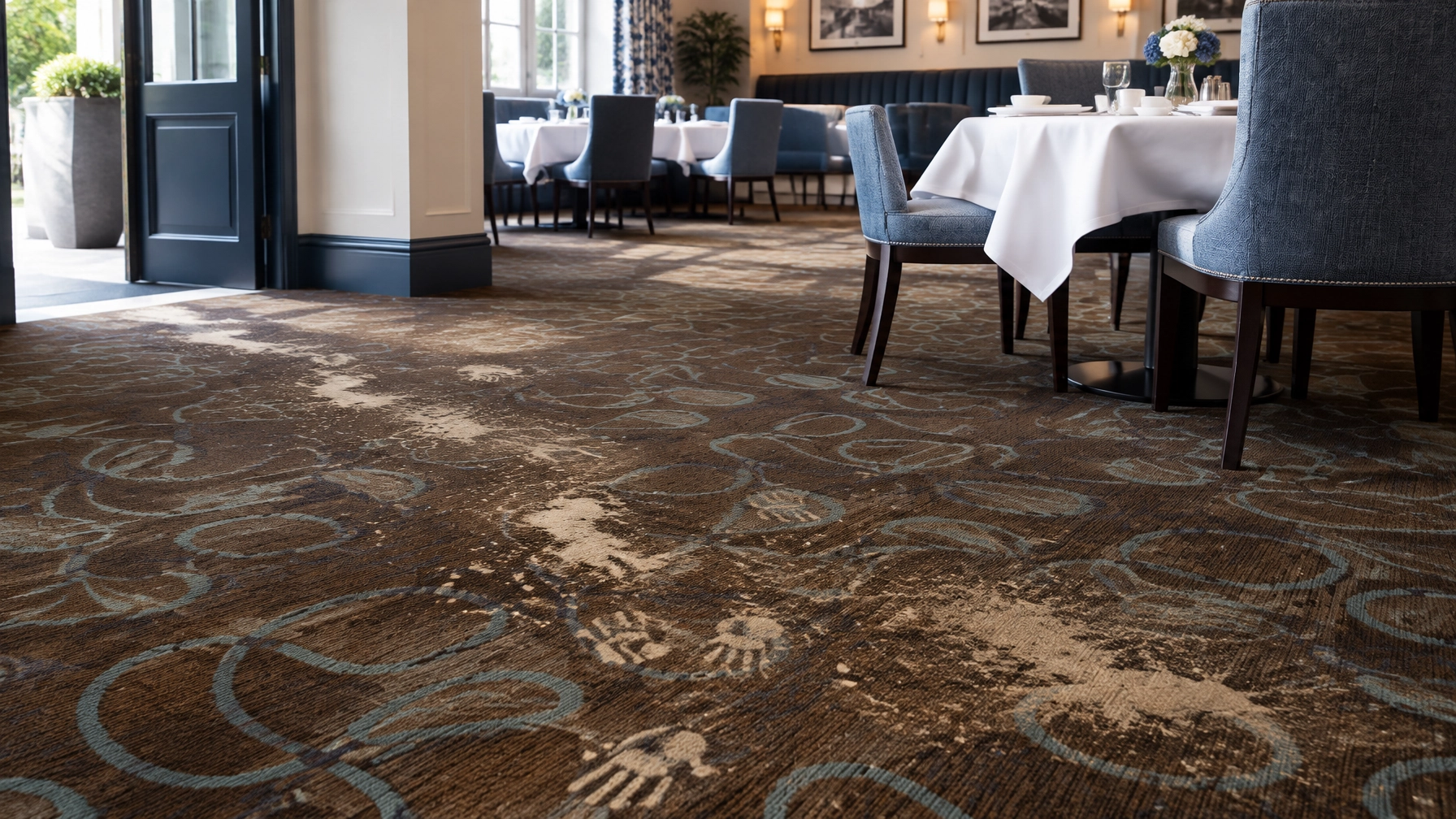
An F&B manager walks the restaurant before breakfast service. The hotel opened eight days ago, and the floor is meant to look immaculate. Instead, there’s a pale, handprint-shaped streak from the door towards Table 12. A few splatter dots. One half-faded patch.
The night porter explains: red wine was spilled at closing time. There was no suitable carpet product nearby, so he grabbed the kitchen’s chlorine-based sanitiser concentrate. It was strong enough for food-contact surfaces, he reasoned, and “way stronger than anything on the bar trolley”. He sprayed it on the wine. The red seemed to fade. Job done. Or so he thought.
By morning, the red had gone, and so had some of the carpet’s colour. The pale marks followed where he gripped the bottle and where droplets landed. The next evening, more light streaks appeared after someone wiped over splashes that were still damp.
A carpeted restaurant is not the place for a back-of-house hygiene product to go on an unscheduled tour.
The stain disappeared. The carpet colour went with it.
Red wine is a stain: pigment from the spill has been added to the carpet. Chlorine bleach can do the opposite. It can strip or alter the carpet’s own dye. So the red may look lighter, while the carpet underneath turns pale, yellowish or patchy.
That difference matters. A stain may respond to appropriate cleaning. Where dye has been removed, more cleaning cannot put it back. And scrubbing is not the answer: it can damage carpet fibres and spread product beyond the first splash.
It’s also why store-bought spotters, including products sold for tackling stains, can sometimes leave pale marks on carpet. Formulations vary, and a product that seems powerful on a stain may not be suitable for that carpet. If you’re seeing a lighter patch rather than a darker residue, don’t assume it needs more stain treatment. Read our guide to the difference between a bleach spot and a regular stain and why carpet turns white after bleach cleaner.

An illustrative close-up of the kind of pale streaking and splatter marks chlorine damage can leave.
Why a carpet mark matters to hotel revenue and downtime
The restaurant and bar floor is part of the guest experience. A conspicuous pale patch can draw the eye at breakfast, during dinner service, or in photographs long after the spill itself is forgotten.
There’s also a practical business question: what does replacement involve? It can mean closing or restricting the restaurant and bar, moving furniture, arranging uplift and fitting, and waiting for work to finish. Matching the new carpet to adjoining areas can be difficult, too. Seams, dye variation and differences in wear can turn one damaged patch into a much bigger-looking change.
The Knight Frank UK Hotel Trading Performance Review reports that food and beverage accounted for roughly 27% of total revenue on average across regional UK hotels in the period it reviewed. That figure is an average, not a forecast for any one property. But it’s a useful reminder that a restaurant floor sits within a revenue-generating part of the hotel.
And wine is only one potential colour challenge. December brings mulled wine; dessert menus may include cherries and raspberries; beetroot, turmeric-rich dishes, borscht-style soups and tomato sauces can all leave pigment-heavy spills. Most need the right response for the spill and the carpet. A product chosen for a kitchen counter is not automatically appropriate for soft furnishings.
One written rule beats “that’s what we did at the last place”
Bar-side habits travel. One porter shows another what worked at a previous job. Night staff change. A new cleaner reaches for what is close to hand. Before long, a kitchen sanitiser is being treated as a universal spill solution.
For hotel F&B managers and GMs, a short written rule can help stop that crossover:
- Keep chlorine-based products for their intended kitchen and food-contact uses. Follow the product manufacturer’s dilution and contact-time instructions, as the Food Standards Agency advises.
- Make the carpet rule clear in inductions for night porters, night cleaners and other staff who may deal with spills.
- Ensure staff know the difference between cleaning residue off a surface and bleaching colour from a carpet.
- Give the night team clear, approved options for soft-furnishing incidents, or instructions to keep people away, report the spill and record what happened.
- Log the product used, where it was applied and when. That gives the owner or insurer an honest record if the damage needs assessment.
One brief safety note: never mix cleaning substances. The HSE’s hospitality guidance warns that mixing bleach-containing products with acidic cleaners or ammonia can release harmful gases. Keep products labelled and use them as directed.
What to do now
If a pale mark has appeared after a spill or product application:
- Keep people off the area and don’t add more products.
- Note what was used, where and when, and take photos.
- Don’t treat possible colour loss as a stain to scrub.
- Book a professional assessment quickly.
Professional colour restoration may save the floor
For suitable carpets, professional bleach spot repair can rebuild missing colour with careful colour matching. Carpet dyeing and carpet colour restoration address the loss of dye, rather than trying to clean away colour that is no longer there. The carpet, fibre, pattern and extent of damage all matter, so an honest assessment is important; restoration is not the right answer for every floor.
Where it is suitable, a targeted repair can be completed with a fast turnaround, often in a single visit. That may help a hotel avoid closing off a larger area for replacement work. It can also cost far less than replacing an otherwise serviceable carpet. The result depends on the carpet and damage, so no responsible assessment should promise a perfect or invisible match before seeing the floor.
BD365 Carpet Colour Solutions specialises in carpet restoration, dyeing and bleach spot repair. Our team has specialist colour training in the UK from leading restoration experts, and BD365 is trusted and used by Dr Beckmann’s. Our eco-friendly dyeing techniques are safe for children and pets. We provide UK-wide, nationwide coverage and work across Europe.
Before replacing a hotel floor, it may be worth checking whether targeted hotel carpet repair can restore it. The same restore-over-replace approach can help businesses and venues with dining rooms, homeowners and facilities teams. We also provide carpet restoration for landlords.

Real BD365 hotel-room carpet repair example. Before-and-after results depend on the carpet, fibre and damage; an assessment is needed to judge what may be achievable in another space.

Real BD365 hotel corridor restoration example. It illustrates a completed job, not a guarantee that every carpet will respond in the same way.
A practical alternative to replacement
Hotel carpet restoration can help avoid unnecessary material waste as well as the cost and disruption of replacement. It’s an eco-friendly carpet restoration option when the carpet is suitable and the rest of the floor remains in good condition.
If a chlorine sanitiser or stain spotter has left a pale patch, BD365 can assess the damage and explain whether bleach spot repair or carpet dyeing may be appropriate. For more information, see our bleach-spot cost guide and carpet restoration FAQs.
If you’re searching from the US, this service is usually described as carpet color restoration or carpet color repair — same problem, different spelling. We serve clients across the UK and Europe, so US visitors are welcome to get in touch about properties on this side of the Atlantic.
For an assessment, call 0800 1931 365, WhatsApp 07561 700670, or email info@bd365.co.uk. We’ll help you understand the options before you decide whether the floor needs replacing.