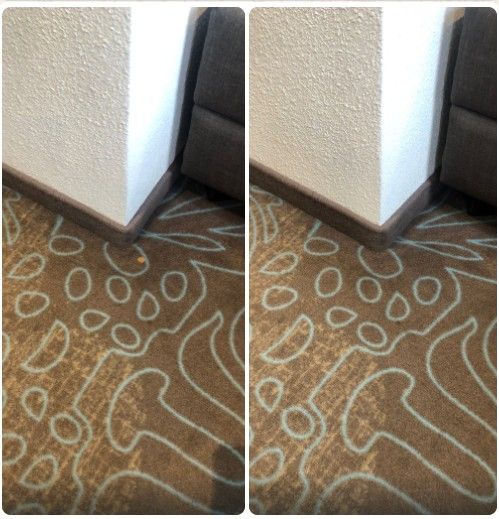
Illustrative BD365 repair example. This is not the shopping centre in the fictionalised story below.
The short version
A fictionalised pre-Christmas deep clean goes wrong when a bleach-based hard-floor sanitiser is carried across the tile line and onto a food court carpet. The damage appears days later as pale drips, splatter dots and a mop-shaped band. Pale marks can mean lost dye, not dirt, so more cleaning is not the answer. Professional carpet restoration may avoid a costly replacement and a disruptive closure, with work often arranged overnight or outside trading hours. BD365 provides nationwide UK coverage and also works across Europe.
This Reddit-style story is fictionalised for illustration. It does not describe a real centre, cleaning contractor or client.
The night shift that left a map
I manage operations at a shopping centre. In the fictional version of this story, we had booked a pre-Christmas deep clean of the communal areas. The cleaning team was working overnight, moving from the hard floors around the food court to the carpeted seating area and the walkway towards the toilets.
The scrubber and mop bucket were doing exactly what they were meant to do on tile. But somewhere at the threshold, wet mop heads and wheel tracks carried cleaning solution onto the patterned carpet. No one noticed anything alarming at the time. The carpet was damp, the lighting was poor, and the floor looked fine.
Then came crisp December daylight.
A pale dotted trail crossed the food court entrance. There was a light band where the mop had passed over the threshold, and splatter marks continued along the carpeted route to the toilets. It was almost a diagram of the cleaner’s journey. Unfortunately, it was in one of the busiest communal spaces in the centre, just weeks before the Christmas shopping peak.

Another illustrative repair example from BD365’s image library, not the fictional food court.
Why this was a Christmas operations problem
The obvious option seemed to be replacing the affected carpet. But fitted carpet in a food court is not a small, tidy swap. Uplift, disposal and fitting all add cost. The seating area might need to close or be hoarded off, right when visitors need places to sit, eat and regroup. And replacing just one section could leave a visible mismatch against the surrounding pattern.
The timing mattered. MRI Software’s OnLocation Footfall Index, reported by Retail Times, showed UK footfall down 0.7% year on year in October 2026. Shopping centres were up 0.1% year on year and 2.1% month on month. In the final week, shopping centre footfall rebounded 17.1% week on week.
The Christmas period can also bring sharp bursts of activity. MRI’s Black Friday week 2025 data reported shopping centre footfall up 14.8% on Black Friday itself week on week. Between 5pm and 8pm, footfall rose 29.2% week on week.
The wider picture is not always a steady climb. Reporting on the BRC-Sensormatic Footfall Monitor, The Independent said December 2025 footfall was down 2.9% across the UK year on year, with shopping centres seeing the biggest fall at 5.1%. UK footfall for 2025 was down 0.8%, the third consecutive year of annual decline.
These are destination-level trends, not forecasts or figures for any single shopping centre. They do underline why every shared space matters. A pale trail in a busy food court is not just a flooring issue. It can affect the first impression visitors get of the whole centre.
Pale is not the same as dirty
Here is the crucial distinction. Residue left on carpet may sometimes be a cleaning issue. But pale marks after chemical contact can mean that colour has been removed from the fibres. More cleaning might remove residue, but it cannot put missing dye back. This is the trap when people try to fix bleach spots on carpet with yet another cleaning product: the colour has to be rebuilt, not scrubbed.
The IICRC consumer carpet guidance says bleach damage is corrected by dyeing or patching, not ordinary cleaning. So the right next move is an assessment, not another pass with a scrubber or spot cleaner.
Cleaning products vary, so check the exact label and follow its directions. The HSE’s CAIS22 guidance covers safe use of cleaning substances, including bleach and sanitisers. If a product is intended for hard floors, keep it on hard floors. A wet mop head or a scrubber’s wheels can carry residue over the tile line and onto carpet without anyone noticing straight away.
Some shop-bought stain spotters, including certain formulations sold under familiar names such as Vanish or Dr Beckmann, may cause colour loss. Formulations vary, so the product label matters. BD365 explains the difference between a bleach spot and a regular stain.
The sensible response before the crowds arrive
In this fictional scenario, the centre team kept the response straightforward. They wanted to understand the extent of the damage, avoid making it worse and find out whether the carpet could be restored without shutting the whole area for replacement.
- Keep footfall off the affected area if practical.
- Photograph the marks and log where they run.
- Identify the exact product the contractor used and flag it before the next deep clean.
- Arrange a professional assessment and quote, and ask about out-of-hours work.
That last point can make a real difference to centre operations. Depending on the carpet and the damage, professional carpet dyeing and bleach spot repair can often be scheduled overnight or outside trading hours. A fast turnaround may help the area be ready before the Christmas crowds, without the disruption of a full carpet replacement. The repair plan and timing depend on an assessment, so ask what is realistic for your site.

BD365 image-library example showing carpet colour repair. This is not a shopping centre installation.
Restore first, replace only if needed
BD365 Carpet Colour Solutions specialises in carpet restoration, dyeing and bleach spot repair. The aim is to restore what can be saved, rather than replace a large area of perfectly serviceable flooring because of pale marks.
For a commercial site, that can mean less waste, lower disruption and a more consistent appearance than replacing just one patch of a patterned floor. BD365’s carpet restoration services include expert colour matching and eco-friendly carpet restoration, using eco-friendly dyeing that is safe for kids and pets. The team is trusted and used by Dr Beckmann’s, with specialist colour training in the UK from leading restoration experts.
There is no one-size-fits-all price or promise that every mark will disappear. Carpet type, pattern, damage and site access all matter. For an idea of what affects a repair quote, see BD365’s guide to the cost of fixing a bleach spot on carpet.
Professional recolouring is not the same as painting a pale patch with shop-bought dye. Please do not try to re-dye the carpet yourself. A professional can assess whether colour restoration is suitable and whether the fibres and pattern can be matched well.

An illustrative drip repair from BD365’s image library, not the fictional centre.
A note for retailers, agents and homeowners
If you manage a retail unit inside a centre, a pale trail near the entrance or shared walkway can reflect on your store too. Flag damage early with centre operations and ask for a professional assessment before it becomes part of the seasonal footfall route.
For estate and letting agents and landlords, the same restore-over-replace thinking can help when preparing a property for viewings. BD365 also offers carpet restoration for landlords. Homeowners can face a similar surprise after using a bargain stain spotter in the hallway. In each case, skip home-remedy experiments and get advice on the carpet itself. Fading from sunlight is a separate problem too, and may call for carpet sun damage repair rather than treatment for a chemical spot.
US readers searching for “carpet color restoration” are looking for the same broad idea as UK carpet colour restoration: restoring colour where it has faded or been removed.
Need a professional view?
Replacing the food court carpet might sound decisive, but it can mean closures, fitting costs and a mismatch that lasts beyond Christmas. For suitable carpets, professional carpet restoration can offer a faster, lower-waste alternative and work around trading hours.
Find out more about BD365 Carpet Colour Solutions. BD365 provides nationwide coverage across the UK and also serves customers in Europe.
Call 0800 1931 365, message on WhatsApp, or email info@bd365.co.uk to discuss an assessment.