The short version
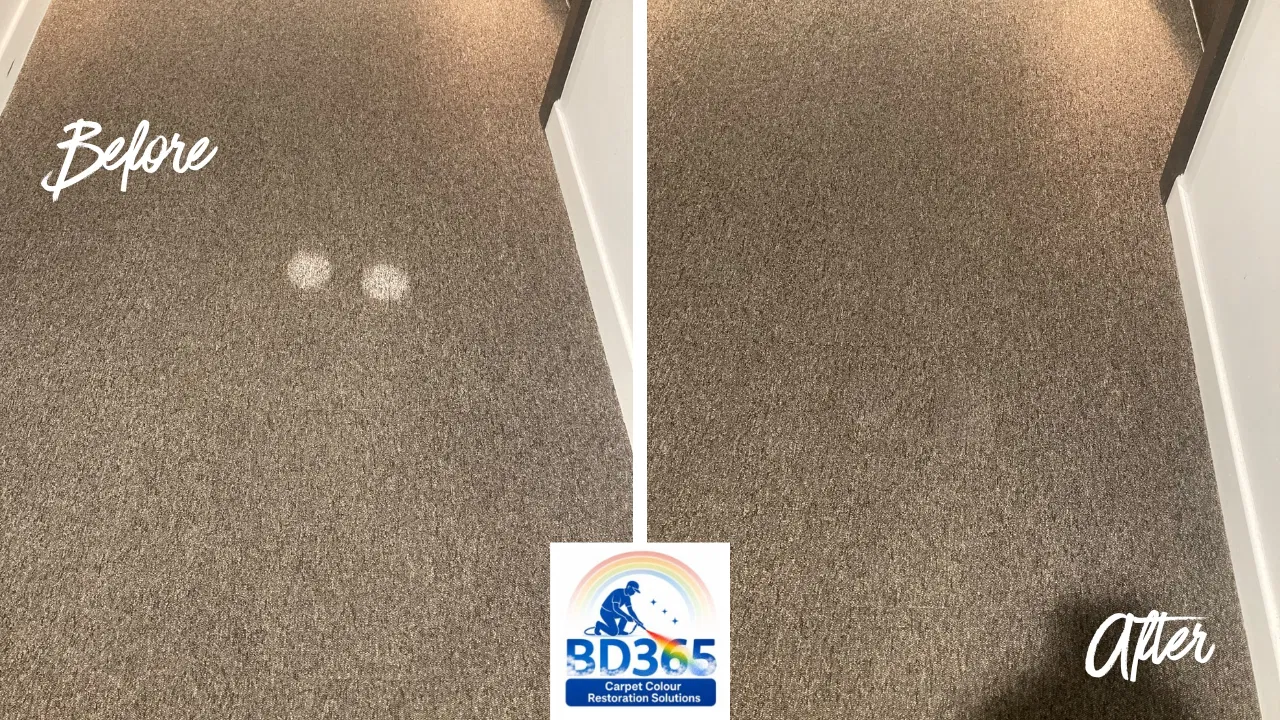
Guests love a hot tub, and they bring the hot tub indoors on their feet. Spa water carries chlorine or bromine, and tracked along the same patio-door-to-bathroom route change after change, it can quietly bleach pale footprint trails into lodge and holiday-let carpets. Those pale marks are not stains: the colour has gone, so no amount of cleaning brings it back. Professional bleach spot repair and carpet recolouring can restore the colour without replacing the carpet.
BD365 specialises in carpet dyeing, bleach spot repair and carpet colour restoration, with nationwide UK coverage and Europe coverage too. We help holiday-let owners, hosts and letting agents get carpets guest-ready fast, saving the cost, disruption and waste of replacement wherever the carpet can be saved.
A familiar changeover surprise
Fictionalised scenario: This story is made up, but the sort of changeover surprise it describes is familiar to holiday-let owners.
The guests have checked out. The hot tub has been enjoyed. The changeover team is working through the lodge when someone spots a trail of pale marks from the patio door towards the bathroom.
“Probably just wet footprints,” says one person.
“Maybe the carpet cleaner will sort it,” says another.
Then the marks stay put.
For a lodge owner, that can be the start of a very unnecessary panic: Is the carpet permanently damaged? Will the next guests notice? Is this going to mean replacing the whole room before the weekend?
The honest answer is: probably yes to the first one, if the marks keep coming back in the same footpath. One wet dash from the tub rarely does much. But a hot tub is not a one-weekend feature. It is there for every single booking, and the water that keeps it guest-safe is the same stuff slowly stripping colour out of the carpet beside it.

Can hot tub water really affect carpet colour?
Here is the part most owners never think about: the water in a commercial hot tub is deliberately dosed with sanitiser. Under HSE guidance HSG282, which covers hot tubs at holiday lets, lodges and hotels, free chlorine should sit at 3 to 5 mg/L or total bromine at 4 to 6 mg/L, tested at least twice a day, with water refreshed between guest bookings. That is a genuinely impressive safety standard. It is also, chemically speaking, a mild bleach solution that guests stand in, splash about in and then walk through your lodge with.
On its own, a splash of properly maintained spa water is nothing like tipping household bleach on the carpet. The damage comes from repetition. Damp feet and wet swimwear carry chlorinated water along the same route, changeover after changeover, and every pass adds a little more exposure. The fibres dry, the water evaporates, the chemical stays. Over weeks and months, the dyes in some carpets start to fade along that exact footpath, especially where the carpet stays damp longest, like the threshold by the patio door and the last steps to the bathroom.
Carpet fibre, dye type and condition all matter. Nylon behaves differently to wool, and sun-faded carpet fades faster still. That is why two lodges with identical tubs can have wildly different carpets.
The IICRC’s consumer guidance on carpet care explains that chlorine bleach causes colour loss in textiles, and the HSE’s spa-pool guidance sets out just how much sanitiser commercial hot tub water is expected to carry. Put the two together and the pale footprint trail starts to make sense.
Pale mark or ordinary stain?
A regular stain adds something to the carpet. A bleach spot or chemical mark takes something away: the colour itself. That is why a pale patch stays visible after cleaning, even when the fibres are spotless. You are not looking at dirt. You are looking at missing dye.
Store-bought stain spotters, including products from Vanish or Dr Beckmann, are intended for particular cleaning tasks. Some stain-removal products use oxidising ingredients, and results depend on the formulation and how the product is used. Over-application, residue or an unsuitable carpet can contribute to colour problems. A pale mark is not a cue to keep trying more products.
For a clearer explanation, see BD365’s guide to the difference between a bleach spot and a regular stain, and its article on why carpet turns white after bleach cleaner.

What should a host do when marks appear?
The first priority is to keep a small carpet concern from turning into a bigger mystery. Record what has happened and get informed advice before authorising a whole-room replacement or trying another cleaner.
- Keep guests off the area and stop adding products to it.
- Note when the marks were first seen and where the trail runs.
- Photograph the marks and the wider room before anything else touches them.
- Book a professional assessment before the next changeover if you can.
This is not a DIY repair guide. Avoid experimenting with household products on the affected area. More cleaning may not restore colour that has already changed, and it can make the cause harder to assess.
Restore the carpet, not the whole lodge
When a carpet is structurally sound but has localised colour loss, professional carpet dyeing or bleach spot repair may be an alternative to replacement. BD365 assesses the carpet, fibre, colour and condition before advising what is realistic. The right option might be targeted carpet recolouring, wider carpet colour restoration or, in some cases, replacement.
The goal is not to promise an invisible result for every carpet. It is to find out whether expert colour matching can improve the appearance and help keep a usable carpet in service.

Why restoration can make sense for holiday lets
Here is why the hot tub matters so much in the first place. Sykes Holiday Cottages’ Staycation Index found around 28% of holidaymakers put a hot tub at the top of their wish list, and cottages with one can earn noticeably more per year than those without. The tub fills the booking calendar. The carpet next to it quietly pays for it.
For holiday-let owners and hosts, replacing that carpet involves more than choosing a new colour. There is the fitting, disposal, furniture moving and the risk of taking a room out of use during a busy changeover period.
Suitable carpet restoration may offer:
- A more cost-effective alternative to replacing sound carpet.
- Less disruption to bookings and changeover schedules.
- A way to reduce unnecessary flooring waste.
- A chance to improve localised colour damage without redoing the whole room.
This restore-over-replace approach can also help letting agents and property managers looking after short-let portfolios. A consistent, well-presented interior matters across every property, but not every pale mark needs to become a full flooring project.
Hoteliers and spa-lodge managers face a similar balancing act. Guest areas need to look their best, while repairs need to fit around occupancy and operations. Homeowners with hot tubs may also find that restoration is worth exploring before assuming a room needs new carpet.
What BD365 brings to the assessment
BD365 Carpet Colour Solutions specialises in carpet restoration services, including professional carpet dyeing, bleach spot repair and carpet colour restoration. Our specialist colour training in the UK comes from leading restoration experts. BD365’s work is trusted and used by Dr Beckmann’s.
We use eco-friendly dyeing techniques described as safe for children and pets, and we aim for fast turnaround times where the job and location allow. BD365 provides nationwide UK coverage and also works in Europe.
Some US searches use the phrase “carpet color restoration”. In the UK, you will usually see it written as carpet colour restoration. Whichever spelling brought you here, the point is the same: if the carpet has lost colour, cleaning may not be the answer. Professional assessment can establish whether restoration is suitable.
We also provide carpet restoration for landlords, letting agents and property managers who need a practical alternative to automatic replacement. If you are trying to fix bleach spots on carpet, or investigating pale marks after a hot-tub stay, send photographs for an initial assessment. The carpet’s fibre, condition and damage all affect what can be achieved.
A pale footprint trail is not an automatic replacement bill
Hot tub water may be one possible factor in carpet colour loss, but it is not the only explanation, and wet footprints do not prove chlorine damage. What matters is getting the carpet assessed before the problem is made worse by guesswork.
If your lodge carpet has developed pale patches, BD365 can help you understand whether carpet recolouring or another restoration option may be suitable. Restore where possible, replace when necessary.
- Call 0800 1931 365
- WhatsApp 07561 700670
- Email info@bd365.co.uk