TL;DR
Bleach damage is easy to miss during a mid-tenancy inspection because it often looks like a pale patch, faded area or strange change in shading. But it is not a normal stain. Bleach removes the carpet’s original colour, leaving white, cream, yellow or orange patches behind.
If agents spot and document the problem early, landlords have a much better chance of resolving it quickly and fairly before check-out. Professional bleach spot repair is usually faster and more cost-effective than replacing an entire carpet, helping avoid a £600+ replacement bill, unnecessary waste and a difficult deposit conversation.
BD365 Carpet Colour Solutions specialises in carpet dyeing, carpet restoration and carpet restoration for landlords. We serve letting agents, landlords and property managers nationwide across the UK.
The mid-tenancy inspection blind spot
Most letting agents are looking for the obvious things during a routine inspection:
- Damp or mould.
- Leaks.
- Broken appliances.
- Damage to walls, doors and fixtures.
- Signs of poor housekeeping.
- Unauthorised changes to the property.
Carpet colour loss is rarely top of the list.
That is the problem.
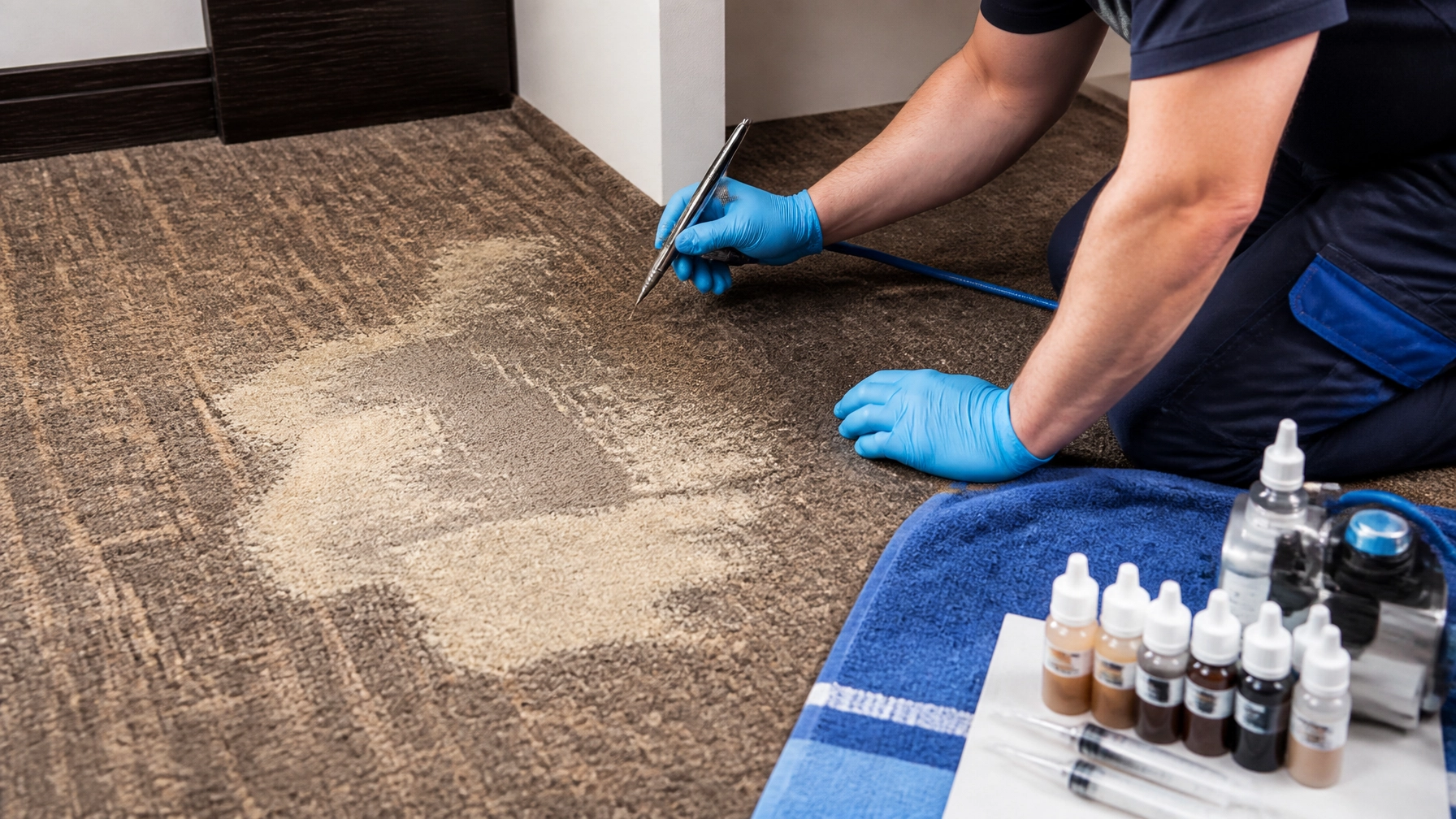
A bleach spot does not always look like a dramatic white splash. It might be a slightly lighter patch beside a sofa. A yellow mark near a skirting board. A pale orange area in a patterned hallway carpet. Under artificial lighting, it can look like ordinary wear, sun fading or a camera exposure issue.
By the time the check-out inspection arrives, the mark may be larger, more noticeable and impossible to date accurately.
That is how a small restoration job can turn into a £600+ replacement conversation.
And, as countless Reddit threads demonstrate, the first response is often panic, more cleaning products and the suggestion of replacing the entire carpet. Not exactly a calm end to a tenancy.

Bleach damage is colour loss, not a normal stain
The simplest way to explain the difference is this:
- A regular stain adds something to the carpet.
- Bleach damage takes something away.
Coffee, mud or food residue may sit within or on top of the carpet fibres. Cleaning can often remove those unwanted substances.
Bleach and other oxidising products can remove the original dye instead. The carpet may be perfectly clean, but the colour is missing.
That is why steam cleaning does not solve the problem. It can remove dirt around the mark, but it cannot put the missing colour back. In some cases, cleaning the surrounding carpet can make the pale patch look even brighter by comparison.
You can read more about this in our guide to the difference between a bleach spot and a regular stain.
What bleach damage can look like
During an inspection, look for:
- White or chalky patches.
- Cream areas against a darker carpet.
- Yellow or orange discolouration.
- Irregular splashes or drip marks.
- Small pale dots in a trail.
- A lighter area beside a cleaning cupboard or bathroom.
- Faded-looking patches that do not match the rest of the room.
- A mark with normal texture but noticeably different colour.
The texture may feel completely normal. There may be no sticky residue. That is one reason agents miss it.
The location can also offer a clue. Bleach damage is often found near bathrooms, toilets, utility areas, cleaning cupboards, pet bowls and places where household products have been used.
“I got bleach on my carpet and it has stained”
This is one of the most common ways the problem is described online.
Strictly speaking, it has not stained the carpet in the usual sense. It has caused colour loss.
That distinction matters because the remedy is different. More scrubbing will not restore the missing shade. A marker pen or fabric dye from a supermarket is unlikely to blend into the surrounding carpet. It may simply create a darker, more obvious patch.
The first step for an agent is not to blame or accuse. It is to record the condition clearly and ask sensible questions:
- Was the mark present at check-in?
- Has it appeared since the last inspection?
- Does the tenant know what caused it?
- Has anyone tried to clean or recolour it?
- Is there any remaining chemical residue?
- Is the carpet otherwise in good condition?
The mid-tenancy inspection is an opportunity to deal with the issue while it is still small.
The DIY disaster: when stain removers cause more trouble
Not every use of a retail stain remover will bleach a carpet. However, some products contain oxygen-based bleaching agents or other active ingredients that can affect dyes, particularly when they are:
- Left on too long.
- Applied too heavily.
- Used on an unsuitable carpet.
- Mixed with another cleaning chemical.
- Scrubbed aggressively into the fibres.
- Applied to a carpet that has already been chemically weakened.
Products such as Vanish and Dr Beckmann are regularly mentioned in online carpet damage discussions because users sometimes discover pale patches after treating a mark. The product may not have been intended to bleach the carpet, but the result can still be colour loss.
This is especially confusing for tenants. They thought they were cleaning a stain. Instead, they may have created a new pale patch around it.
If a tenant says, “I used Vanish and now the carpet has gone lighter,” or “Dr Beckmann has left a white mark,” treat it as a possible dye-loss issue rather than sending in another cleaner with stronger chemicals.
The same warning applies to:
- Toilet cleaners.
- Disinfectant sprays.
- Acne products containing benzoyl peroxide.
- Hair products.
- Dandruff treatments.
- Strong bathroom products.
- DIY carpet dyes and permanent markers.

A practical mid-tenancy inspection checklist for letting agents
1. View the carpet in good light
Open curtains and switch on the main lights. If possible, view the carpet from more than one angle.
Colour-loss marks can disappear in a dim room and become obvious when daylight hits the fibres.
2. Look at high-risk areas
Pay particular attention to:
- Around toilets and bathroom entrances.
- In front of sinks and cleaning cupboards.
- Around sofas and furniture.
- Hallways and stair landings.
- Areas beside pet bowls.
- Around desks and office cleaning stations.
- Any place where the tenant stores household chemicals.
3. Photograph the damage properly
Take both close and wide photographs.
A close-up shows the colour loss. A wide image shows where the damage is located within the room. Include a fixed feature, such as a doorway, skirting board or radiator, to make the location clear.
Avoid relying on one blurry phone image taken under a ceiling light. Photograph from different angles, and where possible include a colour reference or familiar object for scale.
4. Record what you can see, not what you assume
Write:
“Irregular pale yellow patch approximately 20cm wide beside the bathroom doorway.”
Avoid writing:
“Tenant has poured bleach on the carpet.”
You may suspect the cause, but the inspection report should record observable facts unless the tenant has confirmed what happened.
5. Compare with the check-in inventory
Look back at the original inventory and photographs. Was the patch present before the tenancy? Was the carpet already faded, worn or damaged?
Good evidence should show the condition at check-in, during the tenancy and at check-out.
A mid-tenancy report can help establish when damage was first noticed, but it does not automatically prove liability or justify a full replacement charge.
6. Ask the tenant to report any cleaning attempt
If the tenant has used a product, ask for the product name and when it was applied. This information can help a restoration specialist assess the likely damage.
Do not encourage the tenant to keep experimenting. More chemicals can enlarge the affected area and make a straightforward repair more complicated.
7. Call a professional early
If the mark is clearly lighter than the surrounding carpet, send photographs to a professional carpet restoration company before arranging replacement.
BD365 can assess photographs, advise whether restoration may be suitable and provide a clear quotation for bleach spot repair or wider colour restoration.
Why restoration is usually better than replacing the carpet
A full carpet replacement can involve much more than the cost of the carpet itself:
- New carpet.
- Underlay.
- Fitting.
- Furniture removal.
- Disposal.
- Time between tenancies.
- Possible matching issues in adjoining rooms.
- Lost rental time during the work.
BD365’s published guidance shows why a full replacement for an average room typically lands between £600 and £1,600 once carpet, underlay, fitting, uplift, disposal and furniture moving are included. By comparison, a single small bleach spot repair is often around £80–£150, multiple spots around £150–£250, and larger or more complex work from £300+. See our guide to the cost of fixing a bleach spot on carpet.
Professional carpet dyeing can restore the affected area without disturbing the rest of the room. It is often:
- Faster for tenant turnarounds.
- Less disruptive.
- More affordable.
- Better suited to patterned or fitted carpets.
- More sustainable than sending a usable carpet to landfill.
- Easier to justify as a proportionate remedy.
For landlords and agents, that last point matters. A targeted repair may help avoid a betterment argument where a full new carpet would significantly improve the property beyond its pre-damage condition.
Deposit deductions should be reasonable, evidenced and connected to actual loss. Guidance from Shelter and the Tenancy Deposit Scheme highlights the importance of condition reports, photographs, costs and fair wear and tear.

When replacement genuinely is the right call
Restoration is not a magic wand, and a reputable company should say so.
Replacement may be more sensible where the carpet is:
- Threadbare across large areas.
- Torn, melted or physically damaged.
- Severely flattened or structurally worn.
- A difficult-to-dye fibre that will not accept a suitable repair.
- A poor match for the required standard of the property.
- Already at the end of its reasonable service life.
- Damaged across most of the room rather than in isolated areas.
The point is not to avoid replacement at all costs. It is to avoid replacing an otherwise serviceable carpet because of one pale patch that could be restored quickly.
A better inspection habit for busy agents
Add “check for colour loss” to your regular inspection routine.
It takes seconds to look for pale or oddly coloured marks. It can save landlords time, money and a difficult conversation several months later.
If you see a suspicious patch:
- Photograph it clearly.
- Record its size and location.
- Compare it with the check-in inventory.
- Ask whether any cleaning products have been used.
- Avoid further DIY treatment.
- Request a professional assessment.
That simple process turns a Reddit-style carpet panic into a documented maintenance decision.
Need a quick assessment?
If you have spotted a pale patch during a mid-tenancy inspection, send BD365 photographs for a free assessment.
We provide professional carpet restoration for landlords, letting agents, property managers, offices, hotels and rental properties. Our eco-friendly dyeing techniques are designed to be safe for children and pets, with expert colour matching and fast turnaround times.
- WhatsApp: 07561 700670
- Call: 0800 1931 365
- Email: info@bd365.co.uk
- Website: BD365 Carpet Colour Solutions
- Free photo assessment: Send photos for an assessment
Nationwide UK coverage.
Before you price up a whole new carpet, check whether the colour can be restored. Often, the smarter answer is simple: restore, don’t replace.