The short version
A red wine spill during Friday service can become a bigger carpet problem if someone grabs a bleach-based sanitiser meant for tables and hard surfaces. Wine may leave residue; bleach can remove the carpet’s colour. Before you consider a disruptive replacement, get the damage assessed. BD365 provides professional carpet restoration services, including carpet dyeing and bleach spot repair, across the UK and Europe, with nationwide coverage.
“Quick, before it sets”
Picture the Friday-night rush: every table is booked, plates are moving, and a guest knocks a glass of red wine onto the carpet beside their table.
Someone spots the spill. Someone else says, “Quick, before it sets.” A member of the team reaches for the familiar sanitiser spray or wipes from the pass. The ones used between covers on tables and other hard surfaces.
A few sprays. A quick wipe. Job done. Or so it seems.
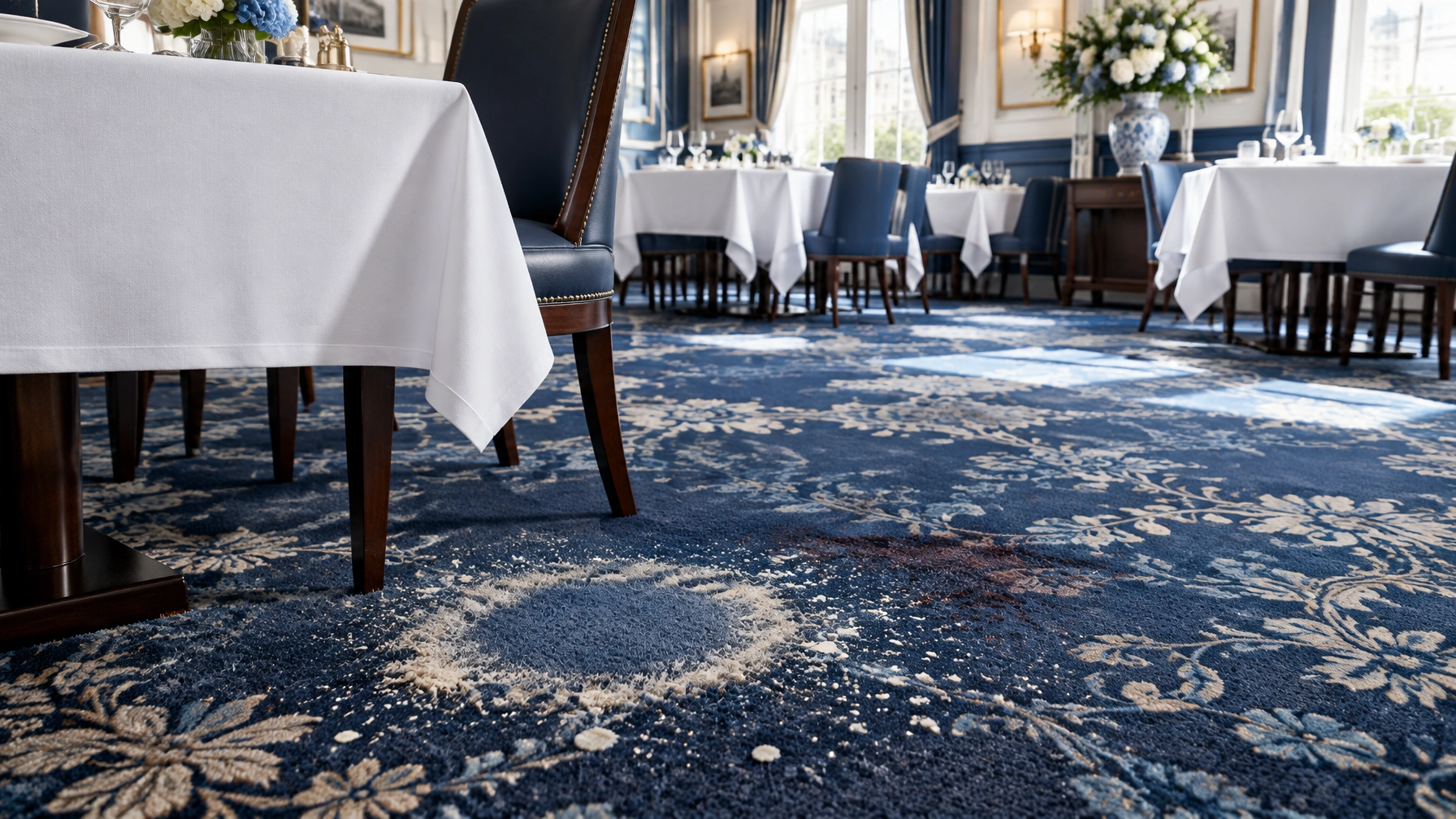
In the low evening light, the carpet is wet and the red looks less obvious. Service carries on. Then morning arrives. In daylight, there are pale splatter dots and a larger, pale halo where the wipe travelled. The table beside the mark is booked again on Saturday.
That’s when the manager’s Friday-night fix starts to look less helpful.

Illustrative before-style image: pale splatter marks and a wipe-shaped halo are the kind of colour loss that can stand out once the carpet dries and daylight reaches the dining room.
Wine residue and colour loss are different problems
Red wine can leave residue in carpet fibres. Depending on the carpet and the spill, an appropriate carpet spotter may help lift that residue.
A bleach-based product is different. It can strip or change the carpet’s dye, leaving pale marks that cleaning cannot simply wash back to the original colour. Scrubbing harder won’t replace missing colour either. It may only rough up the fibres or make the damaged area more noticeable.
If you’re unsure what you’re looking at, read our guide to the difference between a bleach spot and a regular stain and our explanation of why carpet can turn white after using bleach cleaner.
A quick safety note: never mix bleach-based products with other cleaning chemicals. The HSE warns that mixing cleaning substances can release harmful gases, including chlorine or chloramine in certain combinations. See the HSE guidance for cleaning substances in hospitality.
Why a pale patch can become a weekend problem
A pale mark beside a dining table isn’t tucked away in a back office. It’s right where guests sit, talk, celebrate and take photos. It may affect how the room looks to guests and how they describe their visit. No restaurant wants a carpet flaw becoming an unwanted extra in someone’s birthday picture.
The weekend is also when the room matters most. The 2025 UK Dining Out Trends Report found that Saturdays account for 25% of restaurant visits, with Fridays at 19%. Those figures come from the report’s analysis of more than 2,000 UK restaurants, rather than being a universal measure of every venue’s trade. Still, the point is familiar to most operators: a visible problem on the dining-room floor is hardest to ignore when the room is busiest.
Food sales are also a substantial part of turnover for food-led hospitality businesses. In UKHospitality and Christie & Co’s 2022 benchmarking report, food accounted for 49.1% of turnover in the food-led comparison. That’s a useful reminder that the room where guests eat is central to the business.
Replacing the carpet before Saturday service is rarely a realistic quick fix. Uplift, disposal, fitting, furniture moving and drying all take time. A professional assessment may show that targeted restaurant carpet repair, carpet dyeing or broader carpet colour restoration is a more practical route, without turning a carpet mark into room downtime.
What should the manager do next?
There’s a familiar temptation to scrub, spray something else, or decide that the carpet has to go. Pause before making the situation harder to assess.
- Keep guests and staff away from the affected area until it is dry.
- Record what happened with photos, the product name, the time and the location.
- Don’t add more products, and don’t treat colour loss as a stain.
- Arrange a professional assessment promptly, sharing service times and access details.
A quick, clear record helps a specialist understand what happened and plan around the next service. It also gives the manager a chance to check whether a targeted repair is possible before arranging a full replacement.
Restoration first; replacement only if needed
BD365 specialises in carpet restoration, carpet dyeing and bleach spot repair. An assessment looks at the carpet and the damage before anyone promises a result. Many repairs blend well; some are a clear improvement rather than completely invisible. The honest answer depends on the fibre, carpet condition, colour and extent of the damage.
BD365’s specialist colour training in the UK comes from leading restoration experts. The team is trusted and used by Dr Beckmann’s, and its eco-friendly dyeing techniques are safe for children and pets. Nationwide coverage across the UK, service in Europe and fast turnaround help make professional restoration a practical option for busy venues.
Before-and-after examples from hotel carpets show the kind of improvement professional colour work can achieve. They aren’t a guarantee for every restaurant carpet: each job needs its own assessment.

Hotel room patterned carpet: an example of professional bleach spot repair. Results vary, and assessment comes first.

Hotel corridor patterned carpet: another example of colour repair, with the aim of blending the damage into the surrounding carpet.
For an idea of what may affect a quote, see how much it can cost to fix a bleach spot, or browse the carpet colour restoration FAQs.
A note for hotels, homeowners and cleaning teams
Hotel restaurants and breakfast rooms face the same carpet-and-cleaning-crew challenge, often with weekend guests arriving while teams are turning rooms and public areas around. Hotel carpet restoration may help avoid unnecessary replacement where the carpet is still in good condition.
At home, a dinner-party red wine spill can prompt the same rush to act. The useful distinction is still the same: residue and colour loss need different responses. Use only products intended for carpet and suitable for the carpet fibre; don’t improvise with a hard-surface sanitiser.
For cleaners and front-of-house teams: carpet is not a hard surface. Use carpet-safe spotters only, follow your training, and report spills to management promptly rather than improvising mid-service.
For restaurant managers, prevention can be straightforward: brief floor staff that sanitiser sprays and wipes are for tables and hard surfaces only; keep carpet-safe spotters at the pass; use clearly labelled bottles; follow product guidance on spot-testing; and photograph the dining-room carpet after the final service of the week as a baseline.
Save the carpet, not the panic
If a Friday-night spill has left pale dots or a halo on your dining-room carpet, replacement isn’t the only option. BD365 can assess the damage and advise whether bleach spot repair, carpet dyeing or broader eco-friendly carpet restoration is suitable.
US searchers may find us by searching “carpet color restoration”. In the UK, we spell it colour.
Call 0800 1931 365, send photos on WhatsApp, or email info@bd365.co.uk. We work with hospitality venues, hotels, homeowners and property professionals across the UK and Europe.