TLDR: How long does bleach spot repair take?
Most professional bleach spot repairs take around 30 minutes to a couple of hours. Many straightforward jobs are completed in a single visit, with the carpet ready to use again once it has dried properly.
BD365 Carpet Colour Solutions provides specialist bleach spot repair, carpet dyeing and carpet restoration services across the UK. We work with homeowners, hotels, landlords, businesses and professional cleaners.
The exact timeframe depends on the size and number of marks, the carpet fibre, the pattern and whether wider colour fading also needs attention.
In most cases, repairing one damaged area is far quicker than ordering a new carpet, arranging fitting and taking the room out of use for days.
So, before you reach for the phone to “rip it out”, let’s answer the Reddit question properly.
The real worry: “How long will my carpet be out of action?”
Finding a pale white, yellow or orange mark on your carpet is bad enough.
Then comes the second panic.
How long will the room be unusable?
Will the furniture need to be moved? Will the whole carpet need to come up? Will the hotel room need to be closed? Will the tenant’s move-in date be delayed?
Thankfully, a localised bleach mark does not usually need to become a full flooring project.
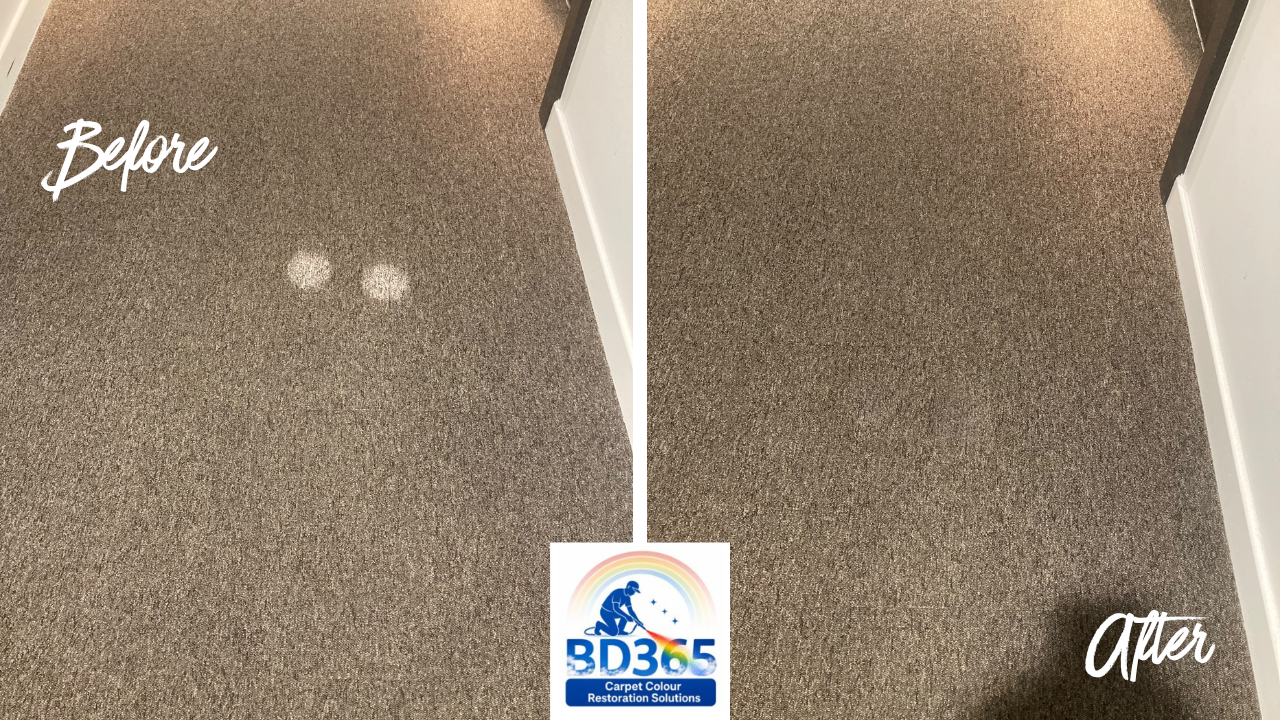
A professional repair is often completed in a short appointment. For one or two manageable spots, that may mean roughly 30 minutes to two hours on site.
Not days.
Not a week of dust and disruption.
And definitely not an excuse to start browsing carpets at midnight while holding a torch over the damage.
Why bleach spots do not simply clean away
A bleach spot is not a normal stain.
A coffee stain adds unwanted colour to the carpet. Cleaning may remove some or all of that unwanted substance.
Bleach damage is different. It removes or changes the original colour within the carpet fibres.
That means there may be nothing left to “lift out”.
Scrubbing harder will not put the missing colour back. A carpet cleaning machine cannot restore pigment that has been chemically altered. In some cases, further cleaning can spread remaining chemical residue, disturb the fibres or make the mark even more obvious.
This is why bleach spot repair is a colour restoration job, not a standard cleaning job.
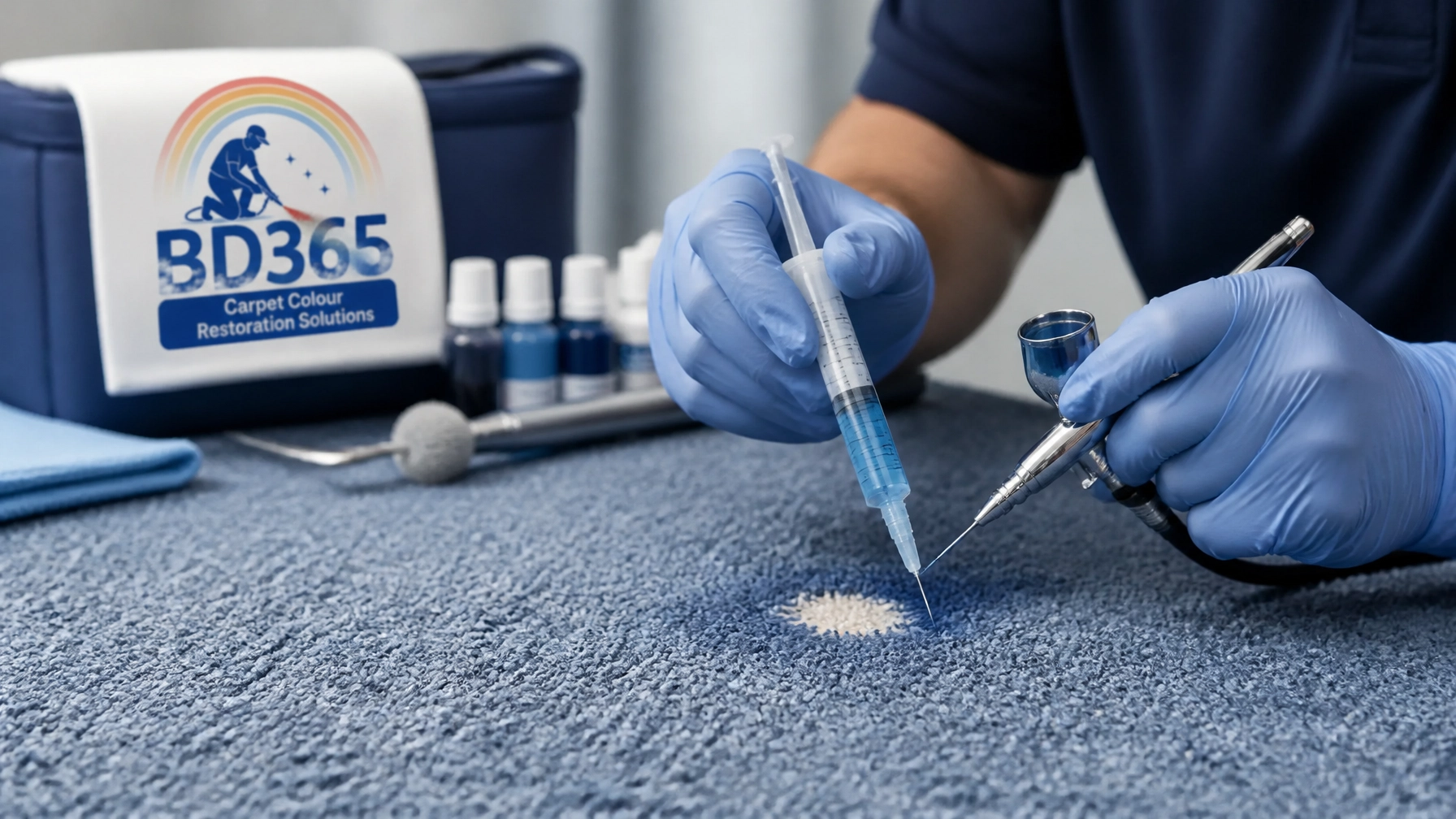
At BD365, our specialist carpet restoration approach assesses the damage first. Where the carpet is suitable, we carefully rebuild or correct the missing colour using professional dyeing and colour-matching techniques.
For a deeper explanation, see our guide to the difference between a bleach spot and a regular stain.
Typical professional bleach spot repair timelines
Every carpet is different, but this is a useful planning guide.
| Type of damage | Typical on-site timeframe |
|---|---|
| One small bleach spot | Around 30–60 minutes |
| One larger or more complex mark | Around 1–2 hours |
| Several spots in one room | Around 1–3 hours |
| Multiple rooms or a hotel corridor | Often a half-day visit or scheduled programme |
| Wider colour restoration | Depends on the size, condition and colour variation |
These timings refer to the repair appointment itself. Getting an appointment on the same day depends on location, availability and the urgency of the job.
BD365 covers customers nationwide across the UK. We can often start with clear photographs, helping us understand what has happened before arranging the most suitable next step.
That means you may not need to wait for someone to visit simply to tell you that the carpet has a bleach mark.
What affects the repair time?
The quickest bleach spot repairs are usually small, localised and on plain carpet.
However, several details can change the timeframe.
1. The size of the bleach spot
A tiny drip or splash may be dealt with relatively quickly.
A large pale patch needs more careful colour work. The repair may need to blend across a wider area so it looks natural from different angles and under different lighting.
2. The number of marks
One spot is one thing.
A trail of drips across a hallway, several splashes around a bathroom or multiple marks in hotel rooms will take longer overall.
The good news is that once a technician is set up, several nearby marks can often be assessed and treated during the same visit.
3. The carpet fibre
Carpets respond differently depending on their fibre and construction.
Wool carpets, for example, may need extra care and assessment. Nylon and other suitable fibres may respond differently again.
This is one reason BD365 does not give unrealistic blanket promises. The fibre, pile condition and existing colour all matter.
4. Plain or patterned carpet
A plain carpet may be more straightforward to match.
Patterned carpets can still be suitable for restoration, but the colour work must sit naturally within the design. A small repair may involve several tones rather than one simple shade.
That is particularly important in hotels, corridors and commercial spaces where people see the carpet from multiple directions.
5. Surrounding fading
Sometimes the bleach mark is not the only issue.
The surrounding carpet may also have sun fading, general wear or uneven colour loss. In that case, a wider colour restoration treatment may create a better overall result than treating one isolated patch.
BD365 assesses each job individually and gives an honest timeframe based on what the carpet actually needs.
Why calling early is usually the fastest option
The longer a bleach-damaged carpet is experimented on, the more complicated the conversation can become.
People often try:
- Scrubbing with a brush.
- Applying another cleaning product.
- Using household dyes or pens.
- Repeatedly steam cleaning the area.
- Covering the mark with furniture and hoping it disappears.
It rarely does.
A bleach mark is already a colour-loss problem. More products can introduce additional colour changes, residue or fibre damage. That may delay the professional assessment and make the final repair more challenging.
The fastest route is usually simple:
- Stop applying products to the area.
- Avoid aggressive scrubbing.
- Take clear photographs in natural light.
- Contact a professional for an assessment.
It is not glamorous advice. But it is considerably better than turning one bleach spot into a larger science experiment.
Repair versus replacement: the timeline nobody puts on the quote
Replacing a carpet can sound simple.
Choose a new one. Book a fitter. Done.
In reality, several steps are involved:
- Finding a suitable replacement carpet.
- Checking stock and delivery times.
- Matching the colour and style to surrounding areas.
- Ordering new underlay if needed.
- Arranging a fitting date.
- Moving furniture.
- Removing and disposing of the old carpet.
- Preparing the floor.
- Fitting the new carpet.
- Allowing time for the room to be put back together.
Even when the fitting itself is completed quickly, the complete process can take considerably longer than a localised repair. The affected room may be out of use for one or more days, with additional waiting time before the work begins.
For a premium carpet, replacement can also create a matching problem. The new carpet may look noticeably different from carpet in adjoining rooms or connected areas.
A carefully matched repair keeps more of the existing carpet in place.

Why “same day” matters to hotels and businesses
For a hotel, a damaged carpet is not just a cosmetic nuisance.
A room that needs replacement may be blocked while materials are sourced, furniture is moved and fitting is completed. That can mean lost bookable nights.
A professional bleach spot repair may allow the room to be treated during a short maintenance window instead.
The same applies to:
- Hotel corridors.
- Reception areas.
- Serviced accommodation.
- Offices.
- Restaurants and venues.
- Commercial properties.
- Rental portfolios.
For landlords, a quick repair can help avoid delaying a tenancy, inspection or viewing. It can also prevent a manageable issue from becoming a larger replacement bill.
For professional cleaners, recognising colour loss early is valuable. Cleaning can remove dirt. It cannot replace carpet dye that bleach has stripped away. Referring the issue for specialist restoration may be the most helpful outcome for the customer.
Can the carpet be used straight after repair?
Usually, the carpet can return to normal use once the treated area is properly dry.
The drying time varies depending on:
- How much treatment was needed.
- The carpet construction.
- Ventilation.
- Room temperature.
- The size of the repaired area.
Your technician should explain when the area is ready for normal foot traffic.
For a hotel or business, this is another advantage of a targeted repair. You are managing a small treatment area rather than waiting for a whole new carpet installation to finish.
Does same-day bleach spot repair always mean same-day attendance?
No. This is an important distinction.
“Same day” often refers to the repair being completed during one appointment. It does not guarantee that a technician is available to attend every location immediately.
Availability depends on:
- Your postcode.
- Technician schedules.
- The number of spots.
- Whether the carpet needs further assessment.
- The urgency of the situation.
BD365 will assess the details and give you a realistic timeframe rather than promising something unsuitable.
Send clear photographs through the BD365 photo assessment service so we can start with the right information.
Is restoration always the better option?
Not always.
If the carpet is heavily worn, physically damaged, melted, badly affected across a large area or unsuitable for dyeing, replacement may be the more sensible choice.
That is why an honest assessment matters.
BD365’s expertise covers carpet restoration, professional carpet dyeing, colour correction and bleach spot repair. But we will not pretend every carpet can be rescued. We consider the fibre, colour, condition, pattern and extent of damage before advising whether restoration is worth exploring.
When the carpet is suitable, the benefits can be significant:
- Less disruption.
- Lower costs than full replacement.
- Faster turnaround.
- Less furniture moving.
- Fewer lost hotel nights.
- Less waste sent for disposal.
- A practical second chance for a usable carpet.
You can also read our carpet restoration FAQs before deciding what to do next.
The answer to the Reddit timeline question
So, how long does a bleach spot repair take?
For many localised spots, around 30 minutes to two hours is a sensible expectation for the repair appointment.
More complex jobs can take longer. Multiple rooms, patterned carpet, wool fibres and wider fading all need additional consideration.
But compared with ordering, fitting and managing a full replacement, professional restoration is often the quicker and less disruptive route.
The important thing is to act early. Do not scrub the mark into the carpet. Do not add more chemicals. Do not assume the whole room is ruined.
Contact BD365 Carpet Colour Solutions for an honest assessment and advice on the most practical option.
Send photos for a free assessment or visit bd365carpetcoloursolutions.co.uk.
A bleach spot may be annoying. It does not automatically mean carpet loss.
Restore where possible. Replace only when necessary.