TLDR
A leaking mop bucket, cleaning trolley or overenthusiastic floor cleaner can leave a pale bleach trail across an otherwise perfectly good carpet. It may look like a stain, but bleach removes colour rather than simply adding dirt. That means ordinary carpet cleaning will not make it disappear.
For hotels, offices, homes and commercial properties, professional bleach spot repair, carpet dyeing and carpet restoration can be a far more practical option than replacing an entire room or corridor. BD365 Carpet Colour Solutions specialises in restoring suitable carpets, with eco-friendly techniques designed to be safe for kids and pets. We provide honest assessments and nationwide coverage across the UK.
There is a particular kind of Reddit post that makes every hotel manager, office facilities team and professional cleaner stare at the floor a little more closely.
It usually goes something like this:
“Why are there white marks all the way down the corridor?”
Then someone spots the trail.
Pale splashes. Faint wheel marks. A long, suspicious streak leading from the housekeeping cupboard towards the toilets.
The culprit?
The housekeeper’s mop bucket did it.
The crime scene: a carpeted corridor and a very guilty trolley
Mop buckets are perfectly innocent when they stay on hard flooring.
The trouble starts when a bucket containing bleach solution, disinfectant or another strong cleaning product is moved across carpet. A little slosh here. A drip there. Perhaps a leaking wheel or an unsecured container on a trolley.
By the time the cleaning team reaches the next room, the carpet may have acquired a trail of pale marks that looks remarkably like a tiny crime scene.
This can happen in:
- Hotel corridors and bedroom entrances
- Office walkways and reception areas
- Serviced accommodation
- Care and hospitality settings
- Commercial stairways
- Domestic hallways and kitchens
- Areas beside toilets, kitchens or service cupboards
The marks may appear as small splashes, thin streaks, irregular patches or repeated dots along a trolley route.
Sometimes the cause is obvious. Sometimes the carpet quietly reveals what happened several days later.

It is not a normal stain
This is the important bit.
A coffee stain adds colour to carpet. Bleach damage removes or changes the colour already there.
That is why scrubbing, shampooing or steam cleaning usually cannot solve the problem. There is no ordinary dirt sitting on top waiting to be lifted away. The original carpet colour has been chemically altered.
A bleach-damaged area might look:
- White
- Cream
- Yellow
- Orange
- Pink
- Faded grey
- Patchy or uneven
The final shade depends on the original carpet colour, the product involved and how long it was left in contact with the fibres.
This is why a carpet can look perfectly clean but still have a glaring pale trail running through it.
For a clearer explanation, see BD365’s guide to the difference between a bleach spot and a regular stain.
Why hotels and offices feel the pain more
One bleach spot in a spare bedroom is frustrating.
A bleach trail through a hotel corridor is a budget meeting waiting to happen.
Commercial carpets cover large areas. They also form part of the customer experience. Guests may not know exactly what looks wrong, but they notice tired, patchy or discoloured flooring. In an office, the same damage can make a reception area, meeting space or corridor look poorly maintained.
For hotels and businesses, replacement can involve much more than buying new carpet.
There may be:
- Furniture and equipment to move
- Rooms or corridors to take temporarily out of use
- Matching issues between old and new carpet
- Fitting and disposal costs
- Access restrictions
- Disruption to guests, staff or visitors
- Delays while replacement carpet is sourced
And if the original carpet is discontinued, a “simple replacement” may quickly become a much larger flooring project.
That is where restoration deserves a proper look.
Restore first. Replace only when necessary.
At BD365 Carpet Colour Solutions, the starting point is simple: do not assume a damaged carpet needs to be thrown away.
If the carpet is structurally sound and the damage is mainly colour loss, professional restoration may provide a more sensible alternative. BD365 specialises in:
- Professional carpet dyeing
- Bleach spot repair
- Colour restoration
- Colour correction
- Restoration of faded and chemically damaged areas
The aim is not to pretend that every carpet can be saved. Some carpets are too worn, too badly damaged or unsuitable for restoration.
The aim is to assess the carpet honestly before a hotel, landlord, office manager or homeowner commits to a costly replacement.

Why DIY fixes rarely end well
When a pale mark appears, the internet offers plenty of tempting ideas.
Permanent marker. Fabric dye. Hair dye. More cleaning product. A mysterious bottle bought online. Perhaps even a “quick fix” involving a paintbrush and a lot of confidence.
The problem is that carpets are not flat, blank canvases.
A repair has to sit naturally within the surrounding colour, pile and pattern. A dark blob may cover a white mark, but it can create an even more obvious dark blob. On patterned commercial carpet, a poor colour match can draw the eye straight towards the damage.
Aggressive cleaning can also spread any remaining chemical or roughen the carpet fibres. That may turn one noticeable area into a larger, messier one.
For that reason, professional restoration is usually the safer route, particularly in a high-value hotel, office or rental property.
You can read more about the potential cost difference in BD365’s guide to fixing bleach spots.
What professional restoration looks like
You do not need to become a carpet dyer to understand the value of specialist work.
A professional restoration team assesses the carpet, the type of fibre, the original colour, the pattern, the extent of the damage and the overall condition. The goal is to decide whether the area is suitable for colour repair and what result is realistically achievable.
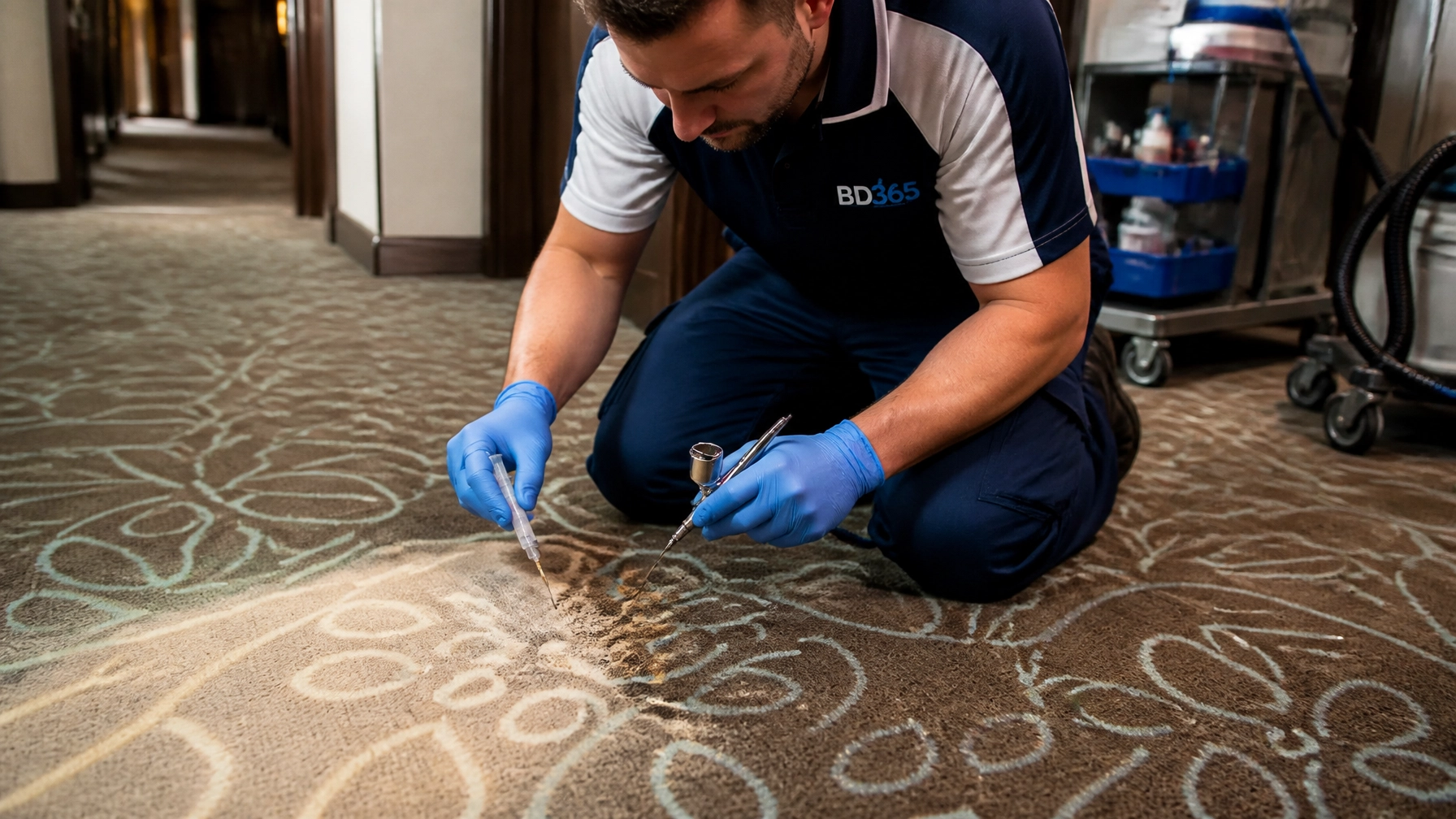
The visual process may involve precision tools such as syringes and airbrushes. These allow trained specialists to work carefully on localised damage rather than treating an entire room unnecessarily.
That precision matters when the damage looks like:
- A trail of tiny mop-bucket splashes
- Several isolated trolley drips
- A large faded patch
- Bleach marks crossing a patterned design
- A pale area beside a hotel room door
- Repeated chemical marks along a corridor
The work is about restoring the appearance of the carpet, not disguising it with a random colour.

The commercial benefits add up quickly
For a hotel manager or facilities professional, restoration is not only about making the carpet look better.
It may also help to:
Reduce replacement costs
Repairing localised colour damage can cost significantly less than replacing a whole corridor, room or reception area. BD365 provides an assessment before quoting, so you can make a decision based on the actual carpet rather than guesswork.
Reduce downtime
A targeted restoration project may create less disruption than moving furniture, closing rooms and arranging fitting work across a large area.
Keep a consistent appearance
A new section of carpet can look noticeably different from older surrounding areas, even when the colour is described as the same. Restoration can help retain a more consistent overall finish.
Extend the carpet’s useful life
If the carpet is still in good physical condition, there may be no reason to discard it because of a few pale marks.
Reduce unnecessary waste
Choosing restoration over replacement keeps usable flooring in service for longer and avoids sending bulky carpet to waste unnecessarily.
That is the restore-over-replace argument in one sentence: if the carpet still has life, give it a second chance.
What to do when you discover a bleach trail
First, do not panic.
Second, avoid experimenting with more products. Adding another chemical can make the colour damage worse or make the eventual assessment more difficult.
Instead:
- Keep people and cleaning equipment away from the affected area until the cause is understood.
- Make a note of what product may have been involved, if known.
- Take clear photographs in natural light.
- Include both close-up images and wider views showing the full trail.
- Contact a professional restoration company for an honest assessment.
BD365 offers a free photo assessment. Clear photographs can help the team understand whether the damage may be suitable for carpet dyeing, bleach spot repair or broader colour restoration.
For a hotel or office, include the room number, corridor location, approximate size of the affected area and whether the carpet is patterned or plain.
Prevention: keep the mop bucket out of the headlines
The best bleach trail is the one that never happens.
Hotels, offices and cleaning teams should make sure staff understand that bleach and carpet are not a good partnership. Where strong products are genuinely required, they should be handled in line with product instructions and workplace safety procedures.
It is also important never to mix bleach with other cleaning products. The CDC guidance on cleaning and disinfecting with bleach warns that bleach should not be mixed with other cleaners or disinfectants because dangerous vapours can be produced.
Simple housekeeping controls can help:
- Check buckets and trolleys for leaks.
- Secure containers during movement.
- Avoid carrying open solutions across carpeted routes.
- Use suitable products for the surface being cleaned.
- Report spills promptly.
- Train staff to recognise early signs of chemical damage.
Because “the mop bucket did it” is funny on Reddit.
It is less funny on a hotel refurbishment invoice.
Need help with a bleach-damaged carpet?
BD365 Carpet Colour Solutions supports homeowners, landlords, hotels, offices, commercial property managers and professional cleaning teams across the UK.
The team specialises in carpet restoration, carpet dyeing and bleach spot repair, using eco-friendly techniques designed to be safe for kids and pets. Every carpet is different, so the first step is an honest assessment of the damage and the likely result.
Send photographs through the BD365 photo assessment service, or contact the team via WhatsApp, email or freephone 0800 1931 365.
Before you replace the whole floor, check whether professional restoration can save it.
The housekeeper’s mop bucket may have started the story.
It does not have to write the ending.