TLDR: Stop scrubbing, take photos and ask before you replace
If you have just thought, “I got bleach on my carpet and it has stained,” do not panic-clean it. Stop rubbing. Blot any excess liquid gently with a clean white towel, keep children and pets away, and let the area dry.
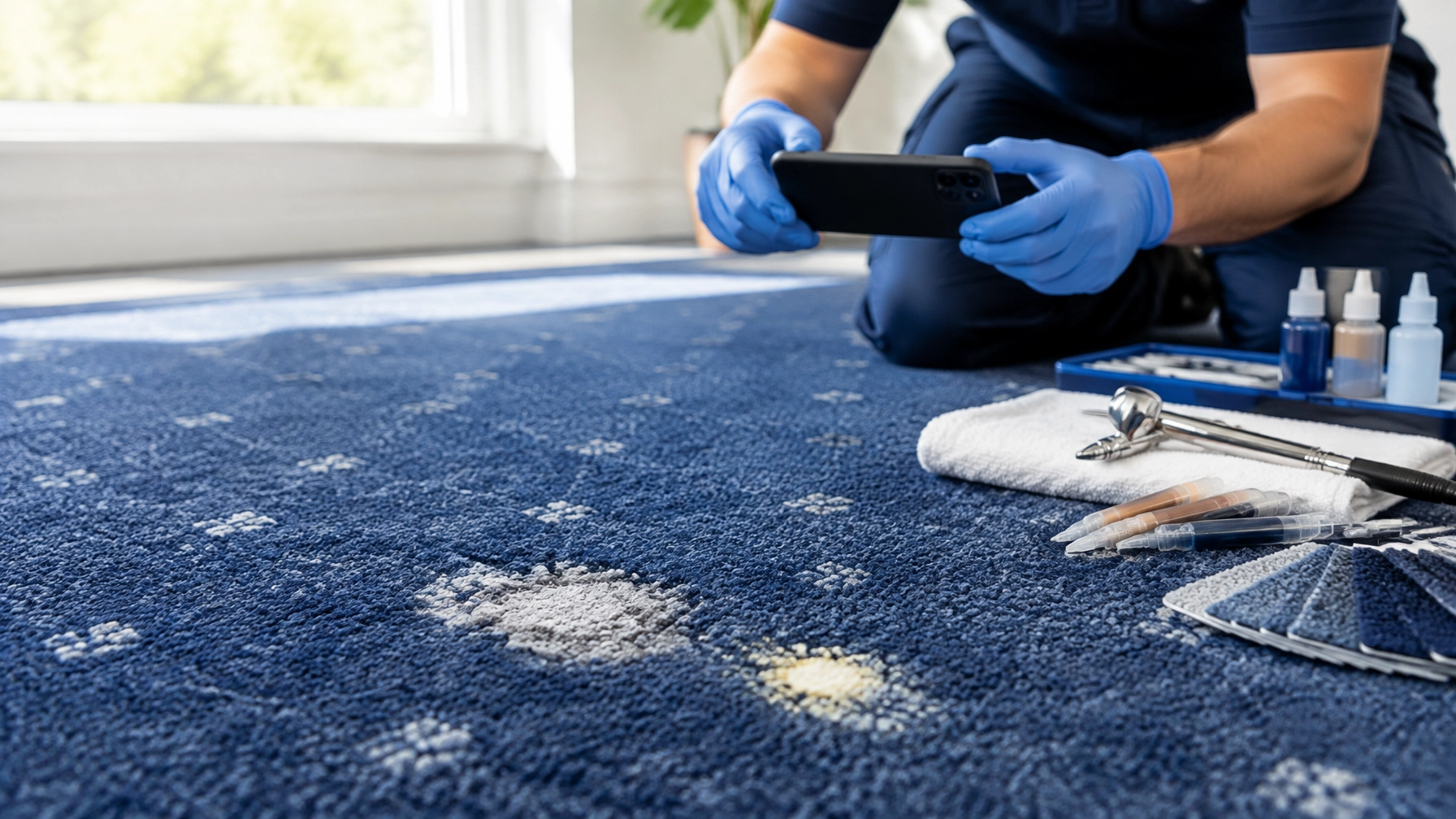
Then take a clear close-up and a wider room photo in natural daylight. Tell the professional what caused the damage and what products have already been used.
That simple information can lead to more honest advice, better quote guidance and a faster turnaround.
BD365 Carpet Colour Solutions provides carpet dyeing, bleach spot repair and carpet restoration across the UK. Our free photo assessment helps homeowners, landlords, letting agents, hotels and businesses check whether restoration is realistic before agreeing to a costly replacement.
Send photos for a free assessment.
The Reddit panic usually starts with good intentions
The story often goes like this:
A cleaning product splashes onto the carpet. The colour changes. Someone searches for an answer. Then the scrubbing begins.
Next comes a supermarket spotter. Perhaps Vanish. Perhaps Dr Beckmann. Perhaps a strong disinfectant that was only meant for a hard floor.
Then more water. More rubbing. Maybe a hairdryer. Finally, a chair is placed over the patch and everyone agrees not to look at it for a week.
Understandable? Absolutely.
Helpful? Not always.
A bleach spot is usually not a normal stain. A coffee stain adds colour or residue to the fibre. Bleach and some oxidising cleaning products can remove or alter the carpet’s original colour.
That is why cleaning alone cannot simply wash the missing colour back.
What should I do before calling a professional?
1. Stop touching the carpet
This is the most important step.
Do not scrub. Do not brush. Do not keep testing different products. Do not rub the spot while wondering whether it is getting better.
Scrubbing can:
- Spread liquid into a larger area
- Fray or flatten the carpet pile
- Push product further into the fibres
- Create a visible halo around the damaged patch
- Make colour matching more difficult
If the area is dry, leave it alone.
If it is still wet, move to the next step.
2. Blot excess liquid gently
Use a clean, plain white towel or white paper towel. Press down gently, then lift.
Do not rub from side to side. Do not use a coloured towel that could transfer dye into the carpet.
Work around the affected area rather than aggressively spreading the liquid. The aim is simply to remove excess moisture from the surface.
You do not need to turn the carpet into a swimming pool. Flooding the area can move chemicals into the backing and surrounding fibres.
3. Do not add another chemical
This is where many small accidents become complicated.
Avoid adding:
- More bleach
- Bathroom cleaner
- Disinfectant
- Hair dye
- Fabric dye
- Permanent marker
- Vinegar or other home remedies
- Another stain remover “just in case”
If a chemical has just been spilled, ventilate the room and follow the safety instructions on the product label. Keep children and pets away.
For carpet restoration purposes, the safest preparation is usually to stop adding products and provide accurate information about what has already happened.
4. Let the carpet dry naturally
Once excess moisture has been blotted, allow the area to dry properly.
Good ventilation can help. Avoid high heat from an iron, steamer or hairdryer. Heat and aggressive treatment can change the texture of the fibres and make the damage harder to assess.
A dry carpet gives a professional a clearer view of the actual colour loss, the pile condition and the size of the affected area.
A warning about Vanish, Dr Beckmann and supermarket spotters
Products such as Vanish Oxi Action carpet products and Dr Beckmann Carpet Stain Remover are designed to tackle stains when used as directed.
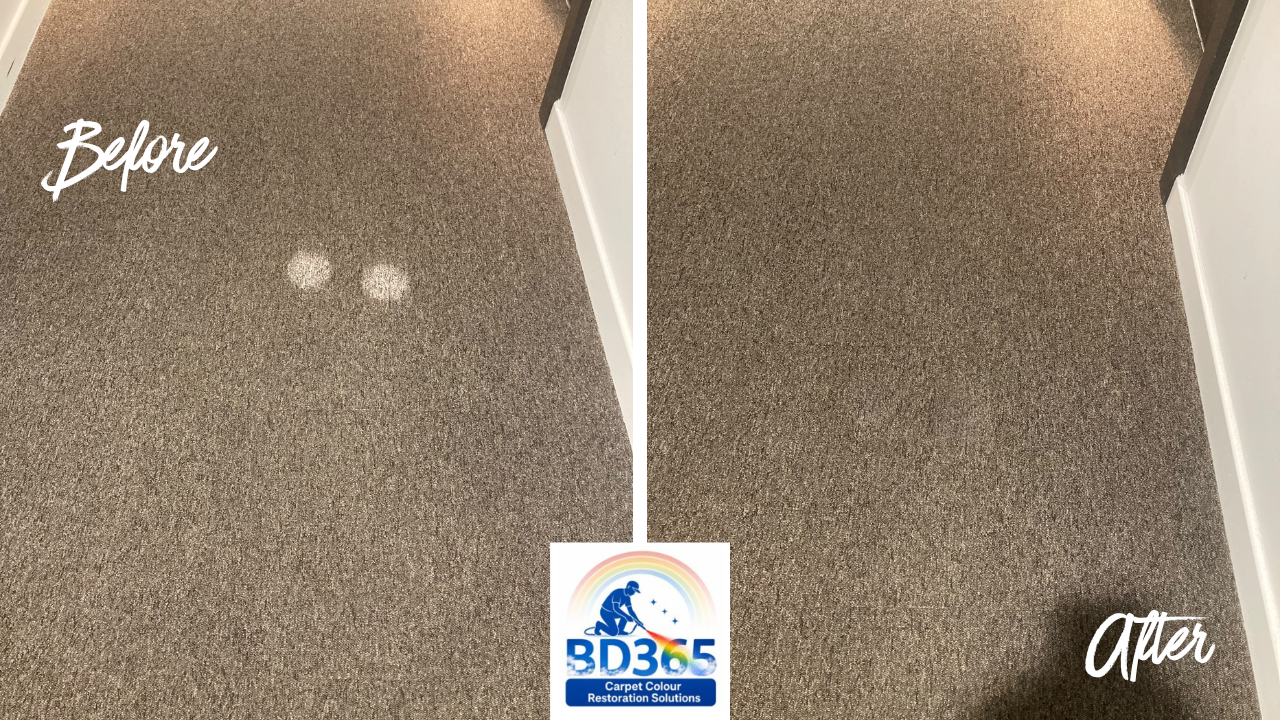
However, some contain oxygen-based bleaching agents. These are intended to help break down marks. On certain carpets, fibres, dyes or incorrect applications, oxidising formulas can also alter the carpet colour or leave a pale patch.
That does not mean every use will damage every carpet. It does mean you should:
- Check the label carefully
- Follow the instructions
- Avoid leaving the product on for longer than stated
- Stop if the carpet colour changes
- Tell the restoration professional exactly what you used
A “colour-safe” claim is not a guarantee that every carpet, dye or situation will react identically. Carpet fibres differ. So do carpet dyes.
If Vanish or Dr Beckmann has caused a pale mark, do not try to correct it with another product. Take photos and ask for an assessment.
The label, not a frantic Reddit comment, should be your first safety reference. The professional assessment comes next.
Take the photos that actually help
A clear photo can save a surprising amount of time.
It may help BD365 understand whether the mark looks like localised colour loss, a regular stain, a residue problem, fading or something more serious.
For the best photo assessment, send:
One close-up
Show the damaged fibres clearly. Hold the phone directly above the area if possible.
Make sure the image is:
- In focus
- Well lit
- Taken without a filter
- Free from heavy flash
- Large enough to show the edges of the mark
One wider room shot
Show where the damage sits in the room.
This helps us understand:
- The size and position of the area
- Whether there are several marks
- The surrounding carpet colour
- Access and furniture considerations
- Whether the whole room is affected or just one patch
A second angle, if useful
Some pale marks look different depending on the direction of the pile and the light. One extra angle can be helpful, particularly for flattened, shiny or heavily worn carpet.
Natural daylight is best. Avoid colour correction, filters and dramatic flash. We need to see the carpet as it really is, not as your phone’s editing software thinks it should be.
Add the details behind the photo
Alongside the images, tell us:
- What caused the damage, if known
- When it happened
- Which product was involved
- How much was used
- How long it was left on the carpet
- What you have already tried
- The carpet fibre, if known
- The postcode or location
- Whether it is a home, rental property, hotel, office or other commercial space
This information helps create more realistic quote guidance.
A photo of a pale mark with no background is useful. A photo plus the product history is much better.
Letting agents and landlords: build an evidence pack at check-out
For estate agents, letting agents and landlords, a bleach spot is not only a cleaning problem. It can become a deposit dispute, a landlord conversation and a replacement quote.
At check-out, document the damage before anyone moves furniture or tries to hide it.
Your evidence pack should include:
- Check-in photographs
- Check-out photographs
- A close-up of the mark
- A wider room photograph
- The carpet’s approximate age, if known
- Notes about the condition of the rest of the carpet
- Any tenant or contractor comments
- Details of products used
- A professional restoration assessment or quote
This gives you a clearer comparison between the carpet’s original condition and its condition at check-out.
Before agreeing to a replacement bill of £600–£1,600, it is worth checking whether localised restoration is suitable. The final cost depends on the carpet and the damage, but a repair may be considerably less disruptive than uplift, disposal, fitting and replacing an otherwise usable carpet.
BD365 works with landlords, property managers and letting agents across the UK. Our free photo assessment can help establish whether carpet dyeing or bleach spot repair is worth exploring.
For more common questions, visit our carpet restoration FAQs.
Hotels and commercial properties: document before authorising replacement
The same preparation matters in hotels, offices, serviced accommodation and other commercial spaces.
A facilities manager or housekeeping team should record:
- The room, corridor or area affected
- The date the damage was discovered
- The likely cause
- Close-up and wide-angle photos
- Whether the carpet is patterned or plain
- Any cleaning products already used
- Whether the room needs to be taken out of service
- The required turnaround time
Do this before authorising a full carpet replacement.
A localised mark in a hotel room or corridor may be suitable for specialist colour restoration. That could reduce disruption, protect presentation standards and avoid replacing a larger area than necessary.

When restoration is not the answer
A responsible carpet restoration company should not promise that every carpet can be saved.
Replacement may be more sensible when:
- The carpet is threadbare or badly worn
- The fibres have melted or suffered physical damage
- The damage covers a large area
- The carpet is heavily contaminated
- The fibre is unsuitable for dyeing
- The carpet is already near the end of its useful life
- The required finish cannot be achieved through restoration
BD365 assesses the fibre, colour, condition and cause of damage before recommending the next step.
Sometimes that means carpet dyeing. Sometimes it means bleach spot repair. Sometimes it means colour restoration across a faded section.
And sometimes, honestly, it means replacement is the better option.
No pressure. No false hope. Just a sensible answer before you spend money.
Good photos beat a rushed replacement decision
When a carpet changes colour, the instinct is to clean harder or replace faster.
The better sequence is simpler:
- Stop touching it.
- Blot excess liquid if it is still wet.
- Keep people and pets away.
- Let it dry.
- Photograph the damage in natural daylight.
- Tell the professional what happened.
- Get an honest assessment before agreeing to replacement.
BD365 Carpet Colour Solutions specialises in professional carpet dyeing, bleach spot repair and carpet restoration for homes, rental properties, hotels and businesses nationwide.
Send your photos for a free initial assessment:
- Call: 0800 1931 365
- WhatsApp: 07561 700670
- Email: info@bd365.co.uk
- Free photo assessment: bd365carpetcoloursolutions.co.uk/#photoassessment
A few good photos could be the difference between restoring a useful carpet and replacing the whole thing.
Restore where possible. Replace only when necessary.