TLDR
Someone gets bleach on a carpet in a rental property or hotel room. The carpet range is discontinued. There is no remnant. Suddenly, one tiny pale mark appears to mean replacing the entire floor.
It sounds ridiculous. It happens all the time.
The good news? Professional bleach spot repair and carpet colour restoration can often save the carpet, the budget and the handover date. BD365 Carpet Colour Solutions covers the whole of the UK, not just one region, helping landlords, letting agents, hotel managers and homeowners restore rather than replace.
And yes, if you are thinking, “I got bleach on my carpet and it has stained”, there may be a much cheaper answer than a brand-new carpet.
The Reddit-style carpet nightmare
Picture the scene.
A tenant, cleaner or hotel guest notices a small pale mark on an otherwise perfectly serviceable carpet. It might be beside a bed, near a skirting board or tucked under a table.
The carpet itself is in good condition. It is not threadbare. It is not falling apart. It does not need replacing.
There is just one problem.
The range has been discontinued.
No matching roll is available. No remnant can be found. The supplier has moved on to a new collection. The landlord, letting agent or hotel manager is then told that the whole room, corridor or floor needs new carpet.
That little mark has suddenly become a very expensive problem.
It is the sort of story that appears on Reddit and makes everyone reply, “Surely there’s another option?”
There usually is.

Why a discontinued carpet does not automatically mean full replacement
Finding an exact match for an old carpet can be difficult. Even if the original style still exists somewhere, the dye lot, age and level of wear may be different.
A replacement patch can then stand out almost as much as the original bleach mark.
Replacing the entire room may solve the matching problem, but it creates several new ones:
- The cost of new carpet.
- Underlay, gripper rods and door bars.
- Furniture moving.
- Uplift and disposal.
- Fitting and finishing.
- Room or property downtime.
- Waste going to landfill.
- The hassle of organising everything before a sale, viewing or check-out.
For a typical UK room, full replacement can easily reach £600 to £1,600, depending on the carpet, room size, access and fitting requirements. Premium carpets and larger areas can cost more.
A small area of colour damage does not always justify that bill.
Bleach spot repair: putting the colour back
A normal stain adds something to the carpet. Coffee, wine, mud and food leave unwanted material behind.
Bleach damage is different. It removes or alters the carpet’s existing colour.
That is why ordinary cleaning is not enough.
You can clean the surrounding carpet until it looks immaculate, but the pale patch may remain. In fact, making the rest of the carpet cleaner can sometimes make the bleach mark look even more obvious.
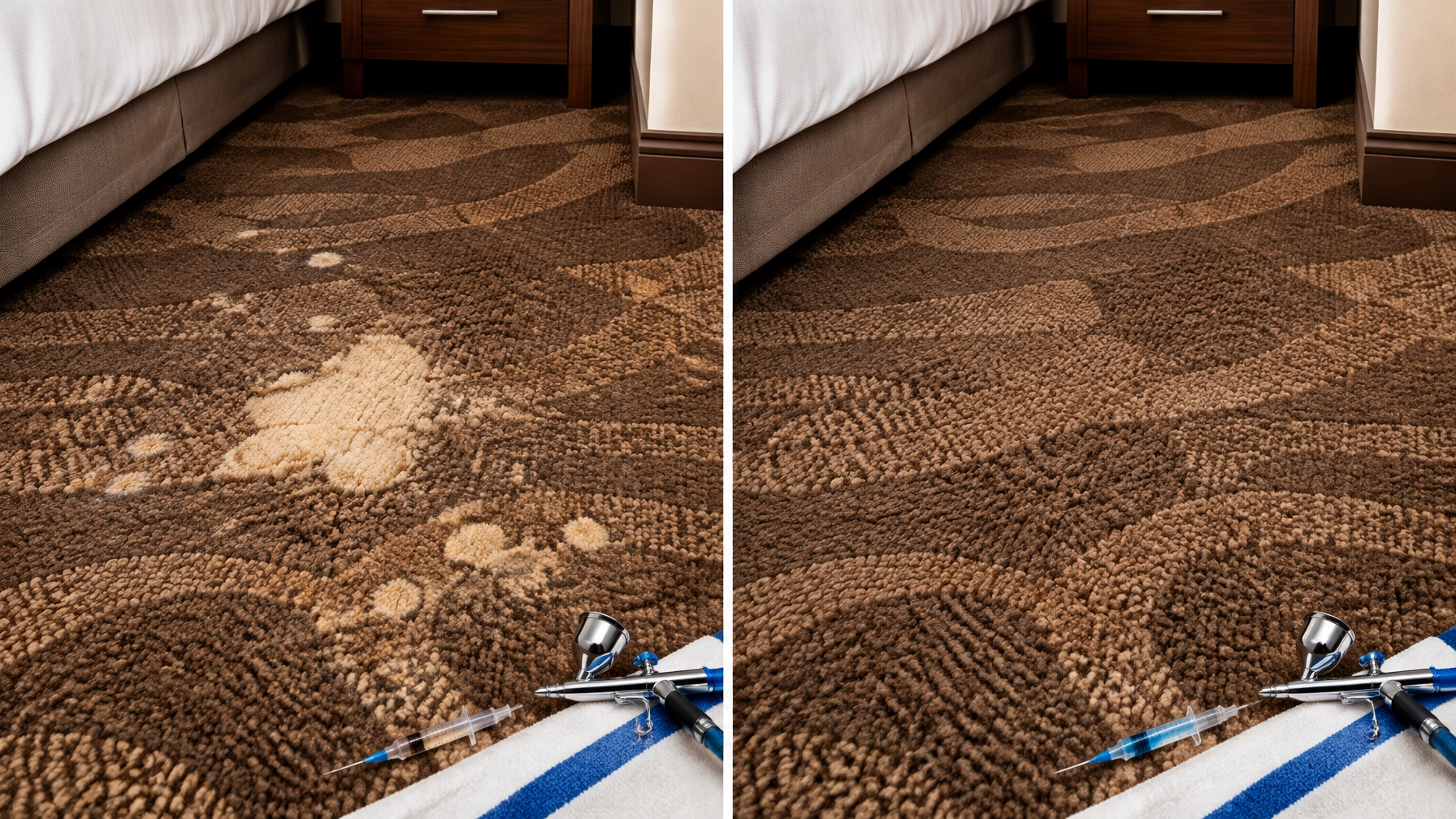
Professional carpet dyeing takes a different approach. Rather than trying to wash the mark away, a trained specialist assesses the carpet fibre, the original shade, the pattern and the level of damage.
The missing colour can then be carefully rebuilt using specialist techniques.
At BD365, our carpet restoration services include:
- Targeted bleach spot repair.
- Professional carpet dyeing.
- Carpet recolouring.
- Faded area restoration.
- Full carpet colour restoration.
- Colour matching on plain and patterned carpets.
The aim is not to cover the damage with a suspicious-looking blob. It is to blend the repaired area into the surrounding carpet so the eye stops being drawn to it.
Patterned carpets are not automatically a write-off
Patterned carpets can look intimidating when they suffer bleach damage.
A pale mark across a plain beige carpet is one thing. A light patch crossing several shapes, lines or tones can look like a much bigger job.
However, a pattern can also help disguise a carefully completed repair. The surrounding design gives the eye more information to process, while professional colour matching helps restore the missing tones.
This is especially useful in:
- Hotel corridors.
- Guest bedrooms.
- Rental properties.
- Offices and communal areas.
- Function rooms.
- Stairs and landings.
- High-end homes with distinctive carpet designs.
The repair method depends on the carpet. No reputable specialist should promise that every mark will become completely invisible without first assessing the damage.
But “the carpet is discontinued” is not the same as “the carpet cannot be saved”.

The DIY disasters that create the original problem
Many bleach spots begin with good intentions.
Someone is trying to remove a mark before a viewing. A cleaner is tackling a stubborn stain before a guest arrives. A tenant wants to avoid losing a deposit.
Then the bathroom bleach comes out.
Other common causes include:
- Bathroom or toilet cleaner splashing onto carpet.
- Peroxide-based products lightening carpet fibres.
- Strong disinfectant or mould remover.
- Acne products containing peroxide.
- Hair or fabric products transferring colour or chemicals.
- Store-bought stain spotters such as Vanish or Dr. Beckmann being over-applied, left too long or used on an unsuitable carpet.
Vanish and Dr. Beckmann products are designed for particular types of stains and applications. They are not colour restoration products. On some carpets, incorrect use can leave a lightened or bleaching-like mark, especially when the product is concentrated, repeatedly applied or not fully removed.
So if your search is “I got bleach on my carpet and it has stained”, do not assume another bottle from the cleaning cupboard will put the colour back.
More chemicals can mean more damage.
The same applies to marker pens, fabric dye and internet “hacks”. A colour that looks close under one light can look completely wrong in daylight. It may bleed, fade or create a darker outline around the original spot.
A small professional repair is usually easier before a DIY experiment turns it into a larger one.
Restoration versus replacement: the practical comparison
Professional carpet restoration is not always the right answer. If a carpet is threadbare, badly worn, physically melted or already due for replacement, a new floor may be sensible.
But where the carpet is structurally sound, restoration can offer a much better balance of cost and disruption.
BD365’s published guidance gives typical starting ranges of around:
- £80–£150 for one small bleach spot.
- £150–£250 for several small spots.
- £300 or more for larger or more complex areas.
These are guides, not fixed prices. Fibre type, pattern, accessibility and damage severity all matter. A photo assessment helps establish whether the carpet is suitable.
Compared with a possible £600–£1,600 replacement bill, the difference can be significant.
That matters when you are:
- Preparing a rental property for new tenants.
- Trying to protect a landlord’s margin.
- Turning around a hotel room.
- Dealing with an insurance claim.
- Getting a property ready for sale.
- Managing several rooms across a commercial site.
Hotel carpet repair without closing the whole operation
Hotels cannot always wait for a full flooring project.
Replacing a bedroom carpet may mean taking the room out of service, moving furniture, arranging a fitter and dealing with drying or finishing time. Multiply that across several rooms and the lost revenue soon becomes part of the bill.
Where the carpet and damage are suitable, hotel carpet restoration can be a faster route.
BD365 can often arrange same-day or next-day hotel room repair, subject to location, availability, access and the size of the job. A small bleach spot may be dealt with far more quickly than a full replacement programme.
That means fewer closed rooms, less disruption for guests and a better-looking space without ripping out a perfectly usable floor.
The sustainability case for restoring
There is also a straightforward environmental argument.
Replacing an entire carpet because of one small bleach spot means manufacturing, transporting, fitting and disposing of materials that may still have years of useful life left.
Choosing eco-friendly carpet restoration helps:
- Reduce carpet waste.
- Avoid unnecessary manufacturing.
- Extend the life of existing flooring.
- Reduce disruption and transport.
- Keep usable materials out of landfill.
BD365 uses eco-friendly dyeing techniques designed to be safe for homes, children and pets once the work is complete. It is a practical way to make a more sustainable choice without compromising on appearance.
A sensible next step for landlords, agents and hotel managers
If you find a bleach spot, do not panic and do not reach for five more products.
Take clear photos in natural light. Include:
- A close-up of the damage.
- A wider image showing where it sits in the room.
- Any information about the carpet’s age, brand or pattern.
- Details of what caused the mark and what has already been used.
Then ask whether professional bleach spot repair or carpet colour restoration is suitable.
BD365 works nationwide across the UK with homeowners, estate agents, letting agents, landlords, hotel managers, business owners and insurance-related projects.
You can read more in our guide to how much it costs to fix a bleach spot on carpet, explore the carpet restoration FAQs, or contact BD365 for a photo assessment.
The carpet may be discontinued.
That does not mean the whole floor has to be.
Sometimes, the smartest way to save the sale, protect the budget and avoid unnecessary waste is simply to restore over replace.
