TL;DR
A bleach spot does not always turn white. It can look orange, yellow, peach, pink or brown, depending on the carpet’s dyes, fibre and the chemicals involved. Wool can yellow when bleach affects the fibre itself; on some synthetic carpets, bleach mainly removes dye, leaving a pale or white patch. The colour can also look different as it dries or under different lighting.
More bleach or layers of shop-bought spotters such as Vanish or Dr. Beckmann can make the damage harder to assess and restore. BD365 specialises in carpet restoration, professional carpet dyeing and bleach spot repair for homes, hotels, landlords, letting agents and businesses. We offer nationwide UK coverage and free initial photo assessments.
Send us a room view, a close-up, your location and what happened.
“I used a tiny bit of bleach and now there’s an orange stain”
This is a familiar kind of Reddit panic. You expected a white mark. Instead, there’s an orange patch on the landing carpet, a peach-coloured patch in a guest room or a yellow streak across a hotel corridor.
The important thing to know is that a bleach spot is usually not a stain sitting on the carpet. It is a change to the colour in the fibres. Bleach can alter or remove parts of the carpet’s dye, and the result depends on the carpet’s original colour and how its dyes respond.
A brown carpet, for example, is made up of colour components. If some are affected more than others, the remaining colour can look orange or yellow rather than white. Industry guidance describes this kind of colour loss as happening in stages, with blue often disappearing before red and yellow. That is a useful general explanation, not a colour chart that can identify every carpet. The fibre, dye and product all matter.
Carpet colour loss explained by Cleanfax and bleach discolouration explained by Cleaning & Maintenance Management both describe chemical colour loss as something cleaning alone cannot correct.

Why wool can turn yellow, while other carpets may go pale
A common question is: “Why is my wool carpet yellow, not white?”
Wool is a protein fibre, so bleach may affect both the dye and the wool itself. That can create yellow or brownish discolouration. It may also weaken or change the feel of the fibres. A yellow patch on wool is therefore not always just a case of missing colour, and the condition of the pile needs to be assessed before anyone promises a result.
On some synthetic carpets, including certain nylon carpets, bleach damage may show mainly as dye loss. If a dye component is removed, the patch could look orange, pink, yellow or pale. Some spots eventually look almost white. Synthetic carpet is not automatically bleach-proof: different fibres, colours and manufacturing methods respond differently.
That is why a photo can help with an initial assessment, but it cannot always confirm the fibre or guarantee how a repair will look. BD365 will assess the carpet and explain whether professional carpet dyeing or another carpet restoration service is suitable.
“It looked white yesterday, now it’s yellow”
A colour shift can be unsettling, but it does not necessarily mean the carpet is suddenly getting worse. A patch can appear different as it dries, under warmer or cooler lighting, or when the pile catches the light from another direction. A brownish or yellowed patch may also reflect the original dye mix or, with wool, a reaction involving the fibre.
If the area has been treated with bleach or another product, residue may complicate the picture. Some stain spotters contain oxidising ingredients, but formulas vary. Layering products can add more chemicals, leave residue, affect nearby colour or make the original damage harder to assess. This applies to products such as Vanish, Dr. Beckmann and similar spot removers: they are designed for particular cleaning jobs, but repeated use on a chemically altered carpet can create further problems.
And please resist the tempting follow-up: “Will more bleach make it even?” It can remove more colour, enlarge the affected area or further damage wool. It will not reliably make the patch match. Adding another cleaner may also introduce a new colour or residue issue.
The safest next step is to stop applying products and ask a carpet restoration specialist to assess the damage. For more on why washing is not the same as restoring colour, see our guide: Can bleach stains on carpet actually be removed?
Hotel, rental or home: a patch does not automatically mean a new carpet
“I’m a hotel manager. Do we have to shut the room and replace the whole floor?”
Not necessarily. If the carpet is otherwise sound and suitable for treatment, targeted hotel carpet restoration may be a much smaller project than replacing a whole room or corridor. A localised repair can help protect presentation while limiting room downtime. Important when an out-of-service room means lost revenue or extra pressure on housekeeping and operations.
For landlords, letting agents and estate agents, a visible mark can quickly become a move-out dispute or a replacement quote. For homeowners, it can feel as if one small accident has ruined the room. But the cost of replacement is more than the carpet itself. It can include:
- Uplifting and disposing of the existing carpet
- New carpet, underlay and fitting
- Moving furniture and putting the room back together
- Room or corridor downtime
- Finding a close match if the original carpet has been discontinued
If the carpet fibres are still in good condition, bleach spot repair or carpet colour restoration may be a practical alternative. Not every carpet is suitable, and a result cannot be guaranteed from a headline or a photo alone. An honest assessment comes first.


Why professional restoration is a better bet than another experiment
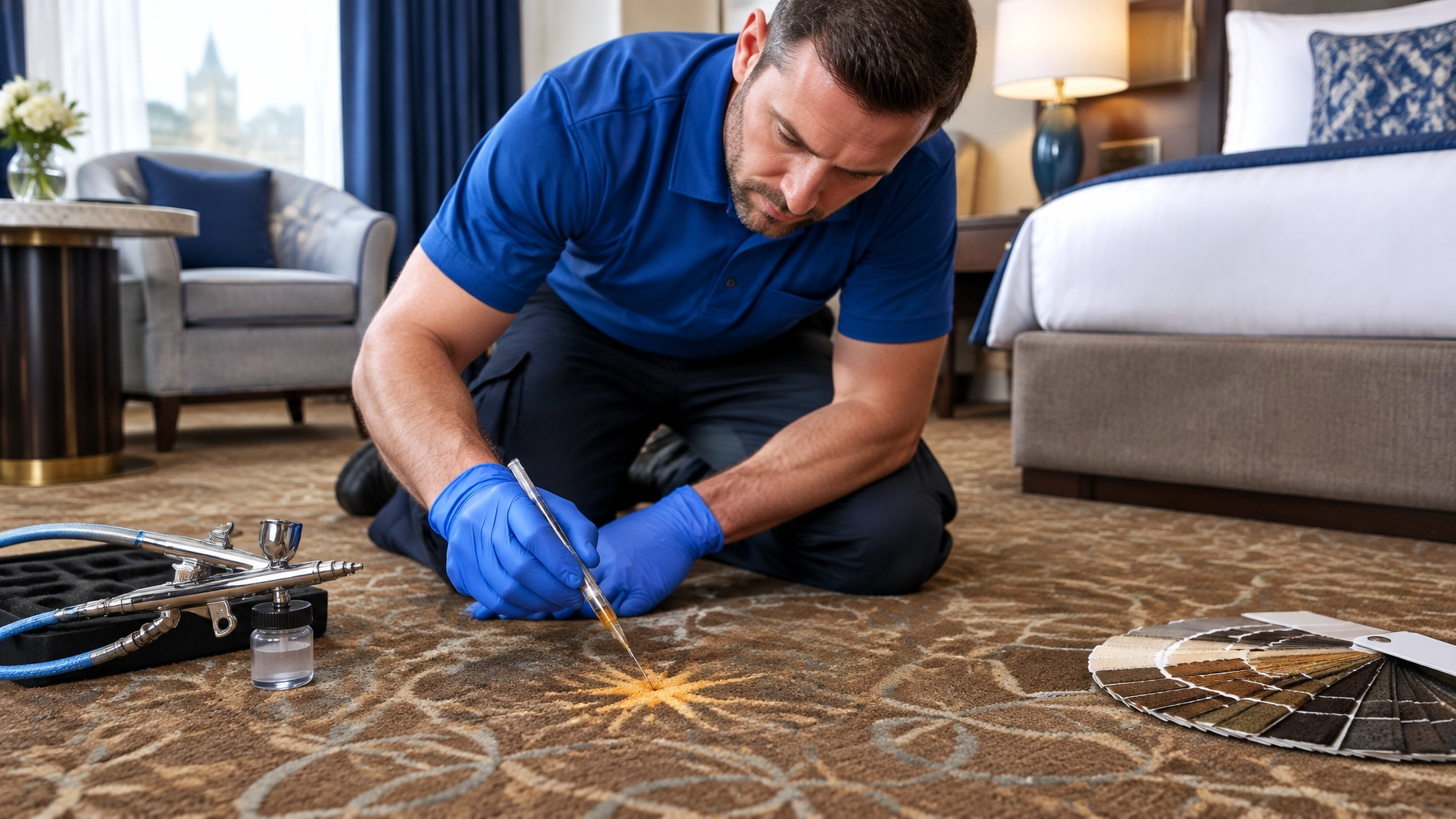
Professional carpet dyeing is not the same as cleaning. Cleaning lifts soil; colour restoration addresses colour that has been changed or lost. BD365’s expertise includes carpet dyeing, bleach spot repair and colour restoration. The approach depends on the carpet, its condition and the damage.
Professional colour matching matters, especially on patterned carpets or in premium interiors. A repair needs to work with the surrounding tones, not simply cover an orange patch with a darker mark. Where a carpet is suitable, specialist colour work can improve the appearance while keeping a usable floor in place.
BD365 uses eco-friendly dyes described as safe for children and pets once dry, and aims for a fast turnaround to reduce disruption. Restoring rather than replacing can also help reduce waste. The result will depend on the carpet and the damage; a responsible specialist will explain what is realistic rather than promise that every repair will be invisible.

“My landlord says the whole carpet needs replacing”
Before agreeing to a full replacement, ask whether the carpet itself is still sound and whether a professional assessment is possible. The right option depends on the fibre, colour, size and location of the damage, as well as the condition of the rest of the carpet. Sometimes restoration is suitable; sometimes it is not. Either way, an informed assessment is better than assuming one discoloured patch means the whole floor has to go.
BD365 provides carpet restoration services across the UK for homeowners, hotel managers, landlords, letting agents, estate agents and business owners. To request a free initial photo assessment, send:
- A room or corridor view
- A close-up of the patch
- Your location
- What happened, including any products already used
Contact BD365 Carpet Colour Solutions on 0800 1931 365, WhatsApp 07561 700670, or email info@bd365.co.uk. You can also visit bd365carpetcoloursolutions.co.uk.
A bleach spot turning orange is alarming. It does not automatically mean the carpet is beyond help, or that the whole floor needs replacing. Get a professional opinion before the panic turns into a bigger project.