TLDR
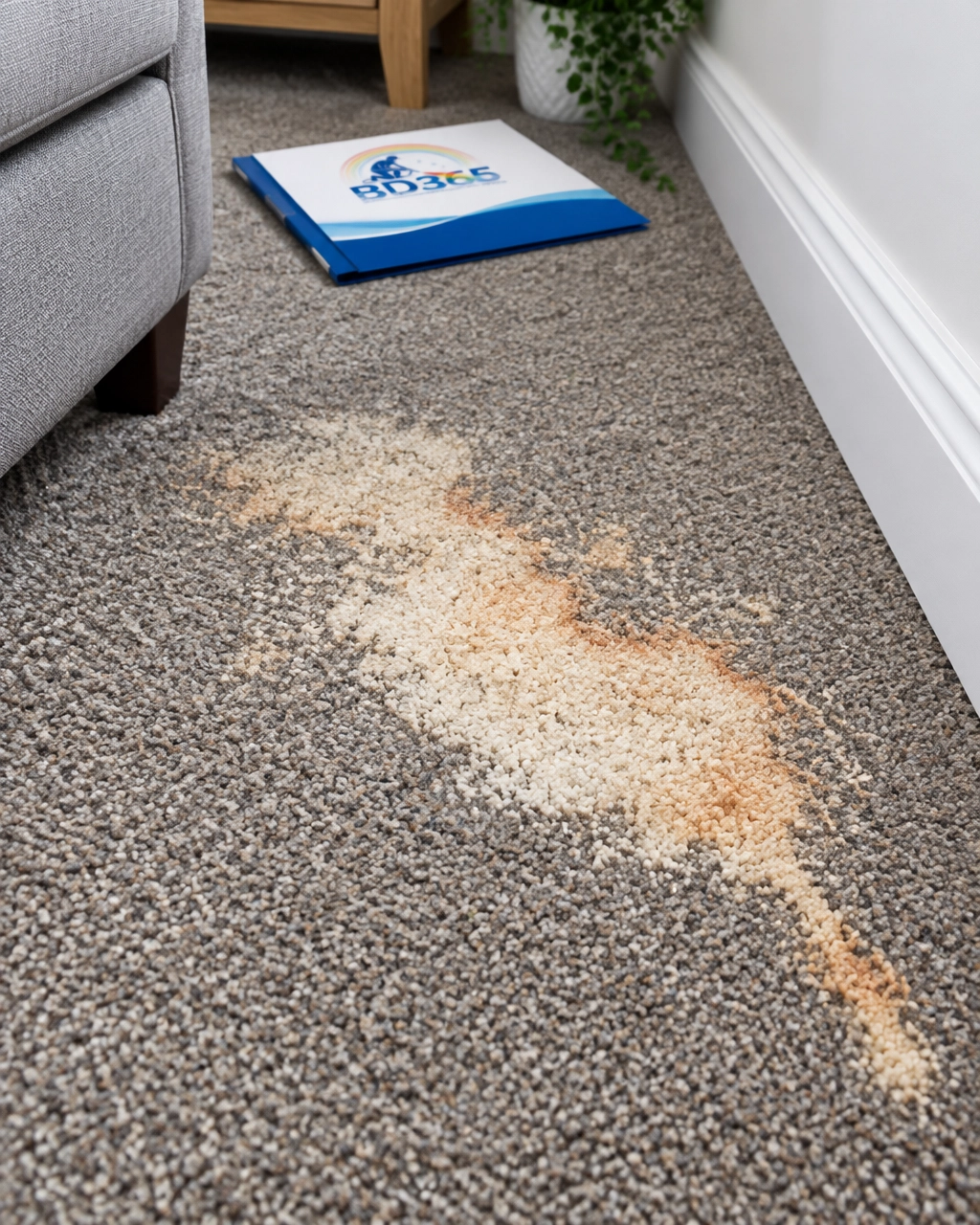
If you have searched “I got bleach on my carpet and it has stained”, the first thing to know is that it usually is not a stain. It is colour loss. Scrubbing, steam cleaning and adding more products cannot put the missing pigment back.
Blot any fresh liquid, do not scrub, let the area dry and take clear photos in natural daylight. Then ask a specialist about professional bleach spot repair, carpet dyeing or wider carpet restoration.
BD365 Carpet Colour Solutions helps homeowners, landlords, letting agents, hotels and businesses across the UK restore suitable carpets instead of replacing them. Nationwide coverage is available, with photo assessments to help you understand your options before spending money on a new floor.
The pale patch that stops you in your tracks
It may begin with one quick glance.
A white mark beside the sofa. A yellow patch outside a hotel bathroom. A pale trail along a corridor. Perhaps a bottle tipped over, a cleaning spray landed in the wrong place or a supermarket spotter was left on too long.
Then comes the panic search:
“I got bleach on my carpet and it has stained. How do I fix it?”
Here is the honest answer. You cannot clean colour back into a carpet.
Bleach and other oxidising chemicals can remove or alter the original dye in carpet fibres. The result may be white, cream, yellow, orange or simply much paler than the surrounding area.
It looks like a stain. But the chemistry is different.
Bleach damage is colour loss, not dirt
A normal stain adds something to the carpet. Coffee, mud, food and oil leave unwanted material behind. Cleaning is designed to remove that material.
Bleach damage is usually the opposite. The original colour has been changed or stripped away.
That is why:
- Scrubbing does not restore the missing pigment.
- Steam cleaning does not restore the missing pigment.
- Extraction does not restore the missing pigment.
- More stain remover may make the pale area larger or more obvious.
Our guide to the difference between a bleach spot and a regular stain explains the distinction in more detail.
It is also worth reading Does steam cleaning remove bleach spots?. Spoiler: it does not. Steam cleaning can remove soil around the damaged area, which sometimes makes the colour loss stand out even more.

What to do immediately
This is not a DIY repair plan. It is a damage-control plan.
If the spill has just happened:
- Blot gently with a clean, dry white cloth.
- Do not scrub. Rubbing can spread liquid and disturb the pile.
- Do not add another product. More chemistry is rarely the answer.
- Let the area dry naturally.
- Take photographs in natural daylight.
- Stop before the second attempt.
Take one close-up and one wider room view. Include a familiar object for scale if helpful.
The photographs can help a specialist understand the size, location and pattern of the damage. They also provide useful evidence for landlords, letting agents, housekeeping teams and property managers.
What makes bleach spots worse?
A small repairable mark can become a much more complicated job after a few enthusiastic experiments.
Scrubbing
Aggressive brushing can spread a liquid halo and roughen the carpet pile. Damaged fibres may reflect light differently, making the area appear even paler.
Bleach-on-bleach
Adding more bleach will not make the original bleach disappear. It may remove more colour and extend the damaged area.
Sharpies and shoe polish
These are not carpet dyes. They can leave harsh, opaque marks that bleed, transfer or sit visibly on top of the pile.
Hair dye and DIY dye kits
Household dye products are made for different materials and different conditions. They rarely match carpet colour reliably. They can also leave a second, darker mark for a professional to correct.
Over-applied supermarket spotters
Products such as Vanish Oxi-Action carpet spray and Dr Beckmann Carpet Stain Remover are intended for suitable everyday stains. They are not colour-restoration products.
Used correctly and according to the label, they may be appropriate for a normal carpet stain. But oxygen-based products can also lighten carpet dye, particularly where the colour has already been weakened.
Always:
- Check that the product is suitable for your carpet.
- Follow the label.
- Test colour fastness in a hidden area first.
- Stop if the colour changes.
- Tell the specialist what has already been used.
The more products applied, the more important residue assessment becomes.
What actually works? Professional colour restoration
Professional restoration is about rebuilding the appearance of the carpet, not pretending the mark is dirt.
At BD365, our carpet restoration team starts with assessment rather than promises. The process may include:
1. Fibre and construction assessment
We look at the carpet fibre, pile, backing, pattern, age and general condition. Wool, nylon, polypropylene and polyester can respond very differently to colour work.
2. Residue and product checks
We need to know what caused the damage and what has been applied since. Previous bleach, stain removers, hair products or DIY dyes can affect the result.
3. Expert colour matching
The target is the actual carpet in front of us. Not a stock colour chart. Not a photograph on a phone screen.
Lighting, wear, pile direction and surrounding fading all matter. We assess the existing colour and how the damaged area sits within the room.
4. Agreeing a physical sample
Where appropriate, a physical sample or test area helps establish whether the carpet is suitable and what result is realistic.
This is important. A good specialist should explain the likely outcome before proceeding.
5. Controlled application
For suitable carpets, colour may be applied carefully with professional tools, including fine syringes and airbrushes. The colour is worked into the affected fibres and blended with the surrounding pile and pattern.
The goal is not to paint over the top. It is to make the repair sit naturally within the carpet.
BD365 specialises in professional carpet dyeing, bleach spot repair and carpet colour restoration. Our techniques are designed for high-quality results, with eco-conscious methods suitable for family and commercial environments.

What restoration cannot do
Restoration is powerful, but it is not magic. Dye can restore colour. It cannot rebuild missing carpet structure.
A repair may not be suitable where the carpet is:
- Worn through or threadbare.
- Melted or heat-damaged.
- Torn or physically cut.
- Crushed or badly perished.
- Affected by failed seams or backing damage.
- Heavily contaminated with pet urine or another substance.
- Made from an unsuitable polypropylene or polyester construction.
- Damaged across such a wide area that a consistent blend is unlikely.
Pet urine and other contamination may need separate treatment before colour work is considered.
Nothing should be promised until the carpet, fibre and damage have been assessed. Sometimes the best answer is restoration. Sometimes it is patching. Sometimes replacement is the sensible choice.
The cost: repair versus replacing everything
For a localised mark, restoration can be far more economical than replacing a complete room.
As a guide:
- One small localised spot: around £80–£150.
- Several spots or a larger area: around £150–£250.
- Large, complex or pattern-matching work: £300+.
These are guide ranges, not fixed prices. Size, access, fibre, colour complexity and testing all affect the quote.
Replacing a room can easily reach approximately £600–£1,600+ once you include:
- New carpet.
- Underlay.
- Gripper rods.
- Door bars.
- Measuring and ordering.
- Fitting.
- Uplift and disposal.
- Furniture movement.
- Minimum order quantities.
- Room downtime.
Our guide to the cost of fixing a bleach spot on carpet explains why a photograph is the best starting point for an accurate estimate.
Why hotels should act quickly
In a hotel, a bleach mark is not just a cosmetic nuisance.
A pale patch in a guest room can affect presentation and reviews. A drip trail in a corridor can be noticed by guests, photographers and event organisers. A damaged function-room carpet can become awkward during a busy booking period.
Professional restoration may help reduce:
- Room downtime.
- Lost bookings.
- Guest complaints.
- Negative reviews.
- Disruption from furniture movement.
- The cost of replacing a wider area.

Landlords and letting agents
Rental properties bring a different set of pressures.
A bleach spot may appear during a check-out inspection. The question then becomes whether the carpet needs replacing, whether the damage can be repaired and how quickly the property can be re-let.
A photo assessment can help landlords, agents and property managers understand whether restoration is worth exploring before:
- Making a deposit decision.
- Ordering replacement carpet.
- Starting a void-period refurbishment.
- Delaying a new tenancy.
- Treating a localised issue as a full-room failure.
Clear photographs, the location of the mark and details of what caused it are especially useful.
Homeowners: one room does not need a full refit
For homeowners, the appeal is simple.
You may love the carpet. It may be part of an expensive room scheme. It may be perfectly healthy apart from one unfortunate patch beside the bathroom door.
Replacing everything because of one mark can feel excessive. Professional carpet restoration gives you another option: repair the colour, keep the carpet and avoid a much bigger project.
When replacement really is the right call
We are firmly in the restore-over-replace camp. But replacement is sometimes the honest answer.
It may be the better option where there is:
- Widespread water damage or mould.
- Perished backing.
- Failed seams.
- Melted or heavily worn pile.
- Severe contamination.
- An unsuitable fibre.
- Damage over too large an area for a consistent blend.
- A carpet already near the end of its useful life.
A reputable specialist should tell you when restoration is unlikely to deliver good value.
A more sustainable choice
A serviceable carpet should not automatically become waste because of one pale mark.
Restoration can help keep carpet out of landfill, avoid new material and reduce the disruption involved in manufacturing, transporting and fitting a replacement. It can also reduce the furniture movement and room downtime that come with a full refit.
It is a practical choice as well as an environmental one.
Send photos for a free assessment
If you need to fix bleach spots on carpet, do not panic and do not reach for another bottle.
Send BD365:
- One close-up photograph.
- One wider room view.
- The carpet’s location.
- What happened.
- Details of any products already used.
We will take an honest first look and explain whether carpet dyeing, bleach spot repair or wider carpet restoration may be suitable.
Call: 0800 1931 365
WhatsApp: 07561 700670
Email: info@bd365.co.uk
You can also use the BD365 free photo assessment.
Restore where you can. Replace only when you need to.