TL;DR
Pale patches on corridor carpet are often colour loss, not dirt. In care homes, clinics and other healthcare settings, chlorine-based disinfectants, hypochlorite products, trolley leaks and cleaning residues can strip carpet dye.
That does not always mean the whole corridor needs replacing.
BD365 Carpet Colour Solutions provides professional carpet dyeing, bleach spot repair and carpet restoration across the UK. We can assess localised damage, agree a colour sample and restore suitable carpet in phased sections, helping managers avoid unnecessary closures, resident moves and major replacement costs.
The key is to assess the carpet properly first. Restoration is not suitable for every floor, particularly where the fibre, backing or hygiene requirements make replacement the safer long-term option.
The pale patches nobody wants to find before an inspection
It is often noticed during a CQC-preparation walkround.
Or an estates review.
A manager spots a pale, uneven patch outside a treatment room. Further along the corridor, there is another mark beside the skirting. Then a faint trail appears along the usual trolley route.
The corridor is otherwise in good condition. The carpet runs continuously for many metres. Replacing one small section would leave an obvious join. Replacing the whole route would mean contractors, equipment removal and disruption for residents, staff and visitors.
In a clinic, the same issue might appear outside a consulting room or along the route between reception and treatment areas.
There may be no practical way to close the corridor for a full refit.
That is where a proper assessment matters. A pale patch may be suitable for professional carpet restoration rather than wholesale replacement.

Why care and clinical settings are particularly vulnerable
Care homes and clinics have demanding cleaning routines. Those routines are essential and must always follow the site’s infection prevention and control procedures.
However, the same cleaning environment can be hard on carpet.
Common causes of pale patches include:
- Chlorine-based disinfectants and hypochlorite products.
- Spray-and-wipe applications near soft flooring.
- Fogging or misting carried close to carpeted areas.
- Cleaning trolleys and caddies parked on corridor carpet.
- Leaking bottles, containers or trolley wheels.
- Residue tracked by commodes, hoists and wheelchairs.
- Commode and toilet-cleaner drip trails.
- Spillage from clinical products.
- Repeated trolley traffic along one route every day.
- Small splashes that are missed during a busy shift.
A single drop can create a small pale mark. A leaking bottle can create a long trail. Repeated exposure may create a broad faded area that looks like wear.
The problem can be especially visible where one pale patch sits in the middle of an otherwise consistent corridor run.
NHS Employers’ guidance on the safe use of chlorine-based disinfectant chemicals highlights the importance of risk assessment, correct handling, suitable controls and communication between healthcare organisations and cleaning contractors. The same joined-up approach is valuable when protecting flooring from accidental chemical damage.
Colour loss is not the same as dirt
A normal stain adds something to the carpet.
Coffee, food, mud or other substances sit on or within the fibres. Cleaning and extraction may remove some or all of that material.
A bleach spot is different. The chemical can alter or remove the original dye.
That is why a pale mark may remain after thorough cleaning. There is no ordinary dirt left to extract. The colour itself has been affected.
Read our guide to the difference between a bleach spot and a regular stain for a clearer comparison.
Steam extraction can still be appropriate for general carpet maintenance when carried out under the site’s approved cleaning regime. However, it cannot put missing pigment back into a fibre. In fact, the pale patch can look more noticeable after the surrounding carpet has been cleaned.
Our guide explains why steam cleaning does not remove bleach spots.
Why the mark matters beyond appearance
A pale patch is not automatically a hygiene risk.
The concern is usually presentation, standards and operational disruption.
Corridors are highly visible spaces. They are used by residents, relatives, staff, contractors and visitors. A collection of unexplained pale marks can make an otherwise well-managed environment look tired or poorly maintained.
That can affect:
- Family and visitor confidence.
- Internal estates reviews.
- Cleaning audits.
- Pre-inspection preparation.
- Contractor performance discussions.
- The overall impression of the home or clinic.
In a care setting, the disruption caused by replacement can be just as important as the appearance of the carpet.
Residents may need to be redirected. Equipment may need to be moved. Handrails and specialist fittings can complicate access. Medication rounds, meals and daily routines still need to continue.
A full corridor refit is not simply a flooring job. It is a coordination exercise in an occupied environment.
Restoration can avoid closing a wing
Professional carpet restoration offers a different route where the carpet remains physically sound and suitable for the setting.
The work can often be:
- Phased in short sections.
- Completed overnight or during quieter periods.
- Planned around medication rounds and mealtimes.
- Coordinated with cleaning contractors and estates teams.
- Carried out without removing every handrail or specialist fitting.
- Matched into the existing continuous carpet run.
That last point is important.
Replacing one metre of carpet in a long corridor may create a new, visibly different strip beside older, faded flooring. Even if the replacement carpet is technically the same specification, it may not match the surrounding colour after years of cleaning and foot traffic.
Colour restoration works with the carpet already in place. The aim is to bring the damaged section back towards the surrounding run, rather than introduce a fresh, contrasting piece.
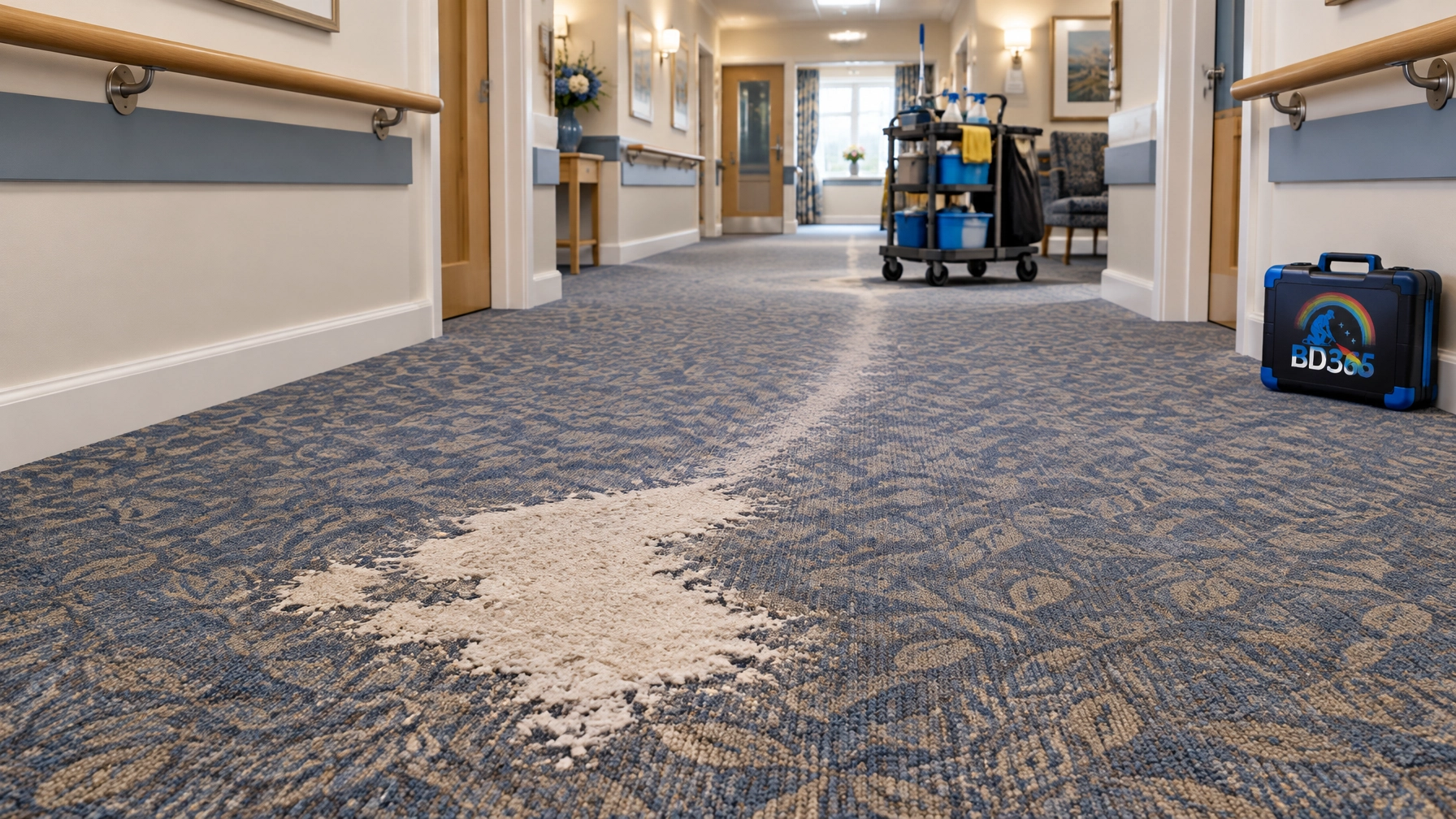
Here is an example of the type of patterned commercial corridor damage that can be assessed for localised restoration:

What professional carpet restoration involves
Every site should be assessed before any promise is made.
At BD365, the assessment considers:
-
Fibre and construction
The carpet fibre, pile, backing and general condition all affect whether restoration is appropriate. -
Chemical history
We need to know what products may have been used, where they were applied and whether residues may remain. -
The condition of the surrounding run
The target is not always the original factory colour. It is usually the current surrounding colour, taking age, traffic and fading into account. -
A physical sample
Where required, a sample can be agreed before larger work begins. This helps managers and facilities teams understand the intended result. -
Precision application
Professional dyeing may use controlled syringe and airbrush application, blended into the pile and surrounding pattern. -
A realistic recommendation
Dye can restore colour. It cannot rebuild worn, melted or crushed fibre.
The process must also take account of the carpet’s intended use. Some fibre types are unsuitable for successful recolouring. Some clinical or high-contamination areas may require a different flooring solution altogether.

Do not create a second problem with more chemicals
Store-bought spotters can sometimes make colour loss worse when they are over-applied or used on unsuitable fibres.
This includes oxygen-based products such as Vanish Oxi-Action and Dr Beckmann. They should always be used strictly according to the product label, with colour fastness considered first. Your cleaning contractor or restoration specialist should be told what has already been applied.
Bleach-based bathroom cleaners and mould products can also damage carpet colour if they reach a corridor or soft floor.
Do not keep adding products to a pale mark in an attempt to correct it. Record what happened and arrange an assessment through the appropriate site process. For chemical safety, always follow your own COSHH procedures, product instructions and infection-control guidance.
A practical checklist for managers and facilities teams
Use this checklist to reduce repeat damage:
- Photograph the area before further cleaning takes place.
- Record which disinfectant or cleaning product was used.
- Note where the product was applied and when.
- Keep chlorine products away from carpeted routes wherever site procedures allow.
- Use secondary containment trays for cleaning caddies and bottles.
- Check trolley wheels, containers and spray bottles for leaks.
- Add carpet chemical damage to cleaning-contractor inductions.
- Make sure contractors know how to report spills and near misses.
- Record recurring marks by corridor, location and shift.
- Review whether a particular trolley route or storage point is contributing to the problem.
- Share relevant findings with estates, housekeeping, IPC and contracted cleaning teams.
This is not about blaming a member of staff. Busy healthcare environments involve many teams and constant movement. Good records make recurring causes easier to identify.
What does restoration cost compared with a corridor refit?
Every job is assessed individually, but guide figures for localised restoration are often:
- £80–£150 for a small repair.
- £150–£250 for multiple localised areas.
- £300+ for larger or more complex work.
A corridor replacement quote can rise much further once the full scope is considered. Costs may include:
- Contract carpet.
- Underlay.
- Gripper and thresholds.
- Uplift and disposal.
- Fitting.
- Furniture and equipment removal.
- Handrail or specialist-fitting access.
- Minimum order quantities.
- Resident protection and movement.
- Out-of-hours working.
- Temporary route planning.
- Additional cleaning and sign-off.
Our guide to the cost of fixing bleach spots on carpet explains why a small repair can be considerably more economical than replacing an otherwise serviceable floor.
When replacement genuinely is the right call
Restoration is not always the answer.
Replacement may be the more appropriate option where there is:
- Perished or delaminated backing.
- Failed seams.
- Water damage or contamination.
- Worn, melted or heavily crushed pile.
- Widespread chemical damage.
- An unsuitable fibre.
- A carpet that cannot meet the site’s cleaning or maintenance requirements.
- A full refurbishment already planned.
- A corridor that requires a different, more suitable flooring system.
In clinical areas, flooring decisions should be made with the relevant estates and infection prevention and control teams. A colour repair should never override a documented requirement for a cleanable, suitable and resilient floor.
The same logic applies to hotels and offices
Care homes and clinics are not the only settings with long, busy corridors.
Hotels, offices, retirement housing and serviced accommodation also face:
- Cleaning trolley traffic.
- Disinfectant drips.
- Repeated wear along fixed routes.
- Pale marks noticed before an inspection or important visit.
- The high cost of closing a corridor or floor.
The principle is the same: if the carpet remains sound, a targeted restoration may protect both the appearance and the operating schedule.
A lower-waste option for suitable carpet
Replacing an entire corridor because of a few pale patches creates avoidable waste.
Restoration helps extend the useful life of existing carpet. It can reduce the demand for new materials, limit uplift and disposal, and support wider ESG and waste-reduction reporting.
It is not a substitute for the right clinical flooring specification. But where the existing carpet remains suitable and the problem is primarily colour loss, restoring rather than replacing is worth considering.
Speak to BD365 about corridor carpet restoration
BD365 Carpet Colour Solutions specialises in carpet dyeing, bleach spot repair and professional carpet restoration for commercial and residential clients across the UK.
We work with care homes, clinics, facilities teams, cleaning contractors, landlords and managing agents.
Send us photographs for a free initial assessment:
- Phone: 0800 1931 365
- WhatsApp: 07561 700670
- Email: info@bd365.co.uk
- Contact form: Request a carpet restoration assessment
A pale patch does not automatically mean a closed wing or a full corridor refit.
Assess first. Restore where appropriate. Replace only when it is genuinely the right decision.