TLDR
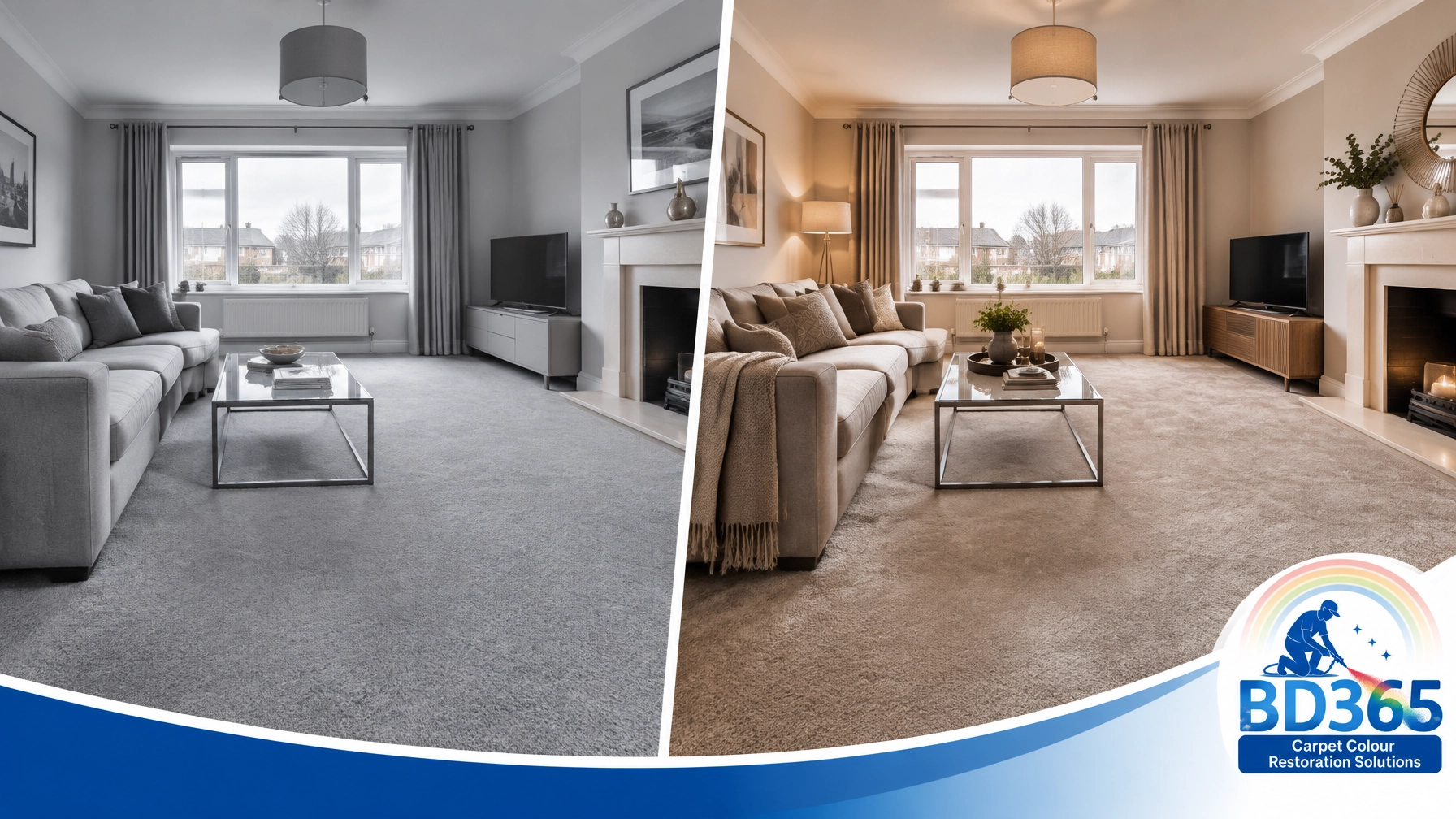
If your grey carpet is clean, comfortable and structurally sound but now feels cold and dated, you may not need a new floor. Professional carpet dyeing can recolour suitable carpets into warmer shades such as mushroom, oat, stone, taupe, greige, olive or terracotta-inspired neutrals. It can be quicker, less disruptive and more sustainable than replacement.
BD365 Carpet Colour Solutions provides carpet restoration services nationwide across the UK. Send photographs for a free, honest assessment before you pay for a full refit.
The carpet is fine. The colour is the problem.
Your carpet is not stained.
It is not worn through.
It is not damaged.
You simply no longer like the colour.
That is increasingly common with the cool blue-grey carpets fitted throughout the mid-2010s. They were once an easy, modern choice. Now, under changing interior schemes and cooler UK daylight, many look flat, clinical or slightly dated.
The challenge is that carpet is the biggest single surface in most rooms. Even when your walls, furniture and accessories have been updated, a cold grey floor can still dominate the space.
The good news? You may not need to remove it.
Professional carpet recolouring can change the appearance of a suitable existing carpet while keeping its useful life, comfort and fit.

Why warm neutrals are replacing cool grey
This is not just a personal impression. UK interior colour reporting for 2026 is highlighting a move towards warmer, more natural shades.
Crown Paints describes the rise of warm neutrals, including greige, warm taupe, mushroom, biscuit and soft terracotta. Other UK trend coverage is also pointing towards earthy, comforting palettes rather than stark whites and cool greys.
Popular directions include:
- Mushroom and soft taupe
- Oat and biscuit
- Warm stone
- Greige
- Muted olive
- Clay and terracotta
- Softened warm grey
These colours can feel more welcoming in living rooms, bedrooms, hallways and commercial interiors. They also work well with timber, brass, cream upholstery, natural linen and richer earthy accents.
You do not need to follow a trend blindly. The point is that if your grey carpet now fights against the rest of your room, changing the colour may be enough to make the whole space feel more current.
Recolouring versus replacing the carpet
The reflex is often: “We should just replace it.”
But full replacement involves much more than buying a new carpet. You may need to pay for:
- Measuring and ordering
- Finding a suitable replacement range
- Waiting for stock or delivery
- Moving furniture
- Uplifting the existing carpet
- Removing underlay and gripper issues
- Disposing of the old carpet
- Professional fitting
- Reconnecting door bars and thresholds
- Taking the room out of use
There is also the problem of discontinued ranges. If your current carpet runs through several rooms, stairs or landings, finding a close match can be difficult. Replacing one area may leave the rest looking mismatched.
Carpet recolouring avoids many of these steps. Where the carpet is suitable, professional dyeing can update the colour in situ, with less disruption and less waste.
It is not always the right answer. However, it is worth checking before you commit to a full refit.
Carpet restoration for landlords, letting agents and estate agents
A grey carpet that looks acceptable in person can photograph surprisingly poorly.
Cool grey floors often absorb light and make rental rooms look flatter and colder in online listings. That can affect first impressions, viewing appointments and the perceived quality of a property.
For landlords and letting agents, recolouring may be useful when:
- The carpet is in good physical condition but looks dated
- A property is between tenancies
- A neutral, warmer colour would improve the listing
- A full refit would extend the void period
- Matching the existing carpet is difficult
- You want to improve presentation without unnecessary waste
A faster carpet restoration service can help prepare a property between tenancies without the disruption of a full flooring project.
It may also help protect the deposit position. If a tenant has caused a localised bleach mark or chemical spot, there may be no need to replace an otherwise usable carpet. A professional assessment creates a more proportionate route: restore the damaged area where possible, rather than automatically charging for a whole new floor.
That is why BD365 offers specialist carpet restoration for landlords, letting agents and property managers across the UK.
Hotels, serviced accommodation and offices
Grey corridors and reception areas can become particularly noticeable in commercial settings.
A corridor may be clean and serviceable but still look tired in photographs. In hotels and serviced accommodation, that can affect the feeling of quality before guests even reach their room.
Replacing commercial carpet can also mean:
- Closing rooms or sections of a building
- Managing furniture and access
- Working around guests or staff
- Ordering large quantities of carpet
- Creating noise and disruption
- Losing valuable trading time
Professional carpet colour restoration may offer a more practical alternative for suitable flooring. It can help refresh faded areas, improve an uneven appearance or move a space away from a cold grey palette.
BD365 assesses carpets in hotels, offices, serviced accommodation, venues and other commercial spaces. The aim is not to promise perfection. It is to establish whether restoration can achieve a worthwhile improvement without a full refit.

“I got bleach on my carpet and it has stained”
If you are searching, “I got bleach on my carpet and it has stained,” the first thing to know is that bleach damage is usually not a normal stain.
A coffee stain adds colour or residue to the fibre. Bleach can remove or alter the carpet’s existing colour. That is why cleaning alone will not put the original shade back.
Bleach damage may appear white, yellow, orange or noticeably lighter than the surrounding carpet. It can be caused by liquid bleach, toilet cleaner, disinfectant, bathroom products or some strong cleaning chemicals.
Supermarket oxygen-based spotters, including products such as Vanish or Dr. Beckmann, can also create unexpected light patches on some carpet fibres or dyes. This does not mean these products are inherently unsuitable. Always follow the product label and check its intended use. However, a product designed to lift a stain can affect carpet colour if it is used on an unsuitable fibre, left too long, over-applied or not rinsed correctly.
The same applies to home carpet dye packs and DIY recolouring kits. Results can become patchy, too dark, too warm or visibly different under natural light. The surrounding pile may also become marked during application.
Avoid adding more chemicals to a pale patch. Take clear photographs and ask a specialist before attempting a further repair. BD365 provides dedicated bleach spot repair and colour restoration assessments.
What determines whether a carpet can be recoloured?
A free photo assessment is useful, but it cannot guarantee that every carpet can be dyed successfully. The main factors include:
Fibre type
Wool, nylon, polyester and polypropylene react differently to colour treatments. Some fibres accept dye more readily than others. The fibre may be listed on your original paperwork, or BD365 may be able to make an initial assessment from photographs and further checks.
Pile condition
A carpet can have a good colour match but still look poor if the pile is heavily worn, melted, crushed or frayed. Recolouring changes colour. It does not rebuild missing or physically damaged fibres.
Existing colour
Some carpets can be refreshed or moved towards a deeper, warmer shade. Others may be difficult to lighten or change dramatically. The starting colour, pattern and degree of fading all matter.
Cause of the colour change
Sun fading, chemical damage, cleaning residue and general unevenness each require a slightly different assessment.
For a free photo assessment, send:
- A close-up of the carpet
- A wider photo of the full room or area
- Images taken in natural daylight where possible
- The carpet’s fibre type, if known
- Details of any products used
- Your postcode and property type
Avoid filters and heavy flash. The more accurately BD365 can see the carpet, the more useful the initial advice will be.

When replacement genuinely is the right call
Restoration is not suitable for every carpet.
Replacement may be the better option when:
- The pile is worn through or badly damaged
- The carpet has melted, hardened or lost its structure
- There is widespread deterioration rather than a colour issue
- The backing or underlay has failed
- The carpet is heavily contaminated
- You already planned a full flooring redesign
- The required colour change is not realistic for the fibre
BD365’s approach is assessment-led. If professional carpet dyeing is unlikely to produce a worthwhile result, the team will explain that before you spend money.
Restore the carpet you already have
A cold grey carpet does not automatically need to go to landfill.
If the carpet is structurally sound, changing its colour could be a more cost-effective and sustainable option than measuring, ordering, fitting and disposing of a replacement. It may also reduce room downtime and help landlords, agents and businesses prepare spaces faster.
BD365 specialises in professional carpet dyeing, carpet colour restoration, bleach spot repair and eco-friendly carpet restoration for homes and businesses nationwide.

Request your free photo assessment
Send BD365 a few clear photographs before replacing the carpet.
- Freephone: 0800 1931 365
- WhatsApp: 07561 700670
- Email: info@bd365.co.uk
- Service area: Nationwide UK coverage
Send photos for a free carpet assessment
No pressure. No false hope. Just an honest view on whether your grey carpet can be given a warmer second chance.