TLDR
A professionally completed carpet colour restoration should blend naturally into the surrounding pile, rather than leave an obvious dyed patch. BD365 provides carpet dyeing, bleach spot repair and localised colour restoration for homes, rental properties, hotels and businesses across the UK. We match the colour against your actual carpet, test it in a hidden area and assess the fibre, fade, pattern and previous treatments before work begins. The honest answer is that no exact result can be promised until the carpet has been assessed. In many cases, restoration is still far more affordable, sustainable and practical than replacing an otherwise serviceable carpet.
The honest answer: usually not, but nobody should promise the impossible
This is the question we hear first.
“Will I be able to see where it’s been dyed?”
It is a fair concern. Nobody wants to replace one pale patch with a suspicious-looking brown blob. Especially not in a hallway, hotel room or living room where the light catches everything.
When carpet colour restoration is carried out properly, the aim is for the repaired area to blend into the surrounding carpet during normal use. A small repair may become very difficult to spot from standing height.
However, a responsible specialist will not promise that every repair will be completely invisible under every possible condition.
Carpet can look different in:
- Bright daylight.
- Warm hotel lighting.
- Evening light from one side.
- Different pile directions.
- Close-up photographs.
- Areas that have faded or worn unevenly.
That is why BD365 assesses the carpet before confirming what is achievable. The best repair is based on the real carpet in front of us. Not a generic colour chart. Not a guess from a phone screen.
Why DIY colour repairs often leave a visible patch
Most obvious DIY repairs have one of three problems.
1. The colour is close, but not close enough
A carpet that looks “beige” may contain several subtle tones. So may a charcoal, taupe, grey or brown carpet.
A marker pen, household dye or ready-made kit usually provides one flat colour. Your carpet may have depth, variation and movement in the pile.
The result can look darker in one direction and lighter in another. It may resemble a patch that has been painted on rather than colour that belongs in the fibre.
2. The product sits on top
Carpet is not a flat canvas.
Applying colour only to the surface can leave a hard edge. It may coat the tips of the tufts while failing to blend into the surrounding fibres.
This is particularly noticeable when the pile is brushed in a different direction. The repair catches the light, and there it is. Hello, DIY patch.
3. The surrounding carpet is ignored
A bleach spot is rarely an isolated colour problem. The carpet around it may have:
- Faded in sunlight.
- Darkened through foot traffic.
- Been cleaned several times.
- Picked up residue from previous stain treatments.
- Changed shade with age.
Matching the original colour from a brochure or leftover sample may therefore produce the wrong result. The correct reference is the carpet as it looks today.
What makes professional carpet colour restoration different?
At BD365 Carpet Colour Solutions, the process is centred on assessment and controlled blending.
We match against the actual carpet
The colour is assessed against the surrounding pile, taking into account its current condition. We look at the visible shade, the depth of colour and how it changes with pile direction and light.
This matters whether the job involves a single bleach mark, several splashes or a larger faded area.
We test in a discreet area
Before committing to the visible repair, a test can be carried out in a hidden or less noticeable location where appropriate.
This helps us understand how the fibre responds and whether the proposed result is suitable for the carpet in question.
We can agree a physical sample before work
For larger projects, full-room recolouring or important commercial areas, a physical sample can be checked against the carpet before the main work proceeds.
That gives homeowners, landlords, letting agents and hotel managers something much more useful than a verbal description. You can see the proposed direction of the colour match in the actual space.

Colour is applied into the pile, not simply painted over it
Professional carpet dyeing uses controlled application methods. Depending on the carpet and the repair, this can include precision syringes and airbrushes.
The colour is worked into the affected tufts and blended through the surrounding area. It is not simply brushed across the top like decorating a skirting board.
The technician also considers:
- Pile direction.
- The angle of the fibres.
- The way light falls across the area.
- The contrast between the repaired section and nearby tufts.
- Whether the carpet is plain, flecked, looped or patterned.

The fibre makes a real difference
No two carpets behave exactly the same way.
Wool, nylon, polyester and polypropylene can respond differently to colour restoration. The original colour and manufacturing process matter too.
A sound wool or nylon carpet may offer good potential for localised repair. Some synthetic carpets can be more difficult, particularly where the fibre is highly stain resistant or was coloured during manufacture.
The result can also be affected by:
- The original carpet colour.
- How much surrounding fade has occurred.
- The age of the carpet.
- Whether the fibres are worn, crushed or physically damaged.
- Whether bleach or another chemical is still active.
- Products previously applied to the area.
- The size and shape of the damaged section.
- The complexity of the pattern.
That last point is important.
What about patterned and multi-tone carpets?
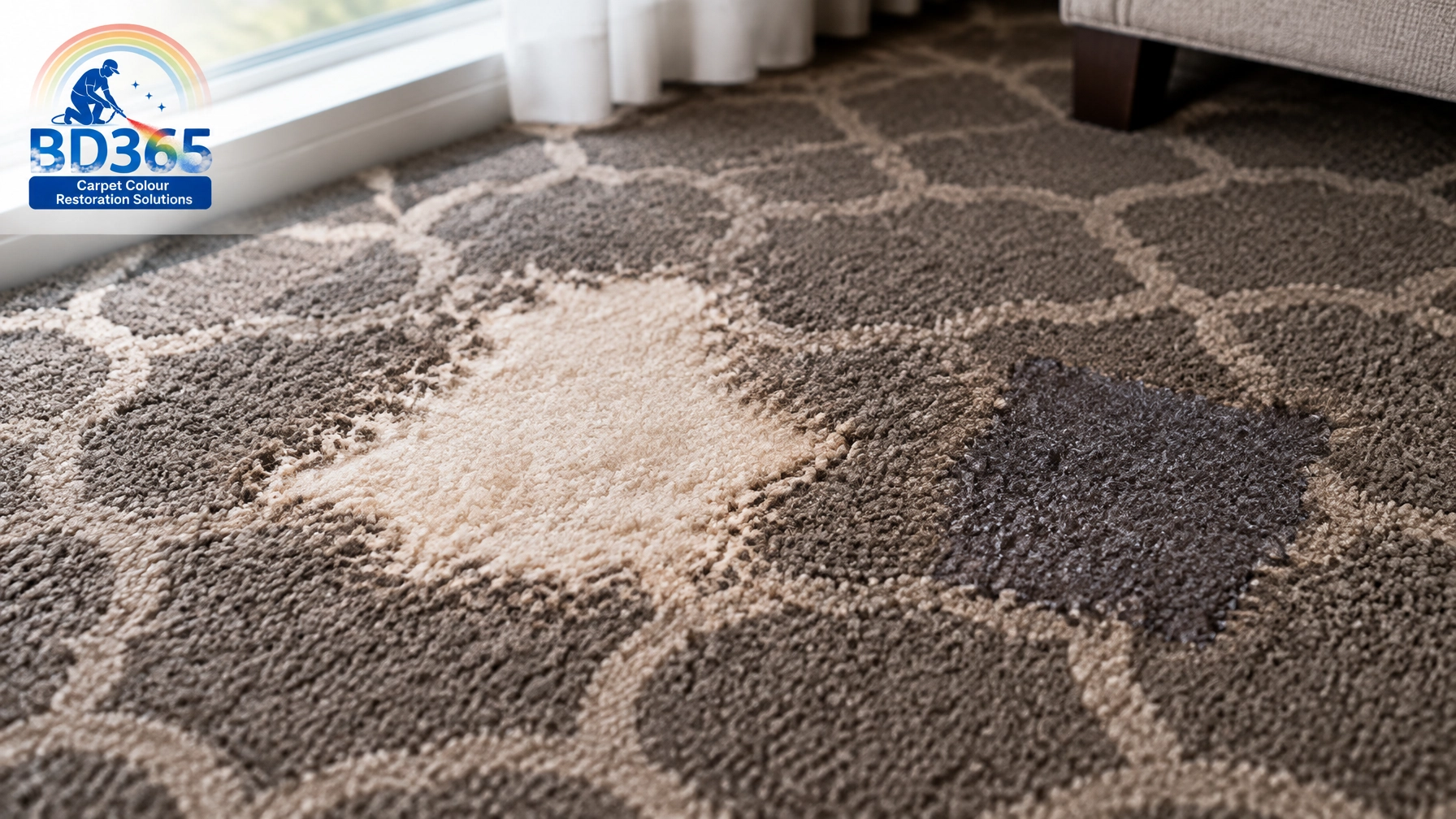
A patterned carpet is not automatically impossible to repair. It is simply more demanding.
A single-colour carpet may have one main visual tone. A patterned carpet may have several colours, lines, loops, flecks or shapes crossing the damaged area.
A repair has to sit comfortably within that visual movement. If the colour is correct but the pattern is ignored, the eye may still notice the work.
This is exactly why colour matching is a specialism. The job is not just to make a pale area darker. It is to reduce the contrast so the repair belongs with the surrounding carpet.
Here are examples of patterned hotel carpet repairs from the BD365 image library:


A useful warning about Vanish, Dr Beckmann and other spotters
Oxygen-based carpet spotters can be useful for suitable stains when used exactly as directed. But they are not harmless on every carpet.
Vanish Oxi-Action products and Dr Beckmann Carpet Stain Remover contain oxygen-based cleaning ingredients. If a product is over-applied, left on too long or used on an unsuitable fibre, it can lighten the carpet further or create a new colour-loss area.
The manufacturers’ guidance matters:
- Follow the label carefully.
- Check whether the specific product is intended for carpet.
- Test colour fastness in an inconspicuous area first.
- Do not keep repeating applications because the first attempt did not work.
- Tell the restoration specialist exactly what has already been used.
The Vanish product guidance specifically distinguishes between products intended for clothing and its carpet range. Dr Beckmann’s Carpet Stain Remover information also advises testing for colour fastness and material compatibility.
If the area has become lighter rather than cleaner, it may be colour loss rather than a normal stain. Steam cleaning will not put missing pigment back. Our guide explains why steam cleaning does not remove bleach spots.
Why this matters to landlords and letting agents
For a rental property, a properly matched restoration is easier to defend than a rushed cover-up.
A marker pen or home dye kit may look acceptable in a quick inspection. It can look very different in close-up photographs, strong daylight or the next inventory report.
A professional repair gives you:
- A more natural visual result.
- A clear before-and-after record.
- A sensible alternative to replacing an otherwise usable carpet.
- Less disruption during a void period.
- A repair that can be explained to a landlord, owner or insurer.
It is also much easier to photograph honestly. That matters when you are managing properties at scale.
Why hotel managers notice the difference
Hotel carpets have nowhere to hide.
Guest-room photographs, online reviews and standards inspections can expose a pale mark that staff may walk past every day. A visibly mismatched repair can become part of the guest experience for all the wrong reasons.
A well-blended repair helps keep the room, corridor or function space looking presentable without waiting for a full flooring project.
That can mean:
- Fewer rooms taken out of sale.
- Less disruption for guests.
- Better presentation during inspections.
- No unnecessary replacement of a serviceable carpet.
- A quicker route back to normal operations.
What to send us for a free photo assessment
To give you the most useful initial view, please send:
- A close-up photograph of the affected area in natural daylight.
- A wider photograph showing the room and the carpet’s location.
- The location of the damage, such as a bedroom, stair, corridor or hotel room.
- The fibre type, if known.
- What caused the colour loss.
- Any products already used, including Vanish, Dr Beckmann, bleach, disinfectant or other cleaners.
Photos cannot replace a proper assessment. They can, however, help us understand whether carpet dyeing, bleach spot repair, wider carpet colour restoration or replacement is likely to be the most sensible option.
When replacement genuinely is the right call
Restoration is not always the answer.
Replacement may be more appropriate when:
- The carpet is severely worn or threadbare.
- The fibres have melted, become brittle or suffered physical damage.
- The damaged area is very large.
- The carpet has extensive staining or contamination.
- The fibre is unsuitable for the proposed restoration.
- The carpet was already due for replacement.
- A new colour or flooring style is part of a planned refurbishment.
We will say so if replacement makes more sense. The aim is not to force a repair. It is to help you make a sensible decision.
The cost difference can be substantial
As a general guide, localised professional repair may cost around:
- £80–£150 for one small area.
- £150–£250 for multiple spots or areas.
- £300+ for complex, extensive or full-room work.
Replacing a room can cost roughly £600–£1,600 or more, before considering uplift, disposal, fitting, furniture movement, downtime and waste.
That is why restoration is worth investigating first. It can save money, reduce disruption and keep usable flooring in service for longer.
Send us a photo before you order a new carpet
If you are worried that a dyed repair will stand out, that is exactly the kind of question we want you to ask.
BD365 specialises in professional carpet dyeing, bleach spot repair and carpet colour restoration for homeowners, landlords, letting agents, estate agents, hotels and businesses nationwide across the UK.
For a free photo assessment:
- Call: 0800 1931 365
- WhatsApp: 07561 700670
- Email: info@bd365.co.uk
You can also explore our carpet restoration services, read the BD365 FAQs or review our guide to bleach spot repair costs.
The short version? A good repair should blend in. But the carpet gets the final say. Let us assess it before you commit to replacing the whole floor.