TLDR
A bleach spot found at 11am can put a hotel room, booking and guest relationship at risk before the 3pm arrival. But a damaged carpet does not always mean a blocked room. BD365 Carpet Colour Solutions provides expert bleach spot repair and carpet colour restoration across the UK, often restoring localised damage in a couple of hours. Send a housekeeping photo for a free assessment before approving a replacement. We cover hotels, serviced accommodation, spas, leisure clubs, offices and rental properties nationwide.
Call 0800 1931 365, WhatsApp 07561 700670 or email info@bd365.co.uk.
The 11am housekeeping report that threatens a 3pm arrival
It is 11am.
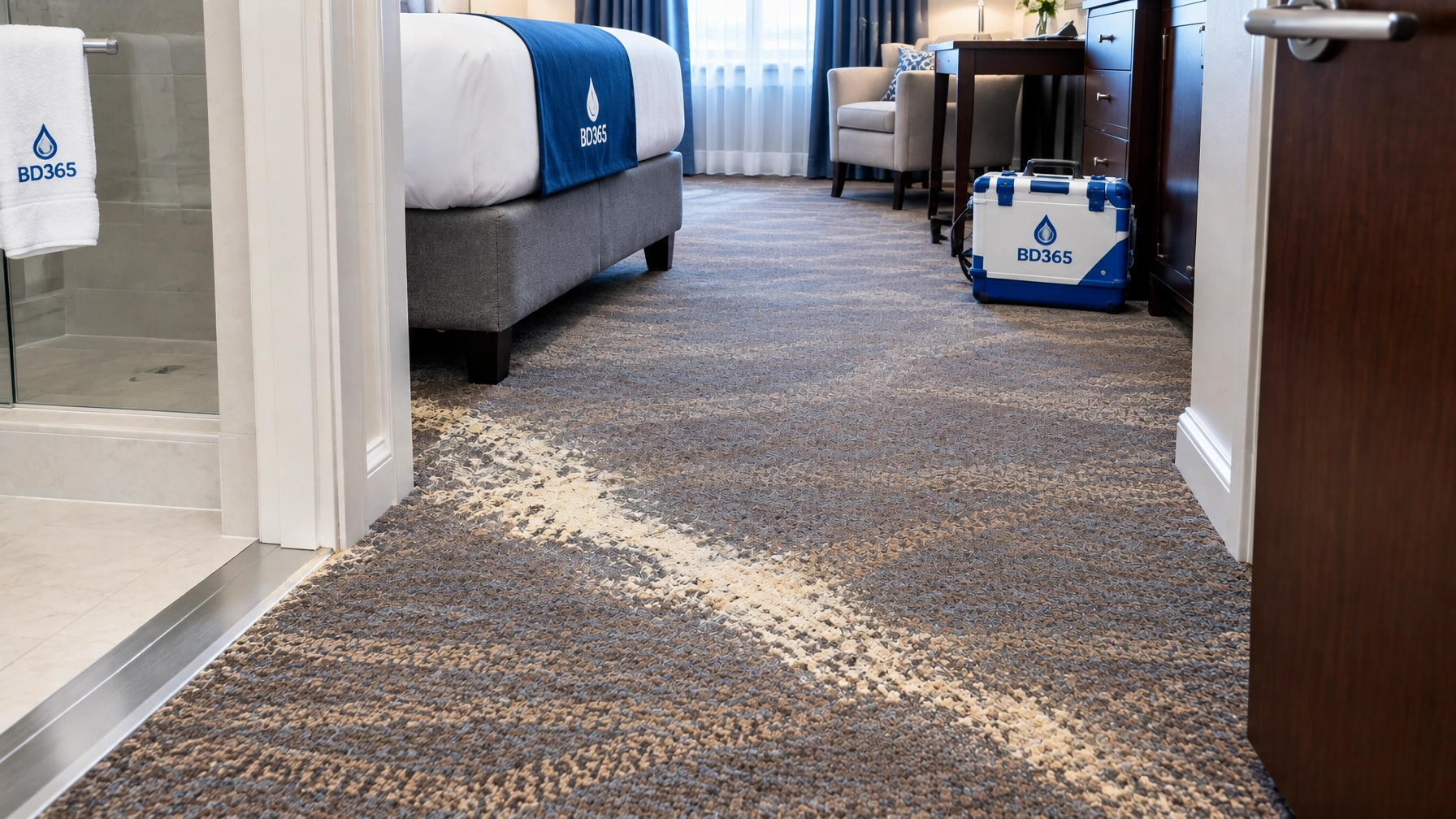
Housekeeping reports a pale drip beside the bathroom door. Or a white mark under the tea tray. Perhaps there is a short trail leading from the entrance where a cleaning product has splashed onto the carpet.
The room is already allocated.
The next guest arrives at 3pm.
There are no spare rooms.
That is when the conversation starts:
“Do we block the room, move the guest or risk putting it back on sale?”
For a hotel, this is not simply a carpet problem. It is an availability problem. A guest-room carpet may be perfectly sound apart from one obvious area of colour loss.
Blocking the whole room can mean:
- Losing a room night and the revenue attached to it.
- Moving the guest to another room or another property.
- Paying for an upgrade or offering a refund.
- Disrupting housekeeping and reception.
- Risking a review that mentions a stained or poorly maintained carpet.
- Creating questions from corporate accounts and online travel agency partners.
- Making listing photographs look less representative of the room.
A professional in-room colour restoration assessment can change the decision. Where the carpet and backing remain suitable, a localised repair may keep the room in service.

The damage may look dramatic in a photograph. Expert colour matching can restore the affected area without replacing the whole room.
Bleach is colour loss, not dirt
A regular stain adds something to the carpet. Coffee, make-up, mud or wine leaves unwanted colour or residue behind.
Bleach does the opposite. It removes or changes the original dye in the carpet fibre.
That is why a bleach spot is often white, yellow, orange or noticeably paler than the surrounding carpet. There may be nothing for steam cleaning to remove.
The housekeeping trolley cannot put the missing colour back.
Steam cleaning may leave the area cleaner, but the pale mark will still be there. In some cases, cleaning can make it look more obvious because the surrounding carpet becomes brighter.
Read our guide to the difference between a bleach spot and a regular stain. We also explain why steam cleaning does not remove bleach spots.
A warning about “one more product”
When a mark appears, it is tempting to try another stain remover.
Vanish Oxi-Action carpet products contain oxygen-based bleaching agents. Some Dr Beckmann stain-removing products are also oxygen-based. They are designed to lift certain stains, but they can lighten carpet further if the colour is already weakened or the product is unsuitable for the fibre.
Always:
- Follow the product label.
- Test colour fastness in a hidden area first.
- Stop if the colour changes.
- Tell the technician exactly what has already been applied.
Do not scrub harder or add a second chemical because the first attempt has not worked. That can enlarge the affected area and make restoration more difficult.
Why same-day response matters
The sooner the damage is assessed, the better.
If active bleach or another oxidising chemical remains in the fibre, the reaction can continue. Moisture and movement may allow it to spread into nearby tufts. Surrounding pile can begin to fade, making the original drip or patch more obvious.
It may look manageable in daylight. Then the evening bulbs come on. Or a guest takes a photograph using camera flash.
Suddenly, the mark is much easier to see.
Same-day colour restoration is not about rushing a poor repair. It is about stopping the situation from becoming a larger operational and visual problem. A fast assessment also gives the duty manager clear information before making a costly decision about the room.
What BD365 does in a hotel room
BD365 Carpet Colour Solutions specialises in carpet restoration, professional carpet dyeing and bleach spot repair.
The first step is a free photo assessment. Housekeeping can send a clear photograph from the room rather than waiting for a replacement contractor to measure the entire floor.
We assess:
- The carpet fibre and construction.
- The size and depth of the colour loss.
- Whether active chemical damage may remain.
- The surrounding colour and pattern.
- Access around furniture, beds, bathroom thresholds and doorways.
- Whether localised restoration is suitable.
Where repair is appropriate, our technician uses expert colour matching and controlled application. Precision syringes and airbrushes allow colour to be placed into the affected area and blended through the surrounding pile.
The aim is not to paint a patch on top. It is to restore the missing colour so the repair sits naturally within the existing carpet.
Most localised hotel repairs can be completed in a short visit, often around a couple of hours depending on the size, fibre, pattern and accessibility. The exact time is confirmed after assessment.
Our techniques are designed to minimise disruption. That can be the difference between preserving a room night and taking a room out of service.

A simple hotel response protocol
Housekeeping and facilities teams can adopt this process immediately.
Housekeeping checklist
-
Photograph the mark before touching it.
Take a wide photograph showing its position in the room, followed by close-ups. -
Note the likely cause.
Record whether it may be bleach, toilet cleaner, descaler, disinfectant, pool water or a stain remover. -
Record any product used.
Include the brand and product name, such as Vanish Oxi-Action or Dr Beckmann. -
Do not scrub.
Scrubbing can spread the chemical and disturb the pile. -
Do not add another chemical.
Do not try to cover colour loss with a marker, dye kit or further stain remover. -
Send photographs in natural daylight.
Avoid relying only on warm room lighting or flash. -
Keep the room status clear.
Tell the duty manager whether the room is safe to use and whether the mark is cosmetic or linked to a wider spill.
Duty-manager checklist
- Check the room calendar and next arrival time.
- Confirm the value of the affected room night.
- Request a free BD365 photo assessment before authorising replacement.
- Ask whether an in-room repair can be scheduled between departures and arrivals.
- Record the incident on the room history.
- Keep the product information and photographs with the maintenance record.
- Review whether the room needs to be temporarily held until the assessment is complete.
A photograph does not replace professional inspection in every case. It does, however, provide a much faster first decision.
Repair cost versus the cost of losing a room
Our bleach spot repair cost guide gives typical ranges:
- Small, localised spot: around £80–£150 plus VAT.
- Several spots, splashes or a larger area: around £150–£250 plus VAT.
- Large, complex or difficult-to-access damage: £300+ plus VAT.
A full room replacement can cost £600–£1,600 or more, depending on the carpet specification and room size. That can include:
- New contract-grade carpet.
- Underlay.
- Gripper rods and door bars.
- Measuring and ordering.
- Uplift and fitting.
- Furniture movement and protection.
- Disposal, waste and transport.
- Contractor availability.
It also takes the room out of service for days rather than hours. The financial comparison should therefore be made against the room rate and lost room nights, not just the price of a roll of carpet.
Restoration is usually the sensible first assessment where the damage is localised and the rest of the carpet is in good condition.
When replacement genuinely is the right call
Restoration is not always appropriate. We will say so when replacement is the better option.
Replacement may be right where:
- The backing is perished or failing.
- Seams have opened or cannot be stabilised.
- There is widespread water damage.
- The pile has melted or suffered serious physical damage.
- The fibre is unsuitable for effective colour restoration.
- The carpet is already at the end of its useful life.
- A full refurbishment is already planned.
- Damage extends across a large area and a consistent finish cannot be achieved.
The purpose of a free assessment is to avoid both unnecessary replacement and unrealistic promises.
The same issue in serviced accommodation, leisure and offices
The hotel example is most urgent, but the same commercial logic applies elsewhere.
In serviced accommodation, a bleach spot found between guests can shorten an already tight cleaning and inspection window.
In spas and leisure clubs, chlorine and cleaning products can leave pale trails between the pool, changing rooms and bathrooms. Our related guide covers pale carpet around pools and leisure areas.
In offices, a corridor or meeting room may need to remain presentable for clients, staff and visitors without waiting for a full flooring project.
For all these spaces, restoration helps reduce waste, cost and unnecessary disruption.
Prevention is cheaper than an emergency repair
Facilities teams can reduce repeat damage with a few practical controls:
- Use drip trays beneath cleaning trolleys.
- Do not decant chlorine sanitisers into unlabelled bottles.
- Keep carpet-approved products separate from bathroom chemicals.
- Use controlled application rather than spraying near carpet edges.
- Place suitable mats at pool entrances and bathroom doors.
- Check trolley bottles, caps and sprayers for leaks.
- Add carpet chemical damage to staff induction and refresher training.
- Log recurring marks by room, floor or cleaning team.
For hotels and leisure clubs, mats are particularly important around wet routes. They can reduce the amount of chlorinated water and cleaning residue reaching carpeted areas.
The landlord and letting-agent parallel
The same decision appears at check-out.
A letting agent finds a pale mark during the inventory inspection. The void clock has started. The property needs cleaning, repairs, photography and a new tenant.
Replacing the carpet may delay marketing and consume the landlord’s budget. A professional colour restoration assessment can establish whether the damage is localised and repairable before the whole floor is condemned.
That means fewer unnecessary replacements, less waste and a faster route back to a lettable condition.
Keep the room on sale where the carpet can be restored
A bleach mark does not automatically mean a blocked room.
The right response is to document it, stop further chemical use and obtain an expert assessment quickly. BD365’s carpet restoration team provides professional dyeing and bleach spot repair for hotels and commercial properties across the UK.
Send photographs for a free photo assessment:
- Phone: 0800 1931 365
- WhatsApp: 07561 700670
- Email: info@bd365.co.uk
Nationwide UK coverage. Restore where possible. Replace only when it is genuinely the right call.