TLDR
A professional carpet cleaner has left a bleach spot. Surely their warranty or public liability insurance will simply pay for a new carpet, right? Not always. Warranties usually cover service defects, not accidental chemical damage, and insurance policies may exclude the carpet being worked on. Claims can also take time, while replacement is costly, wasteful and disruptive. BD365 Carpet Colour Solutions provides professional bleach spot repair, carpet dyeing and carpet restoration services nationwide across the UK, often offering a faster, more affordable and eco-friendly way to put the room right.
Welcome back to today’s instalment in our daily Reddit bleach spot repair series.
Today’s question is one that appears regularly online:
“I paid a professional cleaner to clean my carpet. They left a huge bleach mark. Their insurance will sort it, right?”
It is a fair question.
You paid for a professional service. Something went wrong. Now there is a pale, orange or white patch sitting in the middle of your carpet like it has applied for planning permission.
The natural assumption is that the cleaner’s insurance will pay for a brand-new carpet. Perhaps their “100% satisfaction guarantee” covers it too.
Sometimes, the cleaner or their insurer may agree to fund a repair or replacement. But it is not automatic. The route from accidental bleach spot to brand-new carpet can be much less straightforward than Reddit makes it sound.
And in many cases, replacing the entire carpet is not even the best outcome.
First, what actually happened to the carpet?
Bleach damage is not a normal stain.
Coffee, mud and food marks add something to carpet fibres. Cleaning may remove those substances.
Bleach is different. It removes or changes the original colour in the fibres. That is why further cleaning rarely solves the visible mark.
A professional cleaner may have used:
- A bleach-based product
- Disinfectant
- Toilet cleaner
- Mould remover
- A strong spot treatment
- The wrong chemical for the carpet fibre
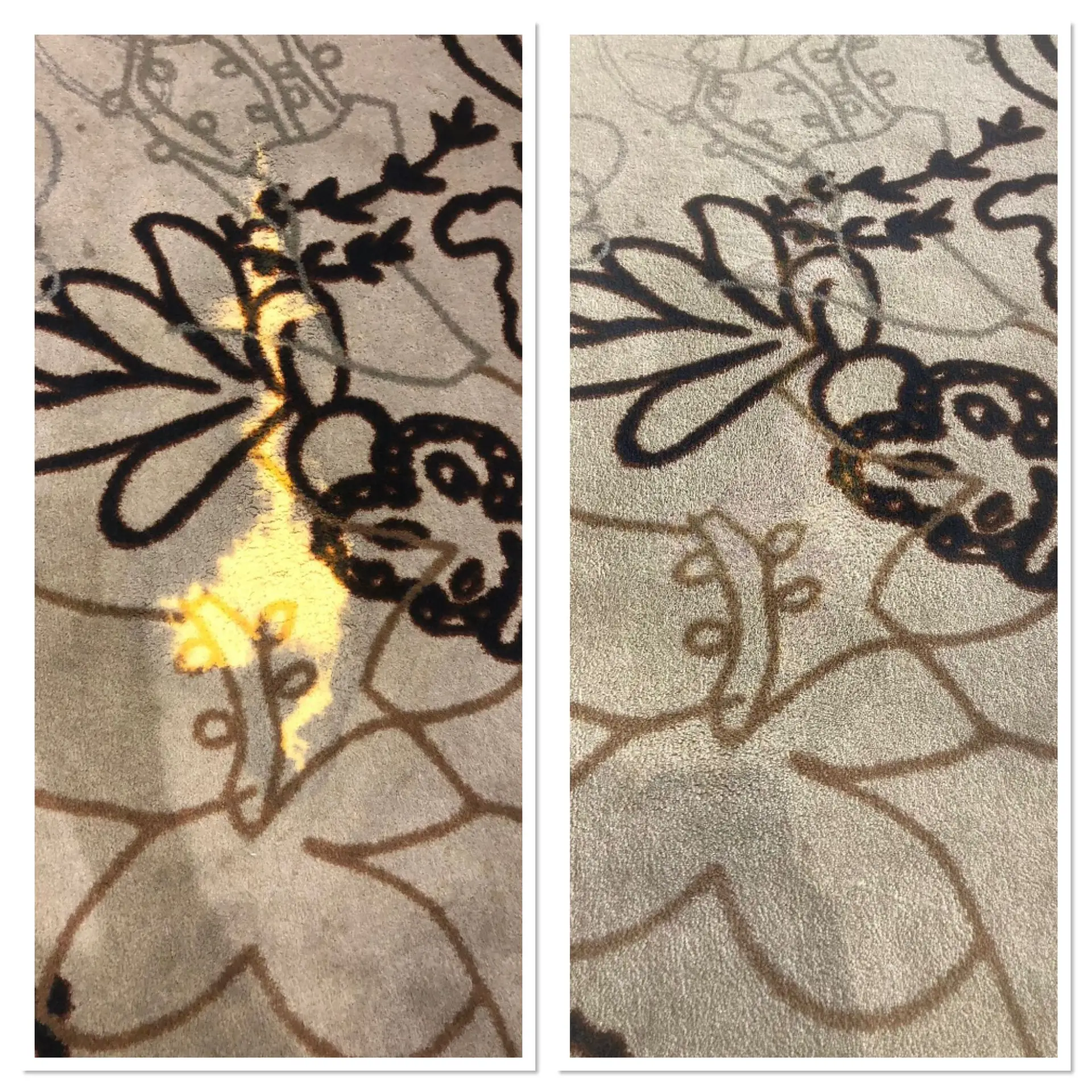
The result can be a localised area of colour loss. On dark carpet, it may look white, yellow or orange. On lighter carpet, it may appear as a pale patch that becomes more obvious as the surrounding carpet gets dirty.
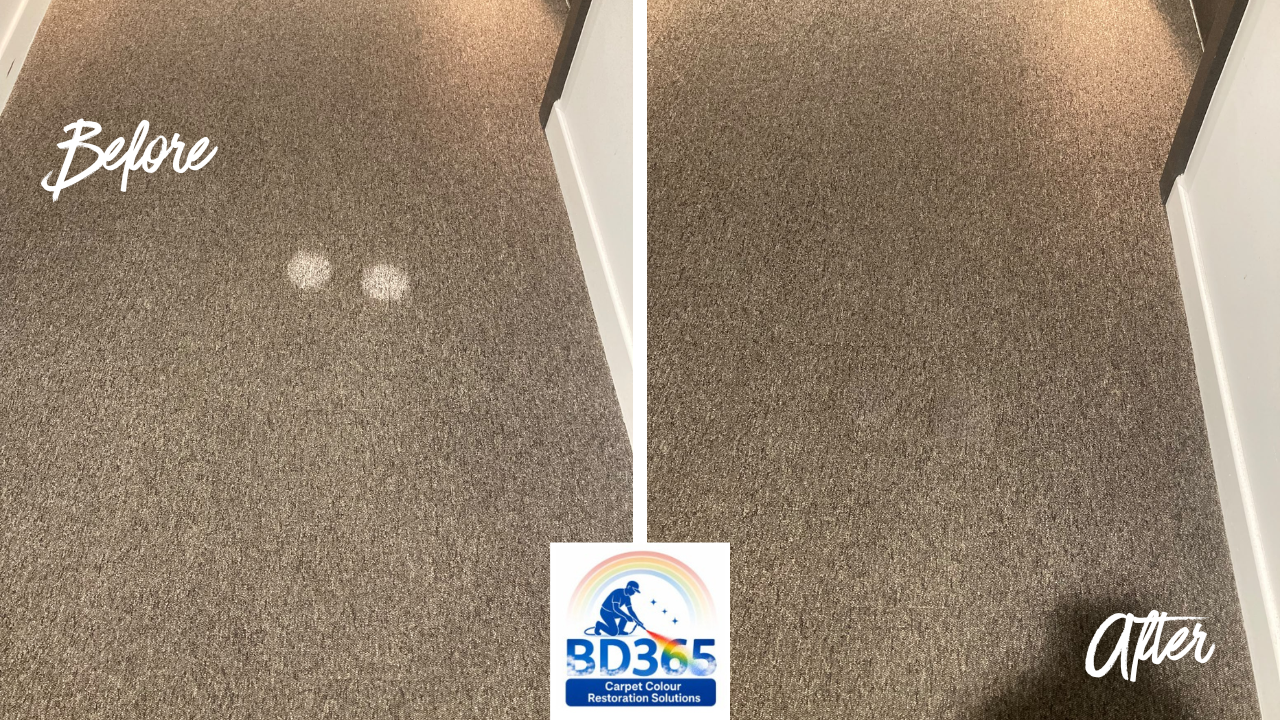
This is where professional bleach spot repair can be a better answer than ripping out a perfectly usable carpet.
Does a cleaner’s warranty cover bleach damage?
Usually, a cleaning company’s warranty or satisfaction guarantee is designed to cover the quality of the cleaning service.
For example, it may promise that the company will:
- Return to deal with missed areas
- Re-clean a surface
- Address a complaint about the standard of work
- Offer a refund in certain circumstances
That is not necessarily the same as covering accidental damage to the customer’s property.
A warranty may help if the carpet was left dirty. It may not automatically cover the fact that the carpet was chemically damaged during cleaning.
The wording matters.
Some cleaning businesses have specific terms covering accidental damage. Others may deal with complaints on a case-by-case basis. A “guarantee” is not a magic insurance policy wearing a tiny hat.
The first sensible conversation is with the cleaning company. Ask them to inspect the damage and confirm, in writing, how they propose to put it right.
What about public liability insurance?
Public liability insurance is intended to protect businesses when their work causes injury or damage to someone else’s property.
A cleaner spilling a chemical on a client’s carpet can fall within the type of incident that public liability insurance may respond to. However, the policy wording is crucial.
Some policies include cover for accidental damage caused while cleaning. Others contain exclusions relating to:
- Property being worked on
- Care, custody or control
- The item being cleaned at the time
- Chemical damage
- Policy excesses
- Specific treatment risks
That means a cleaner might have public liability insurance but still discover that the exact carpet involved is excluded.
Guidance from insurers and brokers, including Simply Business and Everywhen, highlights why policy details matter.
There are generally three possibilities:
-
The policy covers damage to items being cleaned.
The insurer may assess the damage and agree to pay for suitable restoration or replacement. -
The policy excludes the carpet being worked on.
The insurer may decline the claim, leaving the cleaner to resolve the matter directly. -
The cleaner has no suitable insurance.
Public liability insurance is not automatically held by every cleaner, particularly among smaller operators.
The important point is this:
Insurance affects who funds the solution. It does not automatically decide whether the customer deserves a solution.
This is general information, not legal advice. If there is a dispute about responsibility, compensation or a contract, professional legal guidance may be appropriate.
Why insurance claims can become painfully slow
The Reddit version of events often goes like this:
- Cleaner causes bleach damage.
- Cleaner contacts insurer.
- Insurer sends someone out.
- Carpet is assessed.
- Replacement is quoted.
- More paperwork appears.
- Everyone waits.
- The room remains visibly damaged.
This can be particularly awkward in a hotel, rental property, office or managed building.
A hotel manager may not want to close a room while a claim is investigated. A landlord may have a tenant waiting for a deposit decision. A business owner may not want customers staring at a bleach mark in reception for six weeks.
Insurance claims may also involve:
- An excess payable by the cleaner
- A loss adjuster
- Multiple quotes
- Questions about the carpet’s age and value
- Depreciation
- Policy exclusions
- Approval delays
- Disagreement over repair versus replacement
None of this means insurance is useless. It means it is not always the fastest route to a good-looking carpet.
Why replacement is often the expensive answer
Replacing a whole carpet because of one localised bleach mark is rather like replacing a sofa because one cushion has a coffee spot.
Sometimes it is justified. Often, it is simply the easiest thing to write on a claim form.
A replacement bill can include:
- New carpet
- Underlay
- Fitting
- Uplift and disposal
- Furniture moving
- Door bars and gripper rods
- Room downtime
- Matching issues
- Extra labour in commercial premises
A carpet that still has plenty of usable life can end up in landfill because of a single damaged area.
That is not an especially clever outcome for the customer, the cleaner, the insurer or the planet.
Restoration can solve the actual problem
The actual problem is usually not that the entire carpet has failed.
It is that one area has lost its colour.
That is why specialist carpet restoration services deserve to be considered before full replacement.
At BD365 Carpet Colour Solutions, we specialise in:
- Professional carpet dyeing
- Targeted bleach spot repair
- Carpet colour restoration
- Chemical damage correction
- Sun-faded carpet restoration
- Localised colour loss repair
Where the carpet fibre and condition are suitable, we can assess the damage and rebuild or correct the missing colour so the area blends with its surroundings.
The result will depend on the fibre, carpet age, existing colour, pile condition and severity of the chemical damage. Some repairs blend extremely well. Others provide a strong visual improvement rather than a completely invisible finish.
That honest assessment matters.

A faster outcome for the customer and cleaner
Professional restoration can be useful even when an insurance conversation is still taking place.
For example, BD365 can provide:
- An initial assessment from photographs
- Clear guidance on whether restoration may be suitable
- Quote information for the damaged area
- A practical alternative to full replacement
- Documentation that can help the cleaner or insurer understand the proposed remedy
With the customer’s permission, we can work alongside the cleaning company or insurance side so everyone has a clear picture of the damage and the likely cost of putting it right.
That may allow the cleaner to resolve the complaint quickly rather than leaving the customer waiting for a replacement decision.
It can also help an insurer compare the cost of targeted restoration with the cost of replacing an entire room.
The cleaner avoids an unhappy customer. The customer gets their room back. The insurer may avoid paying for unnecessary replacement. Everybody gets to leave the group chat.
What should homeowners, landlords and businesses expect?
The right solution depends on the circumstances.
For homeowners
You may be entitled to ask the cleaner to address damage caused during the service. Before agreeing to a replacement, it may be worth checking whether the carpet can be professionally restored.
For landlords and property managers
A localised bleach mark does not automatically mean the whole carpet should be charged to a tenant or replaced. An independent restoration assessment can help establish whether repair is practical.
For hotels and commercial premises
Downtime has a cost. A targeted colour restoration appointment may be far less disruptive than removing and refitting carpet across a bedroom, corridor or office area.
For professional cleaners
If you have caused accidental chemical damage, do not ignore it and hope the mark becomes emotionally attached to the carpet and disappears.
Be transparent. Photograph the damage. Check your policy. Speak to the customer promptly. Then consider whether specialist restoration can resolve the issue more efficiently than a lengthy claim.
Having suitable insurance is important. Knowing what your policy actually covers is even more important.
The eco-friendly argument is not just marketing
Restoration keeps more existing carpet in use.
That means:
- Less carpet sent to landfill
- Fewer new materials manufactured
- Less transport and fitting disruption
- Lower replacement costs
- A longer useful life for the existing carpet
BD365 uses professional, eco-conscious colour restoration techniques designed to be safe for homes, children and pets once dry.
It is a sensible option for clients who want high-quality results without automatically choosing the most wasteful route.
The practical answer to the Reddit question
So, will the cleaner’s insurance sort it?
Possibly. But do not assume it.
A warranty may not cover accidental chemical damage. Public liability insurance may contain exclusions. The claim may take time. The insurer may prefer replacement, even where targeted restoration is more proportionate.
The better question is:
“What is the quickest, most cost-effective and least wasteful way to restore the carpet?”
For many suitable carpets, the answer is professional bleach spot repair or carpet colour restoration.
Got a bleach spot left by a professional cleaner?
Do not let a single accident turn into a full-room replacement bill before exploring the alternatives.
Send BD365 a few clear photographs for a WhatsApp photo assessment. We can provide an honest initial view of whether restoration may be suitable, whether further assessment is needed, or whether replacement is likely to be the better option.
BD365 Carpet Colour Solutions provides specialist carpet dyeing, bleach spot repair and carpet restoration services nationwide across the UK.
- Freephone: 0800 1931 365
- Email: info@bd365.co.uk
- WhatsApp photo assessment: Send your carpet photos
- More answers: Visit the BD365 carpet restoration FAQs
- Related reading: Can bleach stains on carpet actually be removed?
No pressure. No false hope. Just a proper look at whether your carpet can be saved before somebody starts writing a replacement cheque.