TLDR
A tenant says the bleach spot was already there. The check-in photos say otherwise. Sound familiar?
Bleach damage is usually colour loss, not ordinary dirt. It cannot simply be cleaned away, and repeated attempts with products such as Vanish or Dr Beckmann may make the affected area lighter or larger. For letting agents, the strongest evidence is a clear check-in inventory, matching check-out photographs and a fair, professional assessment.
Before rushing to replace the carpet, ask whether professional carpet dyeing, bleach spot repair or wider carpet restoration could solve the problem. It is often faster, more cost-effective and more sustainable than replacement.
BD365 Carpet Colour Solutions provides professional restoration and free photo assessments nationwide across the UK.
“That bleach spot was already there”
Every letting agent has heard a version of it.
“The mark was there when I moved in.”
Sometimes, that is true. Carpets can have old stains, faded patches, sun damage and general wear before a tenancy begins. A fair assessment matters.
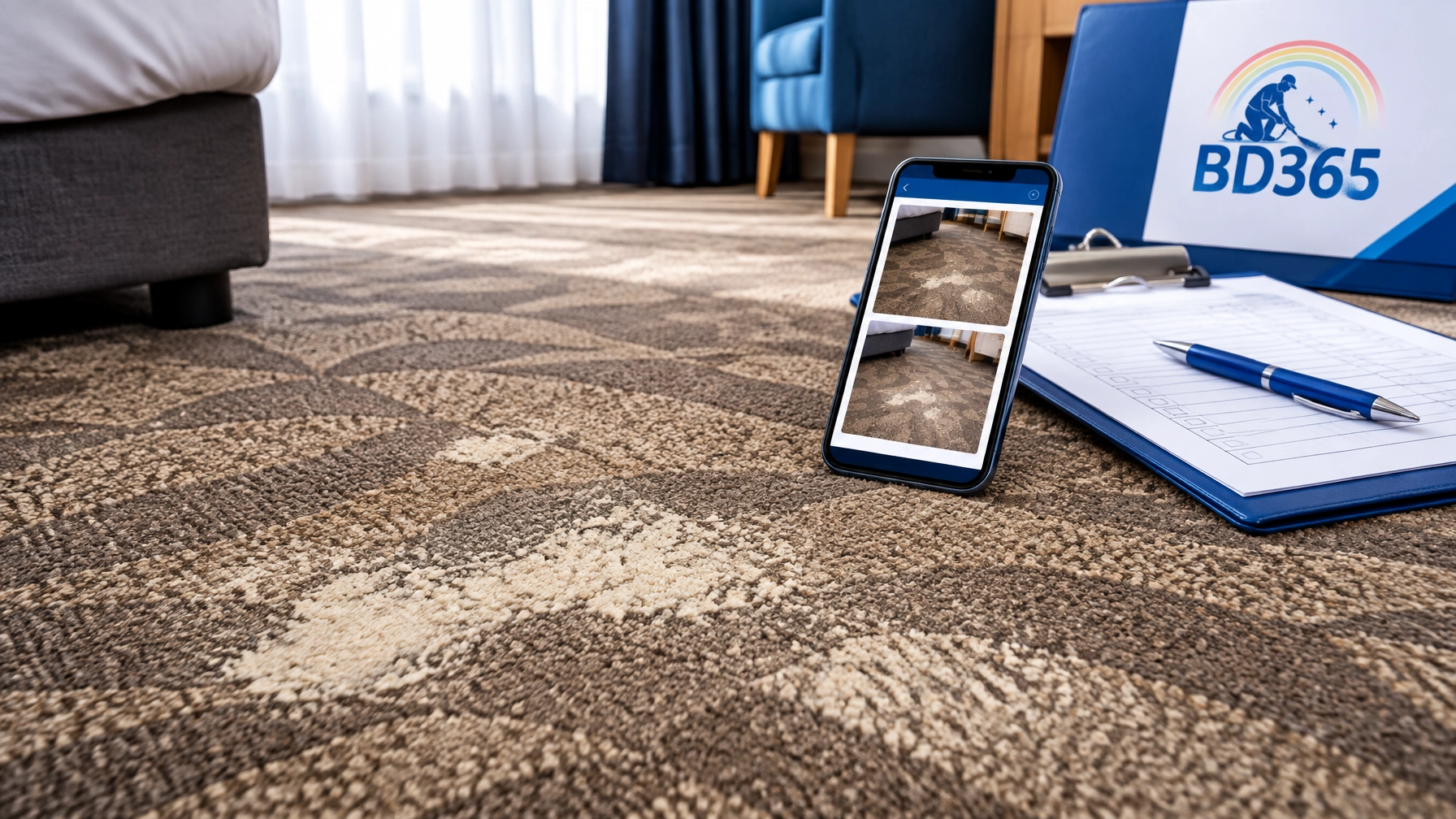
But sometimes the check-in images show a clean, consistent carpet, while the check-out photos show a bright, pale patch that was not previously visible. That is when the discussion becomes less about opinion and more about evidence.
The key question is not simply:
“Who says what?”
It is:
“What does the documented condition of the carpet show at the start and end of the tenancy?”
Bleach damage is colour loss, not a normal stain
This distinction is important.
A regular stain usually adds something to the carpet. Coffee, wine, muddy water or food residue may sit on or within the fibres. Professional cleaning may be able to remove or reduce it.
Bleach damage is different. It can remove or chemically alter the carpet’s original colour. The result is often a pale, white, yellow or orange-looking patch.
So, if you have searched:
“I got bleach on my carpet and it has stained”
the frustrating answer is that it may not be a stain in the usual sense. The carpet may have lost colour rather than gained dirt.
That is why more cleaning is not necessarily the answer. In fact, repeated cleaning, scrubbing or spot treatment can spread residue, disturb the pile or make the colour difference more obvious.
BD365 explains the difference between a regular stain and a bleach spot in its guide to bleach spots versus ordinary stains.

It may not have been household bleach
Many people assume a bleach spot can only come from a bottle marked “bleach”. That is not always the case.
Some household cleaning products and stain removers can alter carpet colour, depending on their ingredients, the carpet fibre and how long the product remains in contact with the floor.
Products such as Vanish and Dr Beckmann are often used with good intentions. Someone sees a mark and reaches for a familiar spot remover. Unfortunately, some formulations contain oxidising ingredients that can affect carpet dyes.
That can leave:
- A pale patch around the original mark
- A lighter ring or halo
- A yellow, orange or washed-out area
- A mark that looks worse after cleaning
- Colour variation that remains even when the carpet feels perfectly clean
Formulations change, and every carpet reacts differently. The point is not to blame a particular product automatically. The point is to recognise that a retail stain remover can sometimes create a colour problem while trying to solve a dirt problem.
If the carpet has become lighter, stop experimenting. Do not keep applying products in the hope that the original colour will reappear.
Ask for a professional assessment instead.
Why check-in and check-out photos matter
For letting agents and landlords, photographs are not just useful for marketing. They can become important evidence when a deposit deduction or repair decision is challenged.
The best inventory records show:
- The whole room
- The carpet from several angles
- Close-ups of existing marks
- The condition around doorways, furniture and high-traffic areas
- A consistent date and time
- Clear descriptions in the written inventory
At check-out, try to photograph the same areas from similar angles and in comparable lighting. A close-up of a pale patch is helpful, but a wider image shows exactly where the damage is located.
If the tenant says the spot was already there, compare:
- Was the area visible in the check-in image?
- Was it described in the inventory?
- Does the check-out photograph show a new or significantly changed patch?
- Was the original image clear enough to make a fair comparison?
- Are there interim inspection records?
- Did the tenant report any spill or cleaning attempt?
No photograph is perfect. Lighting can change. Furniture can hide marks. Cameras can alter colour slightly. That is why fair assessment matters. If the images are unclear, do not overstate the evidence.
A professional report can help establish whether the area looks like ordinary wear, an old mark, sun fading or chemical colour loss.
Do not rush straight to replacement
A carpet with one or two bleach spots can look like a replacement job. Especially in a high-end rental property, a pale mark in the middle of a patterned carpet attracts attention immediately.
But replacing the entire carpet is not always the most sensible first step.
Professional restoration may offer a more proportionate solution through:
- Localised bleach spot repair
- Precision carpet dyeing
- Colour restoration across a faded area
- Carefully matched work on patterned or commercial carpets
- Repair of multiple spots during one visit
BD365 uses professional colour-matching techniques and precision application equipment, including syringe and airbrush-style methods where appropriate. The aim is to blend the affected fibres into the surrounding carpet rather than cover the problem with an obvious dark patch.

The result depends on the carpet type, the extent of the damage, the remaining fibre condition and the surrounding colour. A photo assessment is a useful first step, but the final recommendation should always be based on the actual carpet.
A fair approach to deposit discussions
A bleach mark may be chargeable damage if the evidence shows it was not present at check-in and was caused by misuse or an unsuitable cleaning attempt.
However, the deduction still needs to be reasonable.
A landlord or agent should consider:
- The carpet’s age
- Its condition before the tenancy
- Normal wear and tear
- Whether the damage is localised
- The cost of professional repair
- The cost of like-for-like replacement
- Whether a full replacement would create betterment
A tenant should not normally be charged for ordinary fading, flattened traffic lanes or general ageing. Equally, a landlord should not be expected to accept a new chemical bleach mark simply because the rest of the carpet has some normal wear.
The fairest remedy is usually the one that restores the property without upgrading it at the tenant’s expense.
For general guidance on fair wear and tear, inventory evidence and deposit deductions, see resources from Propertymark, Shelter and the NRLA.
When replacement really is the right option
Restoration is not magic. Sometimes replacing the carpet is the correct decision.
Replacement may be more suitable when:
- The carpet is already badly worn throughout
- The backing or fibres have been structurally damaged
- There are extensive bleach marks across several rooms
- The carpet is contaminated or affected by persistent odour
- A compatible replacement section is unavailable
- The carpet is too old to justify restoration
- The damage is larger than a localised repair can reasonably address
- The existing carpet is being replaced as part of a planned refurbishment
Even then, obtain a proper assessment and consider a proportionate, like-for-like solution. Replacing an entire carpet should not be the automatic response to one repairable spot.
A restoration quote can also give the agent a useful comparison when explaining options to a landlord, insurer or tenant.
The same problem in hotels and commercial spaces
The check-in/check-out problem does not only affect rental homes.
Hotels, serviced apartments, offices, care settings and commercial premises regularly deal with carpet damage caused by:
- Cleaning chemicals
- Disinfectant spills
- Hair and skincare products
- Furniture movement
- Food and drink
- Sunlight through large windows
- Rushed end-of-stay cleaning
A pale mark in a hotel corridor can create a poor first impression. Replacing a whole commercial carpet because of a few isolated spots can also be disruptive and expensive.
The same restore-over-replace approach can work well in commercial settings. Professional assessment, accurate colour matching and fast turnaround can help keep rooms, corridors and workspaces in use.

Practical checklist for letting agents
When a tenant says the bleach spot was pre-existing, work through this checklist.
Gather the evidence
- Locate the signed or acknowledged check-in inventory.
- Compare the original and final photographs.
- Check whether the area was visible at check-in.
- Review mid-tenancy inspection images.
- Look for tenant messages about spills, stains or cleaning.
- Photograph the damage clearly at check-out.
- Record the room, position and approximate size of the mark.
Arrange a fair assessment
- Ask whether the mark appears to be dirt, fading or colour loss.
- Request a written opinion where a deposit deduction may be disputed.
- Obtain a repair quote before assuming replacement is necessary.
- Keep any replacement quote like-for-like.
- Consider age, condition and fair wear and tear.
- Avoid charging for betterment.
Stop further damage
- Do not keep applying Vanish, Dr Beckmann or other spot removers.
- Do not scrub the affected area aggressively.
- Do not attempt to cover it with marker pens, fabric dye or household paint.
- Do not promise the tenant that cleaning will remove the colour loss.
Nationwide carpet restoration from BD365
BD365 Carpet Colour Solutions helps letting agents, estate agents, landlords, homeowners, hotel managers and businesses restore carpets rather than replace them.
Our services include:
- Professional carpet dyeing
- Bleach spot repair
- Colour restoration
- Expert colour matching
- Residential and commercial carpet restoration
We work with clients across the UK, with nationwide coverage and fast turnaround options where available. Our restoration techniques are designed to provide a practical, cost-effective and more sustainable alternative to unnecessary carpet replacement.
If you have a disputed bleach spot, send BD365 clear photographs for a free photo assessment. We can help you understand whether the carpet may be repairable and what the sensible next step could be.
Contact BD365 Carpet Colour Solutions or visit the BD365 FAQs.
Because sometimes the best answer to “the bleach spot was already there” is not another argument.
It is clear evidence, a fair assessment and a carpet restored to looking its best.