TLDR
September is when HMO carpet problems become letting-agent emergencies. Students move out, new tenants move in, and one pale bleach spot can trigger a deposit dispute, a rushed replacement quote and a room that is suddenly not ready.
The culprit may be hair bleach, bathroom cleaner, makeup remover, laundry products, teeth-whitening products or supermarket stain spotters such as Vanish or Dr Beckmann. These products can remove colour from carpet fibres rather than simply leaving a stain.
BD365 Carpet Colour Solutions specialises in professional bleach spot repair, carpet dyeing and colour restoration across the UK. For suitable carpets, restoration is often faster, more affordable and less wasteful than replacing an entire HMO bedroom carpet. Send photos for a free assessment before ordering a new floor covering.
The September HMO carpet nightmare
Picture the scene.
Three students have left a shared house. The checkout inspection is tomorrow. The new tenants arrive on Monday. The cleaner has done the heroic work of removing takeaway debris, mystery marks and enough empty shampoo bottles to open a shop.
Then someone spots it.
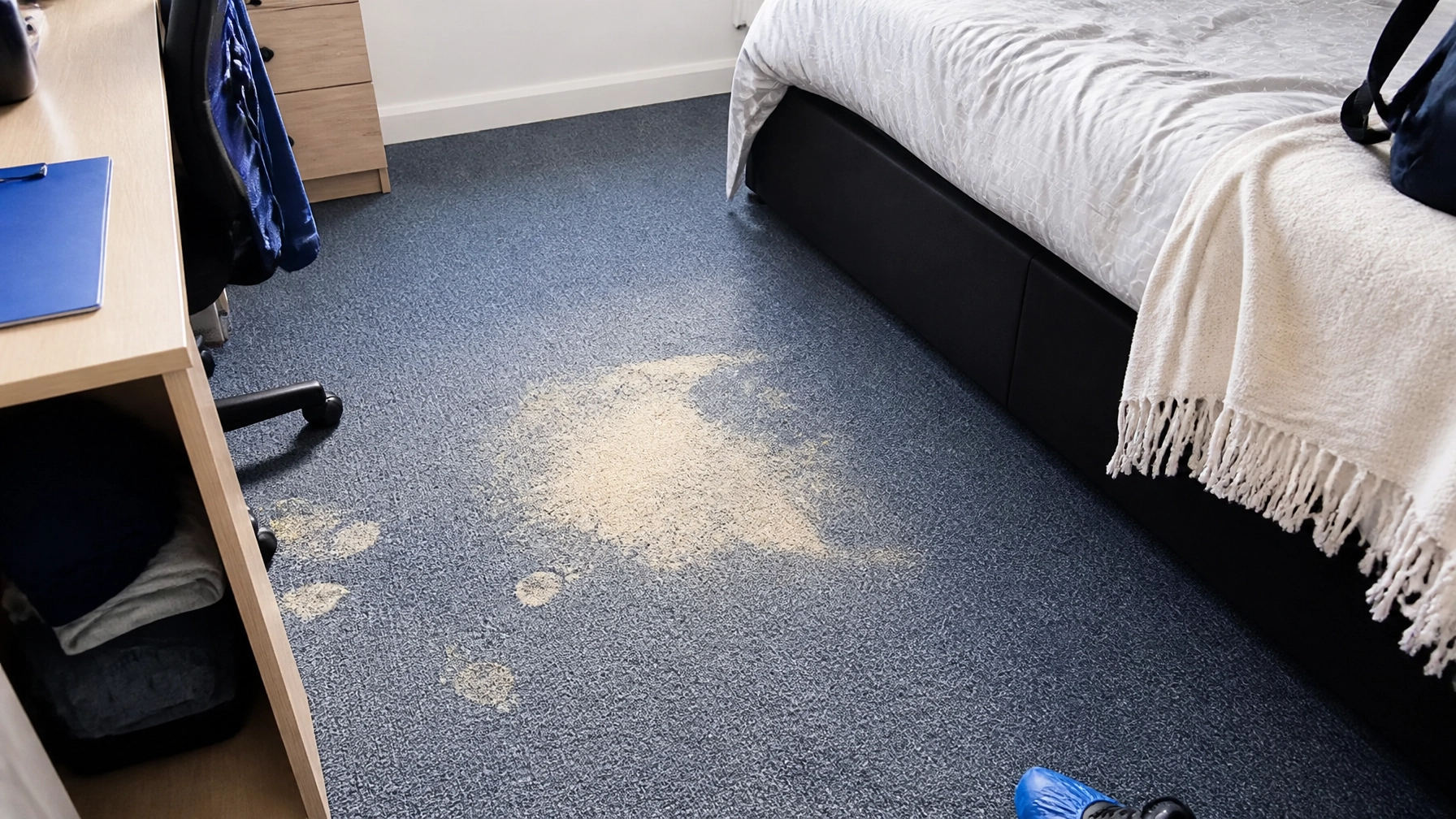
A bright, pale patch beside the bed.
It is not a normal stain. It is a bleach spot.
One tenant says it was already there. Another says it came from a cleaning product. The landlord thinks it happened during move-out. The letting agent has ten minutes to decide whether the room needs a replacement carpet.
And the deposit dispute has entered the chat.
This is particularly common during the September student turnaround. Every room, hallway and shared area is under pressure. There is little time to wait for a full carpet replacement, and even less appetite for paying for one when the carpet is otherwise perfectly usable.
“I got bleach on my carpet and it has stained”
That phrase is searched frequently because the damage looks like a stain.
But bleach does not behave like tea, mud or muddy footprints. It can strip or change the original colour of the carpet fibres. The result may be white, yellow, orange or noticeably lighter than the surrounding carpet.
That means normal cleaning will not restore the missing colour.
The same applies to chemical marks from:
- Hair bleach used in a bedroom or bathroom
- Bathroom and toilet cleaners
- Mould remover or disinfectant
- Makeup remover and skincare products
- Laundry products
- Teeth-whitening products and strips
- Hair dye or beauty treatments
- Supermarket carpet stain removers
The National Carpet Cleaners Association explains that bleach can permanently lighten carpet, much like it lightens hair. It can also affect carpet backing and underlay if the spill is significant.
For a letting agent, the key point is simple: this is usually a colour restoration problem, not a cleaning problem.
The Vanish and Dr Beckmann warning
Supermarket stain spotters are understandable. They are easy to buy, easy to apply and marketed as a quick answer to marks before a property inspection.
However, “stain remover” does not always mean “risk-free for every carpet”.
Some Vanish carpet products contain oxygen-based bleaching agents. The manufacturer advises testing for colourfastness and warns that colour change can occur. Vanish also advises using carpet-specific products rather than laundry products on carpets. You can read the official Vanish carpet-care guidance here.
Dr Beckmann products can present a similar problem on some dyed carpets. A product may lift a stain while also lightening the surrounding fibre. The result is a fresh pale patch where the original mark used to be.
This is why a tenant may honestly say, “I was trying to clean it.”
They may not have caused the original spill. They may have caused the colour loss while trying to remove it.
For agents and landlords, the best policy is not to blame first. Record what happened, avoid adding more chemicals and arrange an expert assessment. A clear photo can often establish whether you are looking at dirt, fading, chemical damage or a mixture of problems.
Why a whole-room replacement is often the wrong first move
Replacing the carpet in one HMO bedroom sounds straightforward. In practice, it can involve:
- Sourcing a close colour match
- Finding matching underlay
- Moving furniture
- Uplifting and disposing of the existing carpet
- Booking a fitter during the busiest month of the year
- Making the room unavailable
- Dealing with door bars, gripper rods and awkward access
- Risking a new carpet that does not match the landing or adjoining rooms
The cost can quickly run into hundreds of pounds. Premium carpet, difficult access or a larger room can push the figure higher.
A localised bleach mark does not automatically justify throwing away the entire floor.
BD365’s guide to the cost of fixing a bleach spot on carpet explains why professional repair is usually assessed on the damaged area, carpet fibre, colour, condition and complexity of the work.
That is the important distinction. You are not paying to replace a whole room when the problem may only occupy a few centimetres.
What professional bleach spot repair changes
Professional restoration is not a bottle of dye and a hopeful afternoon.
BD365 Carpet Colour Solutions assesses the carpet first. The likely fibre type, existing colour, depth of damage and general condition all matter. Some carpets are suitable for localised dyeing. Others may need a different repair approach. A few are better left for replacement.
For suitable carpets, professional work may include:
- Assessing the damage and the carpet’s condition.
- Establishing whether active chemical damage remains.
- Matching the surrounding colour.
- Applying colour carefully to the affected fibres.
- Blending the repair into the surrounding pile.
- Checking the finished result under appropriate lighting.
The work may involve precision application using specialist tools, including controlled syringe or airbrush techniques. It is designed to restore the damaged area without disturbing the rest of the room.

The result will depend on the carpet. Some repairs blend extremely well. Others deliver a significant visual improvement rather than a completely invisible finish. A reputable restoration company should explain what is realistic before the work begins.
That honest assessment matters when you are dealing with a deposit, an insurance file or a tight student-let deadline.
Strong before-and-after results without the replacement drama
Bleach spots are especially frustrating because they often appear in high-visibility places. Beside the bed. In front of the wardrobe. Near the bathroom door. Right where the property photographer will see them.
The good news is that localised damage can sometimes be restored while the rest of the carpet remains in place.

BD365 works with homeowners, landlords, letting agents, hotels, offices and commercial property teams across the UK. That includes single HMO rooms as well as repeated issues across a larger property portfolio.
For professional cleaners, restoration is also a useful referral option. Cleaning can remove soil and many stains. It cannot put back colour that a chemical has removed. Knowing when a carpet needs restoration rather than more cleaning can prevent an already awkward mark becoming a much larger one.
Why restoration suits the student-let turnaround
A professional repair can offer three practical advantages during September:
1. It can be faster
A localised repair avoids the full sequence of ordering, fitting and disposing of a complete carpet. This can help bring a room back into service sooner.
2. It can cost less
You only address the damaged area rather than paying for a new carpet, underlay and fitting across the entire room. The final price still depends on the carpet and the damage, which is why BD365 offers a photo assessment before quoting.
3. It creates less waste
A usable carpet should not automatically go to landfill because of one pale mark. Restoring suitable carpet extends its working life and reduces the materials, transport and disposal associated with replacement.
That restore-over-replace approach is particularly relevant for landlords and agents managing several properties. Small savings on individual rooms can become meaningful across a portfolio.

When replacement is genuinely the right call
Restoration is not magic, and it is not right for every carpet.
Replacement may be the better option when:
- The carpet is already heavily worn or physically damaged.
- The affected area is very large.
- There are many scattered bleach spots across the room.
- The fibres have melted, become brittle or developed a hard texture.
- The carpet is unsuitable for dyeing or localised repair.
- The room was already due for refurbishment.
- A close match cannot be achieved across adjoining areas.
- Repair costs approach the cost of a sensible replacement.
BD365’s approach is assessment-led. If restoration is unlikely to give a worthwhile result, the team will say so. That is useful advice when a landlord needs a defensible decision rather than an optimistic promise.
A better process for agents and landlords
When a bleach spot appears during a September checkout:
- Photograph the damage in natural light.
- Record what is known about the product or incident.
- Avoid adding more stain removers or household chemicals.
- Note whether the carpet is wool, nylon, polypropylene or unknown.
- Send the photographs for a professional assessment.
- Compare restoration with the full cost and delay of replacement.
- Keep the written assessment for the property file or deposit discussion.
Clear records help everyone. They can support a fair conversation with tenants and prevent an automatic replacement decision based on a single photograph.
Save the room before you replace the room
A student HMO does not need a full flooring crisis because somebody used hair bleach beside the bed or sprayed Vanish on the wrong carpet.
The pale spot may be permanent colour loss. But permanent does not always mean irreparable.
BD365 Carpet Colour Solutions specialises in bleach spot repair, professional carpet dyeing and colour restoration for residential and commercial properties, with nationwide UK coverage. The team can assess photographs and explain whether restoration is suitable, whether further testing is needed or whether replacement is genuinely the better call.
Request a free photo assessment
Send clear photographs before ordering a replacement carpet:
- Free photo assessment
- WhatsApp: 07561 700670
- Freephone: 0800 1931 365
- Email: info@bd365.co.uk
A few minutes of assessment could save a room, a deposit dispute and a very expensive September headache.