TLDR: Bleach spots do not automatically mean a new carpet
If an end-of-tenancy cleaning company has left bleach spots on a rental carpet, act quickly. Photograph the damage, keep the check-in and check-out evidence, obtain the cleaning invoice, and ask for a professional assessment before approving replacement.
Across the UK, BD365 Carpet Colour Solutions specialises in carpet restoration, professional carpet dyeing and bleach spot repair. Localised colour loss can often be restored much faster and more affordably than replacing an entire room.
Restoration may avoid the cost of measuring, ordering, fitting, uplift, disposal and property downtime. It also supports a restore-over-replace approach, keeping usable carpet out of landfill.
The key question is not simply, “Who pays for a new carpet?” It is:
“Can the existing carpet be professionally restored to a suitable standard?”
The problem: the cleaners have left pale marks behind
The check-out inspection looks routine until you see it.
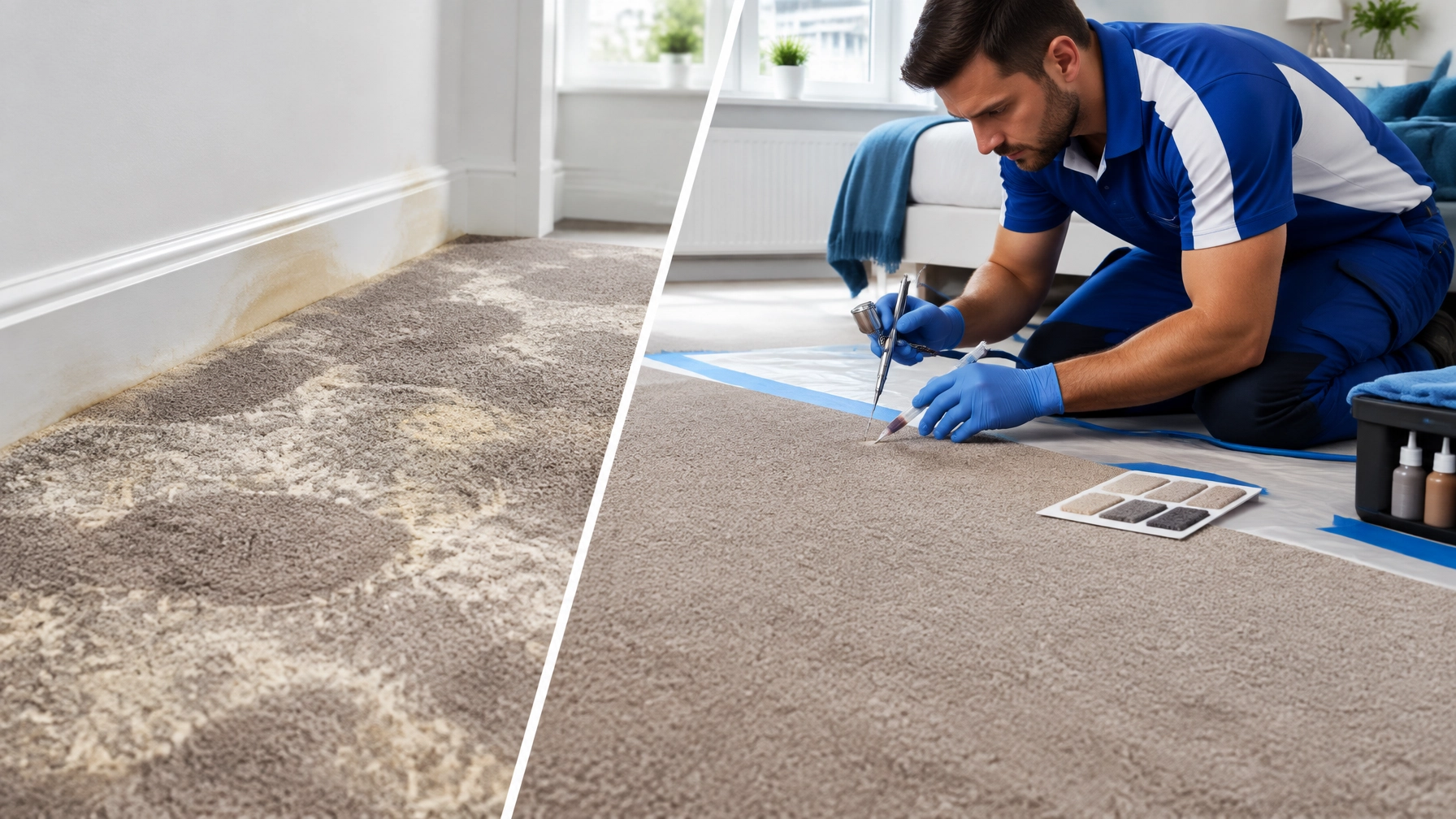
There is a white splash beside the skirting board. A yellow patch near the bathroom door. A pale halo in the hallway. Perhaps there are several small drips across the carpet.
The tenant says the end-of-tenancy cleaners caused the damage. The cleaning company says the mark was already there. The landlord wants the property ready for new photographs and viewings.
Then comes the familiar search:
“I got bleach on my carpet and it has stained. What do I do now?”
For a letting agent, this is more than a cleaning issue. It can affect:
- The deposit assessment
- The landlord relationship
- The next tenancy start date
- Marketing photographs
- Void-period costs
- Communication with the cleaning company
- Potential insurance or liability claims
The first step is to stop the damage becoming harder to resolve.
Do not scrub the area. Do not add more chemicals. Do not cover it with a marker or household dye. Take clear photographs and arrange an expert assessment.
Bleach spots are colour loss, not dirt
A regular stain adds something to the carpet. Coffee, wine, mud and grease may leave unwanted colour or residue behind.
Bleach damage is different. The chemical has removed or altered the carpet’s original dye.
That is why more cleaning usually does not solve the problem. There may be no dirt left to remove. The pale patch is the result of colour loss.
Aggressive scrubbing can also roughen the carpet fibres, spread any active chemical and make the mark look larger. Steam cleaning may improve the surrounding carpet while leaving the bleached area just as visible.
BD365 approaches these problems through professional bleach spot repair and colour restoration. After assessing the carpet, fibre and damage, a technician can work towards neutralising the chemical reaction and carefully rebuilding the missing colour.

The letting agent’s evidence checklist
Good evidence helps everyone. It gives the landlord a clearer basis for a claim, gives the tenant a fair opportunity to respond and helps the cleaning company investigate what happened.
Keep the following together:
1. Before-and-after cleaning photographs
Ideally, the check-out file should show:
- The carpet before the clean
- The carpet after the clean
- Close-ups of each bleach mark
- Wider room photographs showing the location
- Images in natural light and from more than one angle
- Any visible cleaning products or containers
If the cleaners took photographs before starting work, request copies.
A single close-up photograph may show the damage, but it may not prove when it appeared. A dated sequence is much stronger.
2. The check-in inventory and schedule of condition
Compare the current damage with the original inventory.
Look for:
- Existing stains or colour changes
- The carpet’s age and condition
- Previous repair notes
- Photographs showing the same area
- Any comments about fading or wear
Bleach marks are generally different from fair wear and tear. However, a deposit claim still needs to be supported by evidence, and the carpet’s age and condition matter.
3. The cleaning company invoice and booking details
Keep the invoice, receipt, booking confirmation and written instructions.
Record:
- Who booked the cleaners
- Who paid them
- The date and time of the clean
- Which rooms were treated
- What service was requested
- Any product or damage reports
- The company’s terms and conditions
- Any deadline for reporting damage
Contact the cleaning company in writing as soon as possible. Some cleaning firms require damage to be reported promptly.
Liability reality check: who pays?
The answer depends on the contracts and evidence.
Usually, the landlord’s claim is made against the tenant under the tenancy agreement. The tenant may then pursue the cleaning company if the cleaners caused the damage.
If the landlord or letting agent directly instructed the cleaning company, the position may be different. There may be a direct contract or insurance route involving the cleaning business.
Ask the company whether it holds public liability insurance and request that the incident is passed to its insurer. Avoid making statements that assume liability before the facts are clear.
There are also two important limitations.
Deposit disputes
A landlord cannot simply deduct the cost of a brand-new carpet without supporting evidence. The deposit schemes expect claims to be justified.
Betterment
The purpose of compensation is generally to put the landlord back in the position they would have been in, not provide a brand-new upgrade.
If an older carpet had limited remaining life, a full new-for-old replacement may not be appropriate. The age, quality, condition and expected lifespan should be considered.
A professional repair quote can be useful because it shows that a reasonable, lower-cost remedy was considered before replacement.
For general background, see this UK end-of-tenancy cleaning guidance. This is general information, not legal advice. For disputed or high-value matters, obtain specialist housing or legal advice.
Why restoration is often faster and cheaper than replacement
A replacement can involve much more than buying a roll of carpet.
The process may include:
- Measuring the room
- Finding a suitable colour or pattern
- Checking availability
- Ordering materials
- Waiting for delivery
- Moving furniture
- Uplifting the old carpet
- Removing and disposing of it
- Replacing underlay if necessary
- Fitting the new carpet
- Adjusting door bars or gripper rods
- Cleaning and preparing the room again
There may also be supply issues. The original carpet might be discontinued, or a replacement may not match adjoining rooms.
For an average room, full replacement can often reach approximately £600–£1,600, depending on size, materials, access, underlay and fitting requirements.
By comparison, typical professional restoration may be considerably less:
- One small bleach spot: approximately £80–£150
- Several spots or splashes: approximately £150–£250
- Larger or more complex restoration: from around £300
Every carpet is different, so these figures are only an indication. Fibre type, colour, pattern, damage size and carpet condition all affect the assessment.
For a suitable carpet, restoration can be completed in a fraction of the time required for replacement. That can help reduce void periods and get the property ready for photography and viewings sooner.
Read more about the cost of fixing a bleach spot on carpet.
DIY disasters: Vanish, Dr Beckmann and “just one more clean”
Not every bleach spot comes from liquid household bleach.
Some supermarket carpet spotters, including products sold under names such as Vanish and Dr Beckmann, may contain oxygen-based bleaching or oxidising agents. These are not the same as chlorine bleach, but they can still lighten carpet dye on certain fibres and colours.
Products containing terms such as “oxi”, “active oxygen” or hydrogen peroxide may cause colour loss if:
- The carpet is not colourfast
- The product is left on too long
- Too much product is applied
- The area is repeatedly treated
- The carpet is wool, wool-blend or another sensitive material
- The product is not rinsed as directed
Always follow the manufacturer’s instructions and patch-test in an inconspicuous area. The Vanish carpet guidance includes precautions about testing and use.
Once a pale patch appears, applying more spotter is rarely the answer.
Do not use:
- More bleach
- Strong disinfectant
- Permanent marker
- Fabric pens
- Hair dye
- Unapproved carpet dye
- Abrasive brushes
- Repeated doses of stain remover
These attempts can create dark edges, halos, spreading, residue or additional fibre damage. They may also make professional colour matching more difficult.
The safest next step is simple: photograph the area and send it to a specialist.
The same issue affects hotels and commercial properties
Hotels face a similar problem when housekeeping teams or third-party contractors damage a carpet.
A bleach spot in a guest room, corridor, office or serviced apartment can result in:
- A room being taken out of service
- A delayed inspection
- A guest-room move
- Lost bookings
- Disruption to housekeeping schedules
- Poor impressions during a property visit
Professional carpet restoration can help suitable commercial carpets return to service faster than a full replacement project.

The same restore-first principle applies to rental properties, offices, hotels, serviced accommodation and communal areas.
When replacement is genuinely the right call
Restoration is not always suitable.
Replacement may be the better option when:
- The carpet is threadbare across the room
- The backing is damaged
- Fibres have melted or become physically distorted
- There are extensive marks throughout the carpet
- The carpet is heavily contaminated
- The material cannot accept a suitable colour repair
- The carpet is already at the end of its useful life
- The required finish cannot be achieved through local restoration
A responsible specialist should say when replacement makes more sense. The goal is not to avoid replacement at any cost. It is to avoid replacing an otherwise serviceable carpet because of a localised cleaning-company accident.
Send photographs for a free assessment
If end-of-tenancy cleaners have left bleach spots behind, act before the mark spreads or someone attempts another DIY treatment.
BD365 Carpet Colour Solutions provides professional carpet dyeing, bleach spot repair and colour restoration for landlords, letting agents, estate agents, homeowners, hotels and businesses across the UK.
Send photographs for a free initial assessment:
- Freephone: 0800 1931 365
- WhatsApp: 07561 700670
- Email: info@bd365.co.uk
- Photo assessment: bd365carpetcoloursolutions.co.uk/#photoassessment
Restore where possible. Avoid an unnecessary replacement bill. Keep the property moving towards its next tenant.