TLDR
If a hotel, care home, office or rental property carpet is suddenly covered in tiny pale speckles after an autumn deep clean, it may not be dirt at all.
It is often surface colour loss caused by disinfectant mist, hypochlorite overspray or cleaning product residue. Fine droplets settle across the carpet and remove colour from the tips of the pile, creating a pale, mottled or “pitted” appearance.
That is why steam cleaning or using more stain remover does not fix it. The pigment has gone.
The good news? A speckled carpet does not automatically need replacing. BD365 Carpet Colour Solutions specialises in carpet dyeing, bleach spot repair and professional colour restoration across the UK. We can often restore the appearance for far less than a full replacement, with less disruption, less waste and a much faster turnaround.
For a free photo assessment:
- Phone: 0800 1931 365
- WhatsApp: 07561 700670
- Email: info@bd365.co.uk
The morning-after deep-clean shock
You close the hotel for its autumn deep clean.
The housekeeping team works through the bedrooms, corridors and food and beverage areas. A contractor fogs or mists rooms with a disinfectant. Floors are cleaned. Everything looks fresh.
Then, the next morning, someone notices the carpet.
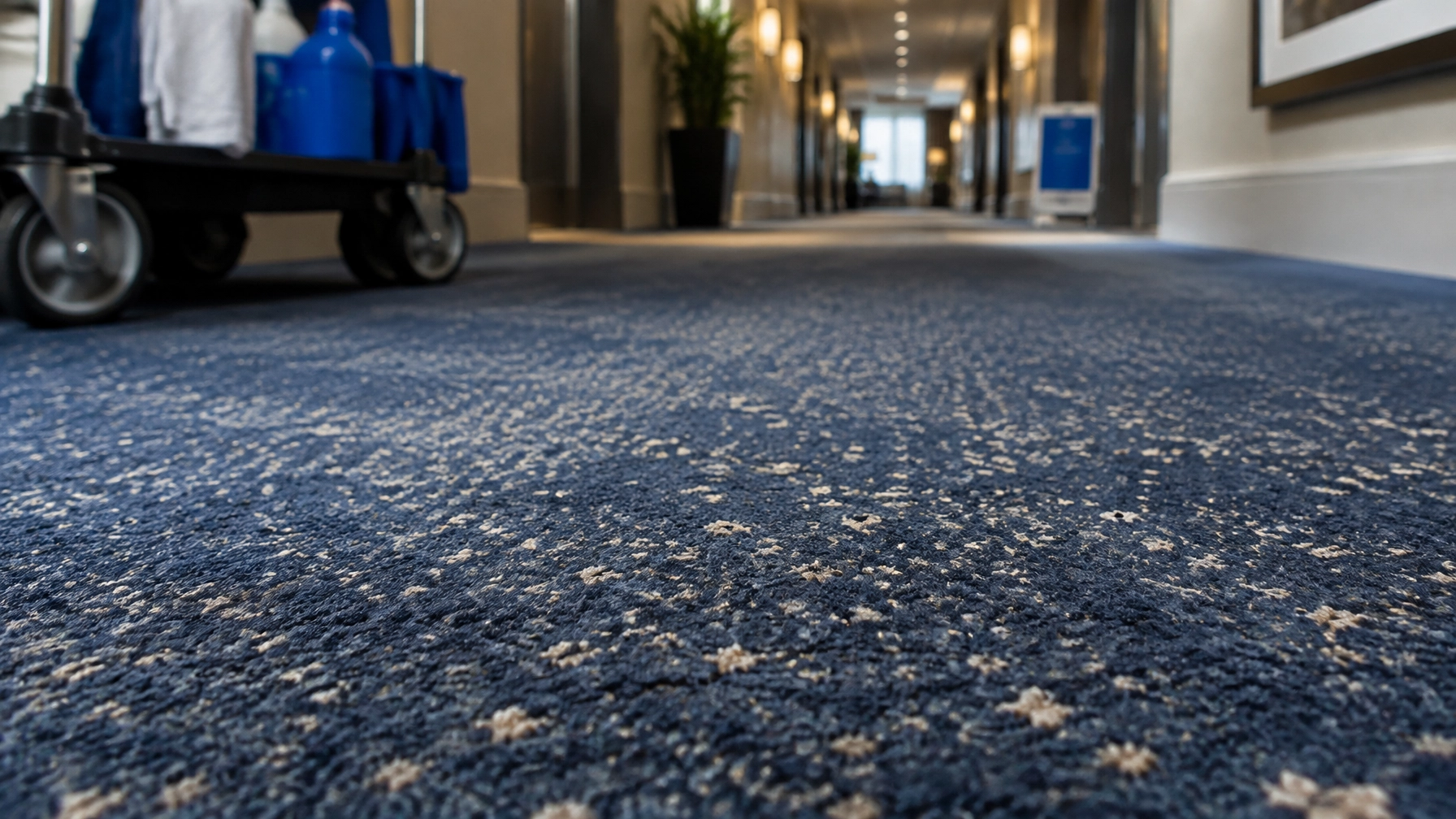
Tiny pale dots.
Not one obvious splash. Not a single bleach patch. A whole scatter of cream, yellowish or almost-white speckles across the pile.
Cue the inevitable questions:
- “Why is my carpet covered in tiny pale speckles?”
- “The cleaner fogged the room and now the carpet looks pitted.”
- “I got bleach on my carpet and it has stained.”
- “Can we just steam clean it again?”
- “Do we need to replace the entire floor?”
Usually, the answer to the last question is no.

Why does disinfectant create a speckled pattern?
A concentrated bleach-based disinfectant can land on carpet in several ways:
- Fine droplets from a fogging or misting machine.
- Overspray from a trigger bottle.
- Splashes from a mop bucket.
- Drift from disinfecting nearby hard surfaces.
- Residue left behind when a product is not properly removed.
- Chemical residue being reactivated by moisture or further cleaning.
A large spill tends to create one noticeable pale mark.
Mist creates hundreds or thousands of tiny contact points.
Each droplet can affect a small area of the carpet. From a standing height, the result looks like pale speckles, mottling or little pits scattered through the floor.
This is particularly noticeable on darker hotel carpets, patterned corridors and commercial carpets with a strong, even colour.
The issue is not usually that the carpet is dirty. It is that the colour has been removed from the exposed fibre tips.
Cleaning removes soil.
It does not put missing pigment back.
How to tell colour loss from ordinary dirt
Speckled colour loss can be mistaken for poor cleaning, especially when it first appears.
Look for these clues:
- The pale marks remain after vacuuming.
- Steam cleaning makes little or no difference.
- The marks are irregularly scattered rather than following foot traffic.
- They are more visible when viewed in bright or raking light.
- The carpet feels broadly normal, with no obvious sticky residue.
- The pattern matches a cleaning route, fogging area or overspray zone.
- The affected areas are paler than the surrounding fibres, not darker.
Shadows and flattened pile can change as you brush or vacuum the carpet.
Bleach or disinfectant damage does not behave in the same way. It is a colour problem, not a grooming problem.
Stop touching it, especially with more products
Once you suspect bleach damage, pause further experimentation.
Do not scrub aggressively. Do not apply another strong stain remover. Do not keep adding products in the hope that one will “lift” the speckles.
If the exposure is very recent and the carpet is still damp, follow the cleaning product’s safety guidance and remove any remaining residue with clean water where appropriate. Ventilate the area and allow it to dry fully.
Then document what happened.
Record:
- The product used.
- Where it was applied.
- Whether it was sprayed, fogged, mopped or wiped.
- The approximate dilution.
- How long it was left in contact with the carpet.
- When the speckling was first noticed.
Photographs taken in good light are extremely useful. So are photographs taken before the deep clean, if you have them.
A second-wave warning: Vanish and Dr Beckmann spotters
There is another common twist in these incidents.
Someone spots the pale marks and reaches for a supermarket carpet cleaner. Vanish Oxi-Action and Dr Beckmann stain spotters are popular products, and they can be useful when used for the right type of stain.
However, oxygen-based “oxy” products work through bleaching action. They are not colour-repair products.
Used on an already pale area, or left on too long, they can make colour loss more obvious. They may also clean the surrounding carpet more effectively than the damaged speckles, increasing the contrast.
This is not a criticism of the products. They are designed for specific stain-removal jobs. The problem is using a stain remover on carpet where the colour has already been stripped.
Always:
- Follow the label.
- Test colour fastness in an inconspicuous area.
- Never mix cleaning products.
- Tell the restoration specialist everything already used on the carpet.
For more background, see our guide to the difference between a bleach spot and a regular stain.
What professional carpet colour restoration does
At BD365 Carpet Colour Solutions, we treat this as a restoration issue, not a cleaning failure.
The first step is an assessment of the carpet fibre, colour, pattern, age and extent of damage. We then match the affected areas to the surrounding carpet.
For localised speckling, this can involve precision work with a syringe and airbrush. Colour is carefully applied to the affected fibre tips and blended into the surrounding carpet.
The goal is not to paint a bright patch over the top.
The goal is to make the repair disappear into the existing floor.
That is especially important in hospitality settings, where guests notice inconsistencies quickly. A poorly matched repair can draw more attention than the original damage. Expert colour matching gives the carpet a much more even and finished appearance.

Why this matters so much to hotels
For a hotel, a damaged carpet is not just a flooring issue.
A bedroom taken out of service can mean lost revenue, lost bookings and a poor guest impression. In public corridors, restaurants and reception areas, speckling can make the whole property look tired or poorly maintained.
Replacement is not always straightforward, either.
The original range may be discontinued. A new carpet may not match adjoining rooms. Furniture, skirting, thresholds and door clearances may all be affected. Replacing one section can create a visible change across an otherwise consistent floor.
Taking an entire floor out of service over tiny colour-loss speckles is a particularly painful trade.
A professional restoration can often be arranged far faster, with less noise, less disruption and fewer guest-facing complications.
A simple deep-clean protocol for housekeeping and facilities teams
Prevention starts with better communication.
Before autumn deep cleans, hotel managers and facilities teams should:
- Brief contractors on which products may be used near carpets.
- Keep fogging and misting away from soft furnishings wherever possible.
- Protect carpeted areas when disinfecting nearby hard surfaces.
- Photograph rooms, corridors and food and beverage areas before work begins.
- Photograph them again after the clean and before reopening.
- Log which product was used in each area.
- Keep incident details with the room or maintenance record.
This creates a clear paper trail if damage appears later. It also means a restoration quote can be obtained quickly instead of spending days trying to reconstruct what happened.
Care homes: less disruption matters
Care homes understandably operate strict infection-control cleaning regimes.
Hypochlorite disinfectants may be used in corridors, dining rooms and shared areas. Unfortunately, these are often the most disruptive carpets to replace.
Many care home corridors are one continuous run. Replacing them can involve moving residents, closing access routes and creating noise and dust in occupied areas.
Where the carpet backing and fibres remain sound, colour restoration may offer a more practical route. It can improve the appearance without turning a whole corridor into a building project.
Offices, commercial premises and end-of-lease cleaning
Office damage often appears after an out-of-hours contractor clean or fogging treatment.
By Monday morning, the tenant sees pale speckles across the carpet and assumes the floor needs a complete replacement. At lease end, the question becomes more complicated: who caused the damage, and who is responsible for the repair?
Photographs, cleaning logs and a professional restoration assessment can help clarify the situation.
The same applies to landlords, estate agents and letting agents after an end-of-tenancy deep clean. A speckled carpet left behind can become the centre of a deposit dispute.
Before accepting a replacement claim, obtain a restoration quote and take clear evidence photographs. A repair may be far more reasonable than a £600–£1,600 replacement claim, particularly when the carpet is otherwise usable.
Restore or replace? An honest answer
Restoration is often suitable for surface colour loss, including:
- Fine bleach or disinfectant speckles.
- Localised pale marks.
- Faded areas.
- Sun damage.
- Multiple small spots across a sound carpet.
- Colour mismatch after cleaning or chemical exposure.
Typical guide prices are:
- Localised repair: around £80–£150.
- Multiple affected areas: around £150–£250.
- Complex or full-room colour restoration: £300+.
By comparison, replacement can cost £600–£1,600 or more, before considering uplift, disposal, underlay, grippers, fitting, furniture movement, room downtime and waste.
Replacement can still be the right call when the carpet has:
- Melted or perished fibres.
- Failed backing or delamination.
- Serious tearing or heavy wear.
- Failed seams.
- Significant water damage.
- Structural damage that colour work cannot hide.
A colour repair cannot rebuild a damaged backing. But where the carpet is physically sound, ripping it out over speckles may be an expensive overreaction.

A greener fix for a very visible problem
Restoration keeps usable carpet in service.
That means less carpet going to landfill, fewer new materials being manufactured and less disruption for guests, residents, staff and tenants.
It is also a sensible financial choice. Restore rather than replace is not about accepting second best. Done properly, professional carpet dyeing and bleach spot repair can deliver a remarkably consistent, high-impact result.
If your carpet has turned pale and speckled after an autumn deep clean, send BD365 a few clear photographs before anyone applies another product.
Our team provides nationwide UK coverage and specialises in carpet restoration, professional carpet dyeing and bleach spot repair.
For your free photo assessment:
- Call: 0800 1931 365
- WhatsApp: 07561 700670
- Email: info@bd365.co.uk
You may not need a new floor.
You may just need the colour putting back.